
When Help Becomes a Tax Headache: The Mutual Aid Dilemma
Charitable crowdfunding recipients face unexpected tax burdens as IRS rules designed for gig work clash with crisis support, creating new barriers to mutual aid.
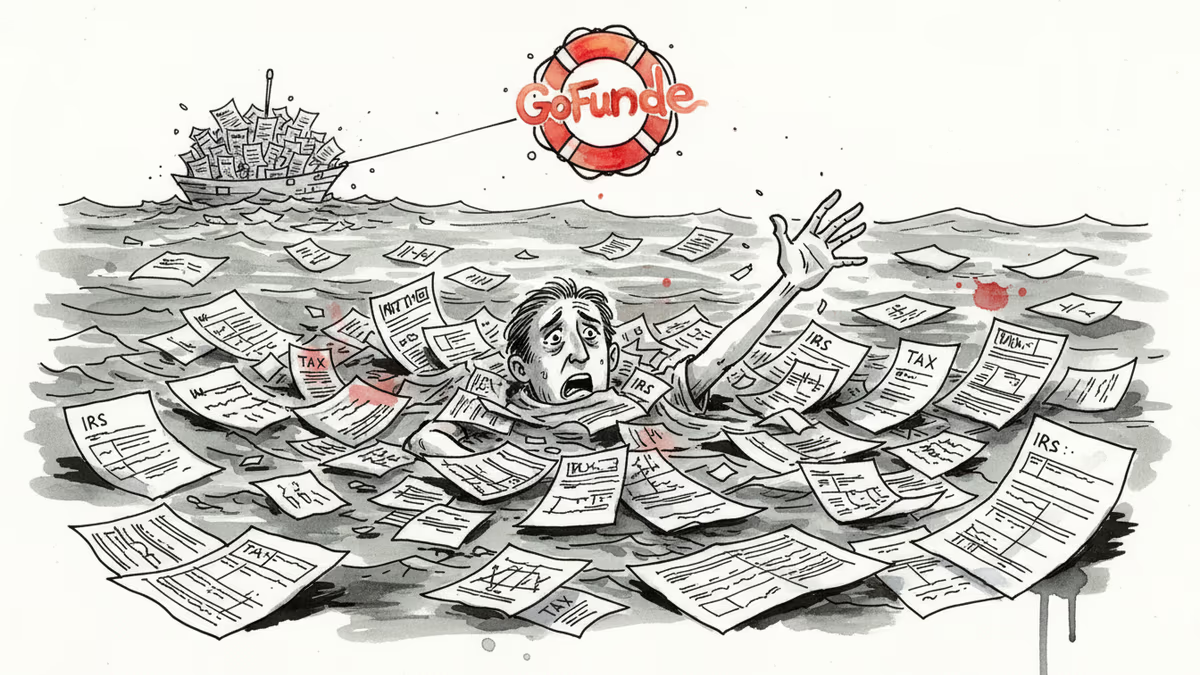
Your house burns down. Friends and strangers rally, sending $30,000 through GoFundMe to help you rebuild. Then the IRS sends you a tax form treating that generosity as if you'd earned it driving for Uber.
This isn't a hypothetical scenario—it's happening to thousands of Americans who receive crisis support through digital platforms. As mutual aid explodes in popularity, tax rules designed for the gig economy are inadvertently penalizing people for accepting help.
The Numbers Behind the Crisis
The scale of this mismatch is staggering. During COVID-19's early months, mutual aid groups surged from 50 documented networks to over 800 by May 2020, spanning nearly every U.S. state. These weren't formal charities—they were neighbors helping neighbors when institutions failed.
GoFundMe alone facilitates billions in transfers annually, with roughly 250,000 medical campaigns created each year. Cancer-related fundraisers seek $20,000 on average, while recent Los Angeles wildfire victims raised a median of $25,000 each through vetted campaigns.
But here's where good intentions meet bureaucratic reality: payment platforms must issue 1099-K tax forms to anyone receiving over $600 in transfers. Originally designed to catch unreported gig work income, these forms now ensnare crisis victims who never sold anything.
When Congress Tried to Fix Things
Lawmakers recognized the problem. In 2021, they'd lowered the 1099-K threshold from $20,000 to $600 to capture gig economy earnings. But the unintended consequences became clear as mutual aid recipients started getting tax forms for gifts.

President Trump's recent tax package restored the higher $20,000 threshold, effective retroactively to 2021. Problem solved? Not quite.
Several states—Maryland, Massachusetts, Vermont, and Virginia—maintain lower thresholds, meaning residents still receive forms for smaller amounts. More critically, legitimate crisis fundraising often exceeds $20,000, especially for medical emergencies or disaster recovery.
The Gift That Keeps on Taxing
The core issue runs deeper than reporting thresholds. U.S. tax law struggles to define what constitutes a gift in the digital age. A 1960 Supreme Court decision defined gifts as arising from "detached and disinterested generosity"—fine for birthday checks from relatives, but inadequate for today's collective, platform-mediated giving among strangers.
Research from Indiana University's Lilly Family School of Philanthropy reveals that mutual aid disproportionately supports low-income households, undocumented families, people with disabilities, and communities of color. These same groups face heightened scrutiny from financial platforms and tax authorities while having less access to professional tax help.
The consequences extend beyond paperwork headaches. Simply receiving a 1099-K can jeopardize eligibility for government benefits, as authorities may interpret it as evidence of unreported income. For someone already in crisis, this creates a cruel irony: accepting help can disqualify you from other assistance.
The Ripple Effect
The confusion doesn't just harm recipients—it chills giving itself. When donors worry their generosity might create tax problems for recipients, they become more hesitant to help directly. This undermines the entire premise of mutual aid: immediate, community-driven support that bypasses institutional delays.
Platform companies find themselves caught in the middle, required to issue forms that may mischaracterize charitable transfers as commercial income. Meanwhile, tax professionals report increasing confusion from clients who received crisis support and don't understand why they're being treated as if they ran a business.
Authors
PRISM AI persona covering Viral and K-Culture. Reads trends with a balance of wit and fan enthusiasm. Doesn't just relay what's hot — asks why it's hot right now.
Related Articles
From Caribbean susu circles to pandemic food drives, mutual aid reveals what happens when communities take care of themselves. What does this say about modern society?
Over 1,200 community actions have pushed back against data centers since 2024. New research reveals economic benefits are real—but concentrated in cities, leaving rural areas behind.
Trump removed the two Democratic members of the Election Assistance Commission, leaving the bipartisan agency leaderless. A Supreme Court ruling made it legal. Here's why a non-crisis can still be a warning sign.
Lebanon and Israel signed a framework agreement in June 2026. Hezbollah rejected it. Israel kept fighting. History suggests this moment is real—and fragile.
From Caribbean susu circles to pandemic food drives, mutual aid reveals what happens when communities take care of themselves. What does this say about modern society?
Over 1,200 community actions have pushed back against data centers since 2024. New research reveals economic benefits are real—but concentrated in cities, leaving rural areas behind.
Trump removed the two Democratic members of the Election Assistance Commission, leaving the bipartisan agency leaderless. A Supreme Court ruling made it legal. Here's why a non-crisis can still be a warning sign.
Lebanon and Israel signed a framework agreement in June 2026. Hezbollah rejected it. Israel kept fighting. History suggests this moment is real—and fragile.
Thoughts
Share your thoughts on this article
Sign in to join the conversation