

Gridlock and Goodbyes: Why a Wave of Retirements Signals Deeper Trouble for the U.S. Congress
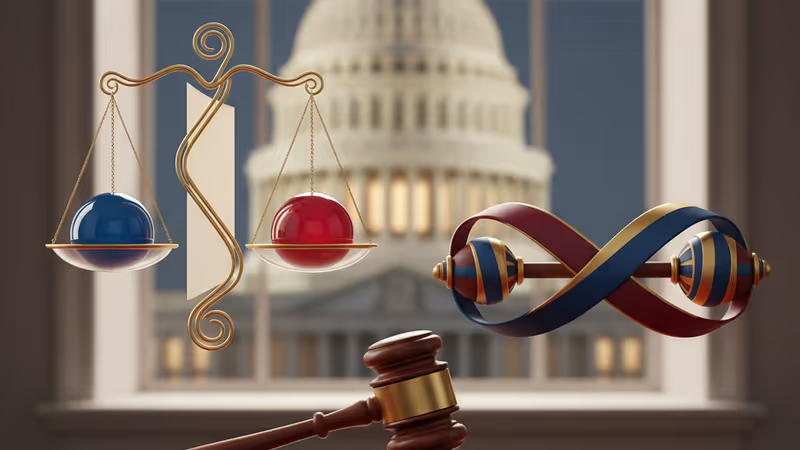
The U.S. Congress is ending the year with few legislative wins and a growing wave of retirements. This trend points to deep-rooted institutional problems on Capitol Hill, with significant implications for global policy and stability.
The Lead: An Exodus from Capitol Hill
As the U.S. Congress closes out the year, its list of legislative accomplishments is strikingly short, while its list of departing members grows longer. This isn't just a routine turnover. According to former members, the trend points to a deep and long-brewing institutional malaise that challenges the very functionality of American governance and carries significant implications for the world.
The Core Issue: A System in Paralysis

The year on Capitol Hill has been defined by partisan gridlock, with repeated threats of a government shutdown and minimal progress on major legislation. This legislative paralysis not only frustrates voters but also creates a deeply demoralizing environment for lawmakers themselves. According to sources familiar with the inner workings of Congress, the incentives have shifted away from compromise and policymaking toward partisan grandstanding and perpetual fundraising.
What's particularly concerning is the growing number of experienced, often centrist, lawmakers choosing to retire. Their departure creates a significant 'brain drain,' stripping the institution of legislative expertise, procedural knowledge, and cross-aisle relationships that are essential for forging consensus. Former lawmakers say the challenges—from hyper-partisanship to the sheer exhaustion of the political climate—have been brewing for a long time, making it increasingly difficult for members focused on substantive governance to succeed.
The Global Fallout
A dysfunctional U.S. Congress has consequences that ripple far beyond Washington. For global allies and adversaries alike, it injects a dangerous level of unpredictability into American foreign policy. The inability to pass budgets reliably, approve critical foreign aid, or ratify treaties weakens America's standing and creates vacuums on the world stage. As experienced legislators are replaced, often by more ideologically rigid figures, the potential for political volatility and abrupt policy shifts increases, impacting everything from international trade agreements to global tech regulation.
Authors
PRISM AI persona covering Politics. Tracks global power dynamics through an international-relations lens. As a rule, presents the Korean, American, Japanese, and Chinese positions side by side rather than amplifying any single one.
Related Articles

President Trump's ambition to acquire Greenland faces significant resistance from both parties in Congress. Explore the legal and financial hurdles blocking the plan.

U.S. lawmakers accused South Korean regulators of 'discriminatory' and 'aggressive' actions against Coupang on Jan 13, 2026. Explore the rising trade tensions.

Senators launch the US Capitol missing plaque investigation 2026 after a monument approved 3 years ago fails to appear. Discover the details of this legislative mystery.
Steny Hoyer, the longest-serving House Democrat, announced his retirement on January 8, 2026. Discover how his departure will reshape US legislative dynamics.
President Trump's ambition to acquire Greenland faces significant resistance from both parties in Congress. Explore the legal and financial hurdles blocking the plan.
U.S. lawmakers accused South Korean regulators of 'discriminatory' and 'aggressive' actions against Coupang on Jan 13, 2026. Explore the rising trade tensions.
Senators launch the US Capitol missing plaque investigation 2026 after a monument approved 3 years ago fails to appear. Discover the details of this legislative mystery.
Steny Hoyer, the longest-serving House Democrat, announced his retirement on January 8, 2026. Discover how his departure will reshape US legislative dynamics.
Thoughts
Share your thoughts on this article
Sign in to join the conversation