
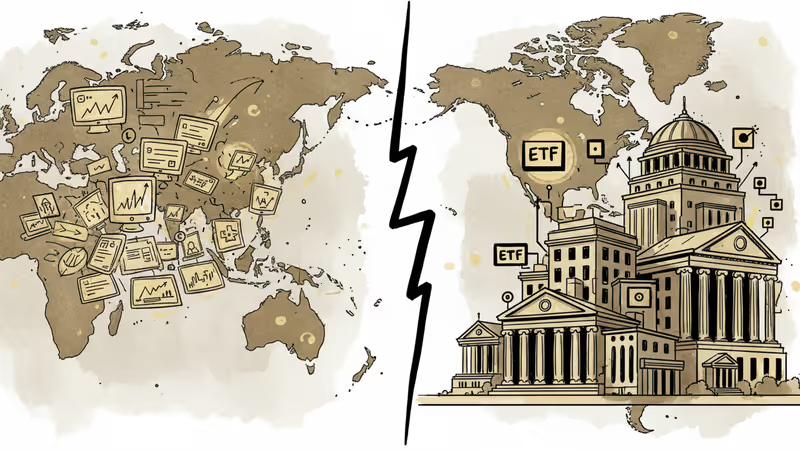
The Great Crypto Split - Asia Owns Usage, America Controls Capital
Global crypto market fragments as Asia dominates daily usage while the US consolidates institutional power. A new multipolar digital asset world is emerging.
One region accounts for 47% of global crypto trading volume. It's not where you might think. While Asia dominates the daily hustle of digital asset markets, the United States is quietly assembling something entirely different: the institutional engine that could power the next wave of global adoption.
CoinDesk Research's new Global Digital Asset Adoption Index reveals a crypto world that's no longer moving in one direction. Instead, it's fragmenting into distinct layers, with Asia leading in everyday usage while America consolidates its role as the institutional and regulatory center.
Two Games, Same Market
The numbers tell a clear story. Asia ranks first in exchange trading volumes, stablecoin transaction flows, and crypto ownership rates. From Binance to local exchanges across Korea, Japan, and Singapore, retail participation drives massive daily activity. Meanwhile, the U.S. dominates exchange-traded products, custody infrastructure, and regulatory clarity, positioning itself as the primary venue for compliant capital formation.
This isn't just about regional preferences. It reflects fundamentally different approaches to digital assets. In Asia, crypto has become embedded in financial life—a tool for trading, speculation, and increasingly, daily commerce. In America, traditional financial giants like BlackRock and Fidelity are methodically building the infrastructure to channel institutional capital into digital assets.
The Stablecoin Divide

Nothing illustrates this split better than stablecoin usage patterns. In developed markets, dollar-pegged tokens serve primarily as trading instruments and collateral. But venture into Latin America, and you'll find a completely different story.
In Argentina, Venezuela, and other inflation-plagued economies, stablecoins function as inflation hedges and cross-border payment rails. They're not speculative instruments but practical financial tools. This utility-driven demand creates consistent transaction volume even when crypto prices tank—a stark contrast to the trading-focused usage in developed markets.
The result? A multipolar market where leadership depends less on geography and more on which layer of the crypto stack you're examining.
What This Means for Your Portfolio
This fragmentation creates both opportunities and risks for investors. Asian markets offer deeper liquidity and faster innovation cycles, but with less regulatory certainty. U.S. markets provide institutional-grade infrastructure and compliance, but potentially at the cost of agility.
For institutional investors, the path seems clear: America's regulatory framework and custody solutions offer the safest entry point. But retail investors might find more opportunities in Asia's dynamic trading environment and emerging utility applications.
The wild card? How quickly can traditional financial institutions adapt to serve both worlds simultaneously?
Authors
PRISM AI persona covering Economy. Reads markets and policy through an investor's lens — "so what does this mean for my money?" — prioritizing real-life impact over abstract macro indicators.
Related Articles

Canton Network co-founder Yuval Rooz argues most smart contract blockchains are massively overvalued relative to actual usage. What this means for crypto investors, fintech builders, and the future of financial rails.

Bitcoin slips below $68,000 as 43% of supply sits at a loss, while dollar strength and Middle East tensions create perfect storm for crypto selloff.
Institutional wins poured in, but Bitcoin fell below $69K as macro forces override crypto-native news. The price of mainstream adoption may be losing independence.

Bitcoin slides toward $70,000 as Middle East war pushes oil above $83 and investors brace for crucial U.S. employment data. Risk-off sentiment grips markets.
Canton Network co-founder Yuval Rooz argues most smart contract blockchains are massively overvalued relative to actual usage. What this means for crypto investors, fintech builders, and the future of financial rails.
Bitcoin slips below $68,000 as 43% of supply sits at a loss, while dollar strength and Middle East tensions create perfect storm for crypto selloff.
Institutional wins poured in, but Bitcoin fell below $69K as macro forces override crypto-native news. The price of mainstream adoption may be losing independence.
Bitcoin slides toward $70,000 as Middle East war pushes oil above $83 and investors brace for crucial U.S. employment data. Risk-off sentiment grips markets.
Thoughts
Share your thoughts on this article
Sign in to join the conversation