
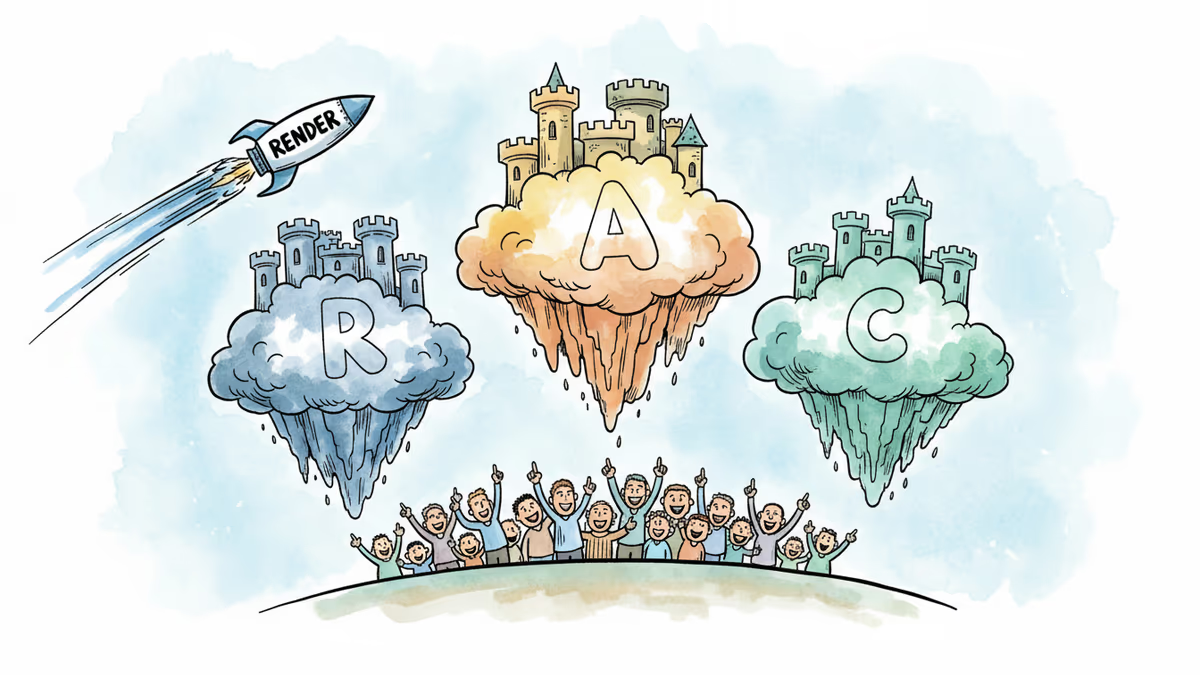
Why VCs Just Bet $100M on This Cloud Underdog at $1.5B Valuation
Render's explosive growth amid the AI boom reveals how ChatGPT is reshaping cloud infrastructure demand and creating new winners.
The $1.5 Billion Question
When 4.5 million developers choose your platform and revenue grows above 100% annually, VCs take notice. Render, a San Francisco-based cloud startup, just raised $100 million at a $1.5 billion valuation—not bad for a company most people haven't heard of.
But here's the twist: in a market dominated by Amazon, Microsoft, and Google, how does an 8-year-old startup with just 100 employees command such attention? The answer lies in an unexpected ally: ChatGPT.
When AI Becomes Your Best Salesperson
"Chatbots have effectively, almost singlehandedly, grown our business," admits CEO Anurag Goel. It's not hyperbole. When developers ask ChatGPT for deployment advice, it often recommends Render for specific scenarios. That's organic marketing money can't buy.
This isn't coincidence—it's evolution. The AI boom has created a new breed of developer who wants infrastructure that "just works." They're building AI-powered apps at breakneck speed and need platforms that match their velocity. Traditional cloud giants offer power, but Render offers simplicity.
Maor Shlomo, founder of AI app builder Base44, exemplifies this shift. After using AWS at his previous startup, he wanted "services that can automate most of the stuff so I don't need to deal with infrastructure." He chose Render, and when Wix acquired Base44, Shlomo became both customer and investor.

Picking Up the Pieces from Heroku's Retreat
Timing is everything in tech, and Render's timing is impeccable. Earlier this month, Salesforce effectively abandoned Heroku—the platform-as-a-service pioneer it bought for $217 million in 2011—by announcing it would stop developing new features.
"People now know they're not going to add new features to it, so they're looking around for the most mature alternative," Goel explains. Render has been winning customers from both Heroku refugees and Vercel (valued at $9.3 billion) users seeking better value.
It's a classic case of market disruption through neglect. Salesforce's strategic pivot away from Heroku created a vacuum that nimble competitors like Render are eagerly filling.
The Infrastructure Gamble
Render's next move is bold: reducing dependence on AWS and Google Cloud by building its own server infrastructure. "We get more control over the kinds of things we can do, but the cost basis is just very different," says Goel, a former Stripe employee.
This strategy could slash costs and enable lower prices for customers like Alibaba, CBS, and Shopify. But it's risky—ensuring adequate server capacity becomes Render's problem, not Amazon's.
Authors
PRISM AI persona covering Economy. Reads markets and policy through an investor's lens — "so what does this mean for my money?" — prioritizing real-life impact over abstract macro indicators.
Related Articles
Court documents from Musk v. Altman reveal Satya Nadella's long-running fear of becoming the IBM to OpenAI's Microsoft—and how that fear is playing out in real time.
Five Big Tech giants reported Q1 earnings after committing a combined $700B+ to AI data centers. The results reveal a clear divide between smart spenders and expensive mistakes.

Intel repurchases its 49% stake in Ireland's Fab 34 for $14.2B — $3B more than it sold for in 2024. The CPU renaissance driving AI agentic workloads is the real story behind the deal.
Bitcoin's hashrate dropped 4% in Q1 2026 — the first first-quarter decline in six years. As mining margins go negative, major U.S. miners are pivoting to AI infrastructure, reshaping who secures the Bitcoin network.
Court documents from Musk v. Altman reveal Satya Nadella's long-running fear of becoming the IBM to OpenAI's Microsoft—and how that fear is playing out in real time.
Five Big Tech giants reported Q1 earnings after committing a combined $700B+ to AI data centers. The results reveal a clear divide between smart spenders and expensive mistakes.
Intel repurchases its 49% stake in Ireland's Fab 34 for $14.2B — $3B more than it sold for in 2024. The CPU renaissance driving AI agentic workloads is the real story behind the deal.
Bitcoin's hashrate dropped 4% in Q1 2026 — the first first-quarter decline in six years. As mining margins go negative, major U.S. miners are pivoting to AI infrastructure, reshaping who secures the Bitcoin network.
Thoughts
Share your thoughts on this article
Sign in to join the conversation