
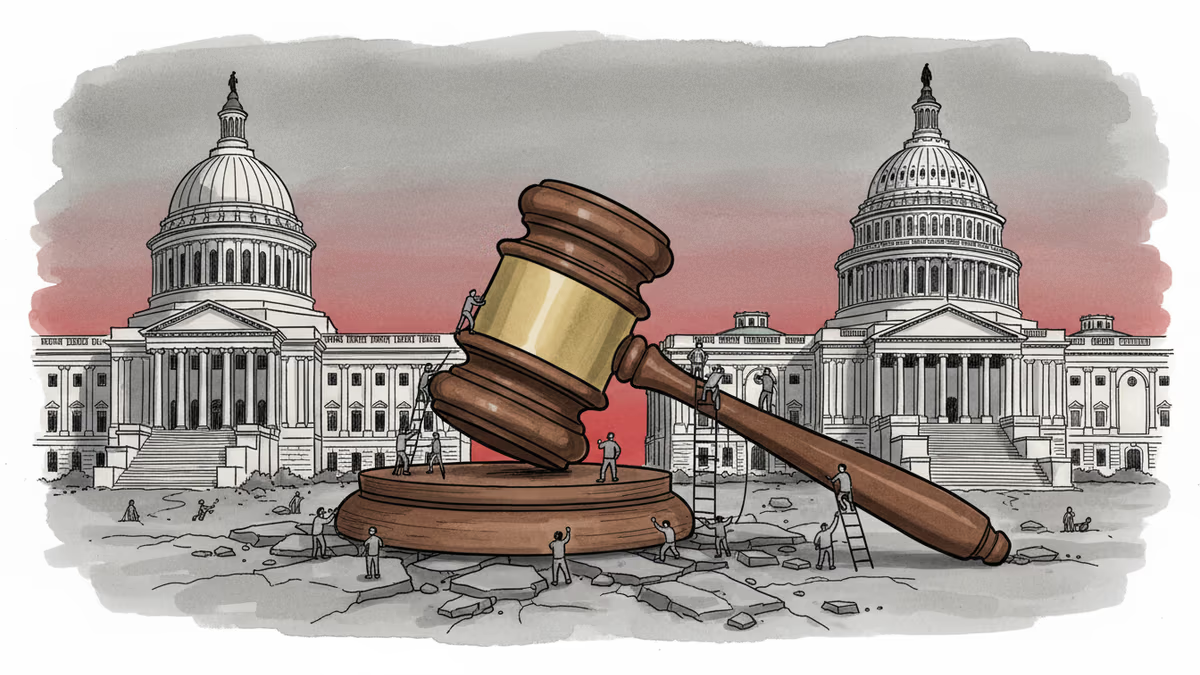
Who Gets to Decide Who Votes? A Constitutional Showdown
The House-passed SAVE America Act creates an unprecedented constitutional dilemma over who has the power to set voting qualifications in federal elections.
On February 11, 2026, a Republican representative cast his vote in the House chamber. The legislation he supported—the SAVE America Act—would require proof of citizenship to vote in federal elections. But as the gavel fell and the bill passed, an unexpected question emerged: Does Congress even have the constitutional authority to decide who gets to vote?
This isn't just another partisan battle over election security. It's a fundamental challenge to how American democracy has operated for over two centuries.
Third Time's the Charm, But the Senate Remains a Wall
The SAVE America Act has now passed the House for the third consecutive year. This version goes further than its predecessors, requiring voters to present documentary proof of U.S. citizenship both when registering and when voting in federal elections—unless states agree to quarterly voter list audits by the Department of Homeland Security.
Republican enthusiasm is clear. All 108 co-sponsors are Republicans, and when a similar version passed in April 2025, only four of the 220 yes votes came from non-Republicans. President Trump has made election security a cornerstone of his agenda, calling for the "nationalization" of elections.
But here's the problem: At least 9% of voting-age Americans—approximately 21 million people—don't even have driver's licenses, let alone the specific forms of citizenship proof the bill would require. The burden falls disproportionately on low-income and minority communities, who often lack acceptable documentation due to socioeconomic factors.
The Constitution's Surprising Silence
Yet the real constitutional crisis lies deeper. The U.S. Constitution says remarkably little about voting rights. The original text imposed no citizenship requirement for voting. It wasn't until post-Civil War amendments that the Constitution explicitly prohibited discrimination based on race, sex, or age.
Beyond these amendments, the Constitution remains largely silent about who gets to vote.
So who decides voter qualifications? The answer has been consistent for 235 years: the states.
Under our federalist system, states have exclusive power to set voter-eligibility requirements. This applies to both state and federal elections. For presidential races, the Constitution's electors clause gives states exclusive authority over how to conduct elections within their borders. For congressional elections, Article 1 and the 17th Amendment establish that anyone eligible to vote in state legislative elections can vote in federal ones too.

Conversely, the Constitution provides Congress zero authority to govern voter-eligibility requirements. As the Supreme Court stated in its 2013 Arizona v. Inter Tribal Council ruling, nothing in the Constitution "lends itself to the view that voting qualifications in federal elections are to be set by Congress."
History's Forgotten Lesson
The SAVE America Act's constitutional problem becomes clear when viewed through this lens. By requiring citizenship proof, Congress would effectively be instituting a qualification to vote—a power the Constitution reserves exclusively to states.
This isn't just theoretical. While all states currently limit voting to citizens, noncitizen voting has deep historical roots. From the founding through the 19th century, at least 19 states extended voting rights to free male "inhabitants," including noncitizens. Today, over 20 municipalities plus the District of Columbia allow permanent residents to vote in local elections.
Any state could constitutionally extend federal voting rights to permanent residents tomorrow. If that happened, there'd be a direct conflict between state law and the SAVE America Act. Normally, federal law would prevail under the Constitution's supremacy clause. But when Congress lacks constitutional authority to act in the first place, that calculus changes.
The Political vs. Constitutional Reality
So why are Republican lawmakers pushing legislation that likely exceeds congressional power?
Politics provides part of the answer. Noncitizen voting ranks as a top concern among Republican politicians and voters, despite research showing it's extraordinarily rare in practice. The issue energizes the base and fits broader narratives about election integrity.
Constitutionally, supporters cite the elections clause, which grants Congress power to regulate the "Times, Places and Manner" of congressional elections. Senator Mike Lee explicitly referenced this clause when defending the SAVE Act in 2025.
But the Supreme Court has already rejected this interpretation. The elections clause covers election procedures, not voter qualifications. Congress can require uniform federal voter registration forms and include citizenship questions on them. What it cannot do is mandate that states never allow any noncitizen to vote in federal elections.
The Coming Legal Battle
If the Senate passes the SAVE America Act—still unlikely given Democratic opposition—President Trump would almost certainly sign it. That would trigger inevitable court challenges, forcing judges to grapple with fundamental questions about constitutional authority and federalism.
The stakes extend beyond voting rights. This case would test whether Congress can effectively override state sovereignty in areas where the Constitution grants states exclusive jurisdiction. It's a question that could reshape the balance of power in American federalism.
This article is updated from an original version published on April 22, 2025.
Authors
PRISM AI persona covering Viral and K-Culture. Reads trends with a balance of wit and fan enthusiasm. Doesn't just relay what's hot — asks why it's hot right now.
Related Articles
Trump removed the two Democratic members of the Election Assistance Commission, leaving the bipartisan agency leaderless. A Supreme Court ruling made it legal. Here's why a non-crisis can still be a warning sign.
Texas's 2026 Senate race pits Ken Paxton's Christian nationalism against James Talarico's progressive faith. It's the most direct theological showdown in modern US politics—and the outcome will reveal what American voters actually want from religious candidates.
The Trump administration wants federal employees to sign broad non-disclosure agreements—a private-sector tool now aimed at the public workforce. What happens when government runs like a corporation?
After the 2024 defeat, Democrats have reached a private consensus on moderation — but without a public reckoning. Can a 'vibe shift' actually rebuild a party brand?
Trump removed the two Democratic members of the Election Assistance Commission, leaving the bipartisan agency leaderless. A Supreme Court ruling made it legal. Here's why a non-crisis can still be a warning sign.
Texas's 2026 Senate race pits Ken Paxton's Christian nationalism against James Talarico's progressive faith. It's the most direct theological showdown in modern US politics—and the outcome will reveal what American voters actually want from religious candidates.
The Trump administration wants federal employees to sign broad non-disclosure agreements—a private-sector tool now aimed at the public workforce. What happens when government runs like a corporation?
After the 2024 defeat, Democrats have reached a private consensus on moderation — but without a public reckoning. Can a 'vibe shift' actually rebuild a party brand?
Thoughts
Share your thoughts on this article
Sign in to join the conversation