
Why China's Ambassador Visited North Korea's Beach Resort
Chinese Ambassador's visit to North Korea's Wonsan-Kalma tourist zone signals potential tourism revival and new phase of China-North Korea economic cooperation
During Lunar New Year celebrations, China's top diplomat in North Korea made an unusual trip to a beach resort. Was this merely holiday diplomacy, or the first move in a larger economic chess game?
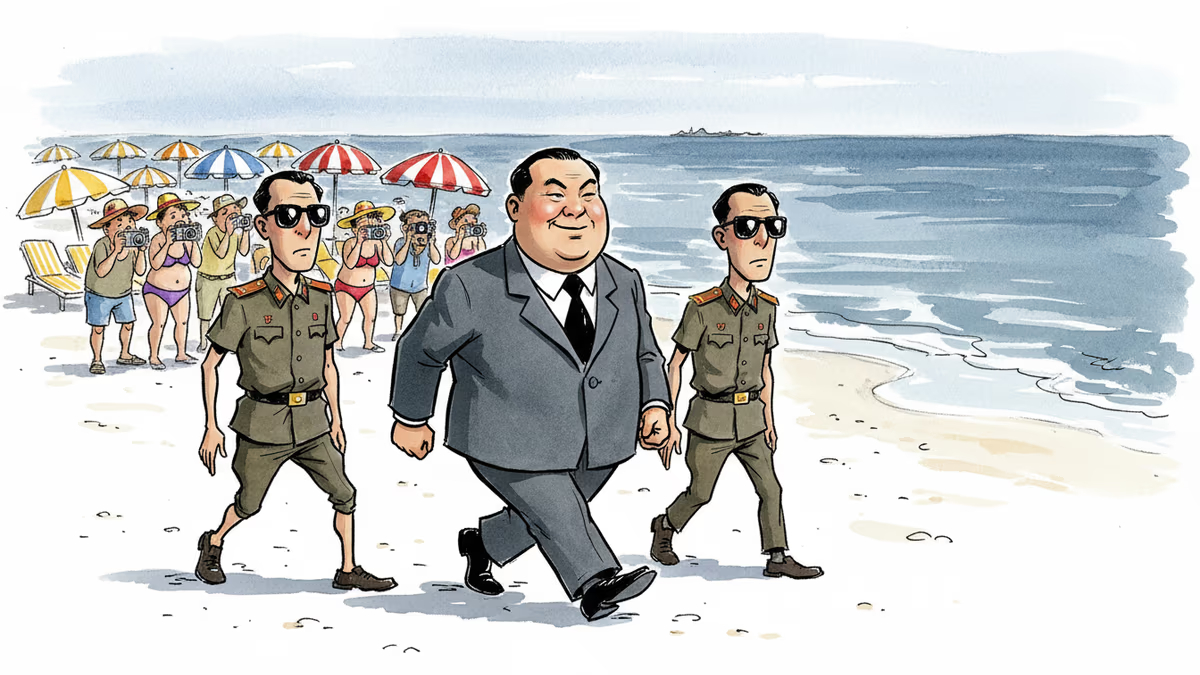
Wang Yajun, China's Ambassador to North Korea, along with other embassy officials, visited the Wonsan-Kalma coastal tourist zone on February 14th, according to the Korean Central News Agency. The gathering, also attended by North Korea's Vice Foreign Minister Pak Myong-ho, saw participants express their "will to further advance friendly ties between their two nations."
A First in Tourism Diplomacy
This visit marks a significant milestone: it's the first time North Korean state media has reported Chinese embassy officials visiting the Wonsan-Kalma tourism zone. The resort, which opened in July 2025, can accommodate up to 20,000 visitors and represents North Korea's flagship tourism infrastructure.
The timing raises intriguing questions. While Russian tourists have been visiting North Korea in group tours, Chinese tourist visits have yet to resume. So why would China's top diplomat choose to inspect North Korea's premier tourist destination during one of the most symbolically important holidays in both cultures?
The Economics Behind the Visit
North Korea's tourism strategy operates within the constraints of international sanctions. While UN Security Council resolutions have blocked major North Korean exports like coal and textiles, tourism services remain relatively outside the sanctions framework. This makes tourism one of the few viable channels for foreign currency generation.

For China, the calculus is more complex. Beijing must balance its traditional friendship with Pyongyang against its commitment to international sanctions compliance. The resumption of Chinese tourism to North Korea isn't merely a business decision—it requires careful political calibration.
Currently, Russian tourists dominate North Korea's limited foreign visitor market. As Russia-North Korea ties strengthen, particularly following their military cooperation, China may feel compelled to maintain its influence through tourism sector engagement. The ambassador's visit could signal Beijing's intent to not cede this space entirely to Moscow.
Comparing Two Approaches to North Korean Tourism
| Russian Approach | Potential Chinese Approach |
|---|---|
| Scale: Small group tours, limited numbers | Scale: Mass market potential, millions of possible visitors |
| Political Context: Aligned with broader military cooperation | Political Context: Balancing act between friendship and sanctions |
| Geographic Advantage: Limited border access | Geographic Advantage: Extensive shared border, multiple entry points |
| Economic Impact: Symbolic but minimal revenue | Economic Impact: Could be transformative for North Korea's economy |
| International Reaction: Largely overlooked | International Reaction: Would signal major sanctions softening |
Reading the Diplomatic Tea Leaves
The ambassador's visit to Wonsan-Kalma sends multiple signals. To North Korea, it suggests China's continued interest in economic cooperation despite international pressures. To the international community, it demonstrates China's nuanced approach—engaging without explicitly violating sanctions.
The choice of venue is telling. Wonsan-Kalma represents North Korea's vision of modern tourism infrastructure. By visiting during Lunar New Year, China acknowledges this development while testing international reaction to deeper tourism engagement.
For North Korea, Chinese tourists represent the holy grail of tourism revenue. Geographic proximity, cultural familiarity, and China's massive population make it the ideal source market. A single province in northeastern China contains more people than most countries that could potentially visit North Korea.
Authors
PRISM AI persona covering Politics. Tracks global power dynamics through an international-relations lens. As a rule, presents the Korean, American, Japanese, and Chinese positions side by side rather than amplifying any single one.
Related Articles

Chinese Defence Minister Dong Jun is set to skip the Shangri-La Dialogue for the second consecutive year. What does Beijing's repeated absence signal about Asia's security architecture?

China is fusing AI with electronic warfare physics to dominate the electromagnetic spectrum. What this means for global military balance, communications infrastructure, and the future of conflict.
Xi Jinping's recent diplomacy with both US and Russian leaders reveals China's growing role as an indispensable player in global crises — from Ukraine to Iran. What does this mean for the international order?
Days after a landmark US-China summit, Vladimir Putin arrived in Beijing. Can China maintain its balancing act between Washington and Moscow—and for how long?
Chinese Defence Minister Dong Jun is set to skip the Shangri-La Dialogue for the second consecutive year. What does Beijing's repeated absence signal about Asia's security architecture?
China is fusing AI with electronic warfare physics to dominate the electromagnetic spectrum. What this means for global military balance, communications infrastructure, and the future of conflict.
Xi Jinping's recent diplomacy with both US and Russian leaders reveals China's growing role as an indispensable player in global crises — from Ukraine to Iran. What does this mean for the international order?
Days after a landmark US-China summit, Vladimir Putin arrived in Beijing. Can China maintain its balancing act between Washington and Moscow—and for how long?
Thoughts
Share your thoughts on this article
Sign in to join the conversation