
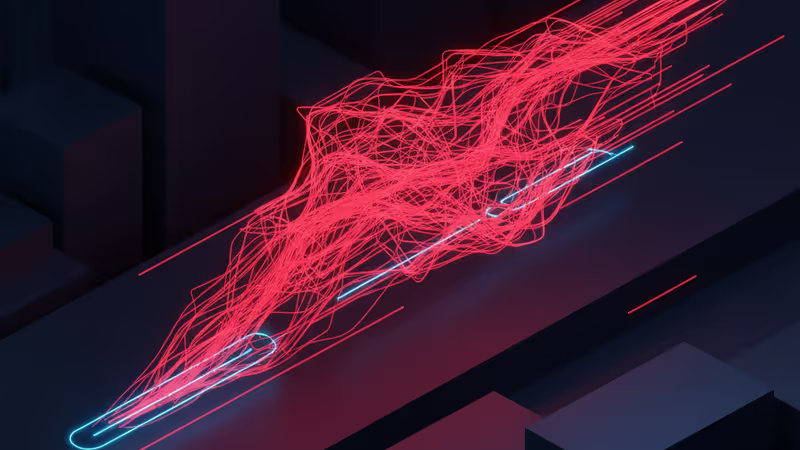
China's BCI Leapfrog: Why Ecosystem, Not Implants, Is the Real Race Against Neuralink
While Neuralink focuses on implant tech, China's BCI leapfrog shows the real race is in building an integrated ecosystem of robotics, AI, and wireless.
The Lede: Beyond the 'Telepathy' Hype
While the world watched Elon Musk's Neuralink teach a patient to play digital chess, China quietly demonstrated the next, and far more critical, phase of the Brain-Computer Interface (BCI) revolution: real-world, economic integration. A paralyzed individual is now performing paid work and managing daily tasks using a network of robots controlled by thought. This isn't just a medical marvel; it's a strategic shot across the bow, signaling that the BCI race is not about the implant alone, but the entire ecosystem built around it.
Why It Matters: From Lab Demo to Life Platform
This development from the Chinese Academy of Sciences fundamentally shifts the BCI narrative. The significance lies not just in the technology, but in its application, which has profound second-order effects:
- Redefining Success: The benchmark for BCI is no longer controlling a cursor on a screen. It's now about orchestrating multiple, complex devices in the physical world to restore autonomy and economic potential. This moves BCI from an assistive tool to a life-integration platform.
- The Platform Precedent: By seamlessly connecting a neural implant to smart wheelchairs, robotic dogs, and workplace tools, China has demonstrated a proof-of-concept for a 'brain-as-a-hub' model. This lays the groundwork for future applications in advanced manufacturing, remote operation of hazardous machinery, and defense.
- Accelerating Adoption: Demonstrating tangible, life-altering outcomes like earning an income and ordering food will dramatically accelerate public acceptance and regulatory pathways, potentially outpacing the West's more cautious, step-by-step approach.
The Analysis: Silicon Valley's Moonshot vs. China's Full-Stack
The US-China BCI competition is a classic clash of innovation philosophies. Neuralink, a product of Silicon Valley's 'moonshot' culture, has focused intensely on perfecting a single, hero component: the high-channel-count, surgically elegant implant. The media narrative has followed, focusing on the sheer technical audacity of the device itself.
China, however, is executing a different playbook—one we've seen before in drones (DJI) and telecommunications (Huawei). They are pursuing full-stack integration. Their advantage isn't necessarily a superior implant, but a state-backed, integrated industrial ecosystem that excels at making disparate technologies—neuro-implants, low-latency 5G/6G, advanced robotics, and AI-powered decoding algorithms—work together in perfect, real-time synergy.
While Neuralink is building the world's best engine, China is building a functional, road-ready car and the charging network to support it. This recent achievement is less about a single breakthrough and more about the maturity of that integrated system. It answers the question: what good is 'telepathy' if it can't interact with the world?
PRISM Insight: Invest in the BCI 'Pick-and-Shovel' Plays
For investors and corporate strategists, the key takeaway is to look beyond the neurotech implant itself. The immense value in the emerging BCI economy will be captured not just by the implant makers, but by the companies building the essential, interconnected infrastructure. The real growth verticals are in the 'pick-and-shovel' plays: the specialized robotics platforms, the real-time AI decoding software, and the ultra-reliable, low-latency communication hardware that form the backbone of any functional BCI ecosystem. China's state-led approach gives its domestic players a significant advantage in creating and capturing this integrated market.
PRISM's Take: The Race for the Operating System of the Mind
The West, and particularly the US, risks being mesmerized by the elegance of its own core technology while China pragmatically builds the real-world applications around it. This isn't just about helping a patient move a wheelchair; it's about who defines the dominant 'operating system' for connecting the human brain to the digital and physical world. The winner won't be the company with the most advanced implant, but the nation that first masters and scales the entire BCI ecosystem. Right now, China has shown its intent to be the platform, not just the component supplier.
Related Articles
RheEnergise is using a dense, mineral-based fluid to reinvent pumped hydro storage. Can this innovation solve the grid's biggest energy bottleneck?

Analysis of the recent iOS update backlash. Discover why user frustration signals a deeper strategic risk to Apple's brand and competitive moat.
A new documentary deepfakes Sam Altman, revealing critical insights into digital identity, AI's power struggles, and the future of reputational risk.

Oracle's $10B data center funding issue signals a new risk for the AI boom. Our analysis reveals the financial fragility threatening the AI hardware sector's growth.