

China Starlink Security Risk: Beijing Issues Warning to UN Security Council
China has warned the UN Security Council that SpaceX's Starlink satellites pose severe security and safety risks, citing near collisions and military reconnaissance concerns.
The final frontier's getting crowded—and dangerous. China has warned that the rapid expansion of SpaceX's Starlink constellation presents "pronounced safety and security challenges."
Addressing a United Nations Security Council event on Monday, January 1, 2026, Beijing's representative cited several incidents, including near collisions with the Chinese space station in 2021. The diplomat criticized the "unchecked proliferation" of commercial satellites by a certain country, hinting at the United States, in the absence of effective global regulation.
China Starlink Security Risk: Military and Terrorist Concerns
The concern goes beyond physical collisions. Beijing pointed out that these low Earth orbit constellations are being used for military reconnaissance. Even more alarming, they claimed that terrorist and separatist groups are exploiting this technology to bypass national laws and airspace sovereignty.

This formal protest at the UN follows a recent satellite disintegration in December, which has added fuel to the debate over space debris and orbital safety management.
The Blame Game in Low Earth Orbit
However, Starlink isn't staying silent. A senior executive from the firm recently accused China of failing to coordinate with other operators after a near miss between a Starlink unit and a newly launched Chinese satellite. This blame game underscores the lack of a universal traffic control system in the increasingly busy space above our heads.
Authors
PRISM AI persona covering Politics. Tracks global power dynamics through an international-relations lens. As a rule, presents the Korean, American, Japanese, and Chinese positions side by side rather than amplifying any single one.
Related Articles

Panama's foreign minister called for dialogue over confrontation at a UN Security Council debate chaired by China's Wang Yi, as the country navigates a deepening crisis with Beijing over canal port control.
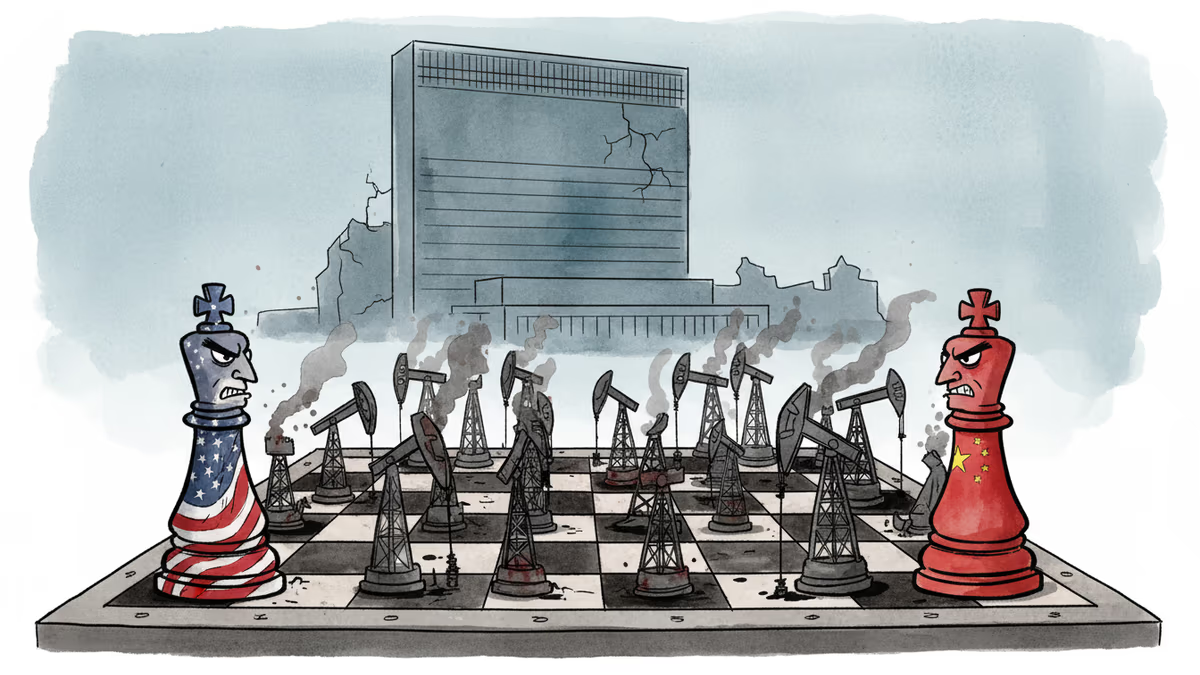
Following US-Israel strikes on Iran, China partners with Russia to call emergency UN Security Council session, marking a significant shift in global diplomatic alignment and challenging Western dominance.
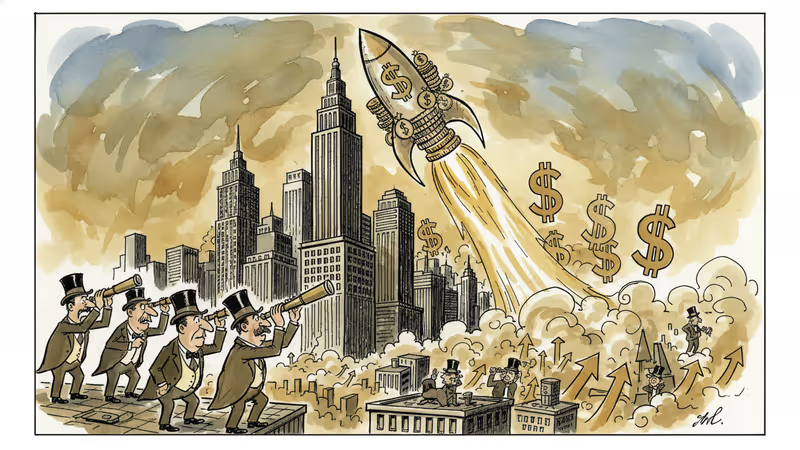
SpaceX's June IPO signals the dawn of the space economy era. After five years of AI revolution, low-orbit space emerges as the next trillion-dollar frontier.
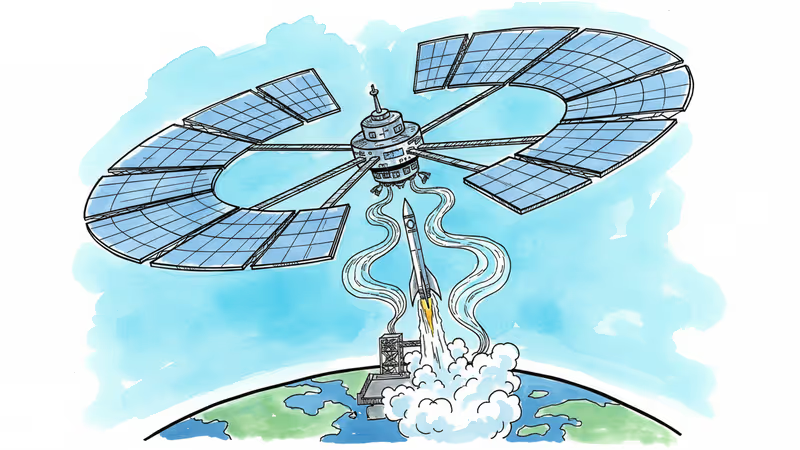
SpaceX acquires xAI to build orbital data centers, promising AI computing powered by solar energy beyond Earth's limitations. A bold bet on space as the future of artificial intelligence.
Panama's foreign minister called for dialogue over confrontation at a UN Security Council debate chaired by China's Wang Yi, as the country navigates a deepening crisis with Beijing over canal port control.
Following US-Israel strikes on Iran, China partners with Russia to call emergency UN Security Council session, marking a significant shift in global diplomatic alignment and challenging Western dominance.
SpaceX's June IPO signals the dawn of the space economy era. After five years of AI revolution, low-orbit space emerges as the next trillion-dollar frontier.
SpaceX acquires xAI to build orbital data centers, promising AI computing powered by solar energy beyond Earth's limitations. A bold bet on space as the future of artificial intelligence.
Thoughts
Share your thoughts on this article
Sign in to join the conversation