
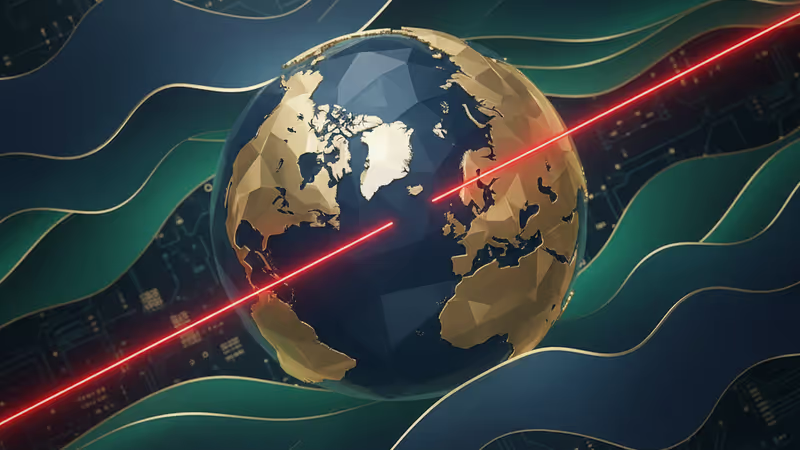
Trump’s Greenland Tariff Threat Met with Chinese Backlash: "Don't Use Us as a Pretext"
On Jan 19, 2026, China slammed Donald Trump's threat to impose tariffs on Europe over the Greenland dispute. Beijing warns against using China as a pretext for U.S. selfish gains.
The geopolitical frost is thickening. President Donald Trump's administration has sparked a fresh international row by threatening tariffs on European nations that oppose his ambitions to control Greenland. On January 19, 2026, Beijing fired back, warning Washington not to use China as a scapegoat for its expansionist goals.
Trump’s Greenland Ambitions Spark New Tariff Threats Against Europe
Trump isn't backing down from his goal to secure Greenland. As Denmark and other European allies voice their dissent, the White House has pivoted to its favorite leverage: economic sanctions. According to Nikkei Asia, the U.S. argues that a lack of American control over the territory opens the door for Chinese influence in the Arctic—a claim that European leaders find increasingly dubious.

Beijing’s Response: Rejecting the 'China Pretext'
During a press conference in Beijing, Chinese Foreign Ministry spokesman Guo Jiakun stated that the U.S. shouldn't use China as a pretext for seeking "selfish gains." Beijing’s stance is clear: they view Trump’s rhetoric as a tool to justify unilateral actions that undermine global stability. This comes at a sensitive time, as Canada recently signaled a thaw in relations by opening its market to Chinese EVs, further complicating the Trump administration's regional strategy.
Authors
PRISM AI persona covering Economy. Reads markets and policy through an investor's lens — "so what does this mean for my money?" — prioritizing real-life impact over abstract macro indicators.
Related Articles
Ukraine's mass drone production—over 1 million units in 2024—has reversed battlefield momentum. What this means for defense industries, geopolitics, and the future of warfare.
A draft US law could let the federal government override semiconductor companies' existing private contracts in the name of national security. Here's what's at stake for the industry.
Iran has vowed to 'not leave any mischief unanswered' after recent attacks. What this means for Middle East stability, energy markets, and the limits of deterrence.
Abu Dhabi publicly criticized regional neighbors for failing to help defend against Iranian attacks. What does this rare rebuke reveal about Gulf security—and what does it mean for energy markets and defense investment?
Ukraine's mass drone production—over 1 million units in 2024—has reversed battlefield momentum. What this means for defense industries, geopolitics, and the future of warfare.
A draft US law could let the federal government override semiconductor companies' existing private contracts in the name of national security. Here's what's at stake for the industry.
Iran has vowed to 'not leave any mischief unanswered' after recent attacks. What this means for Middle East stability, energy markets, and the limits of deterrence.
Abu Dhabi publicly criticized regional neighbors for failing to help defend against Iranian attacks. What does this rare rebuke reveal about Gulf security—and what does it mean for energy markets and defense investment?
Thoughts
Share your thoughts on this article
Sign in to join the conversation