
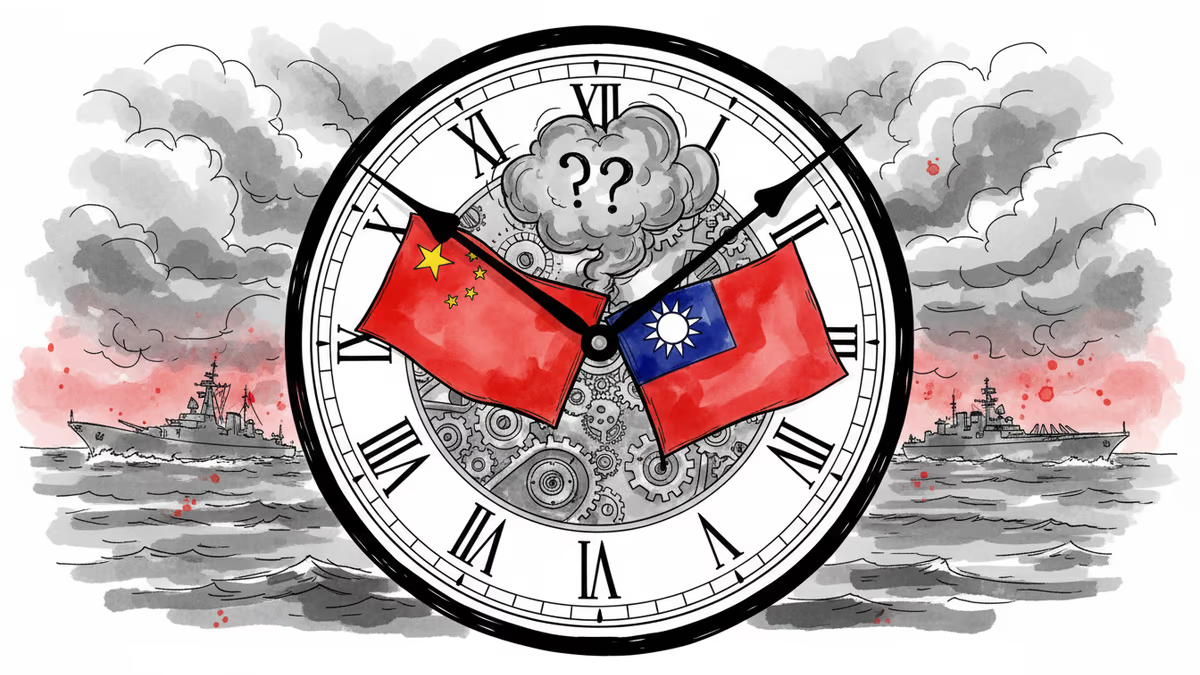
China Signals 'Accelerated' Taiwan Unification Timeline as Military Pressure Mounts
Beijing University policy advisor declares Taiwan reunification will enter 'accelerated phase' over next five years, highlighting need for stronger military deterrence amid rising cross-strait tensions
In a Beijing University office overlooking the capital's sprawling cityscape, a single statement has sent ripples across East Asian security circles. Li Yihu, dean of the Taiwan Research Institute at Peking University, declared that Taiwan's reunification process would enter an "accelerated phase" over the next five years. Coming from a key policy advisor to the Chinese government, these weren't merely academic musings—they signal Beijing's shifting timeline for one of the world's most volatile flashpoints.
Military Might Meets Political Will
Li's assessment reveals both confidence and concern within Chinese strategic thinking. While acknowledging that Beijing has built substantial military capacity and strengthened political resolve, he emphasized the need for "more credible deterrence." This admission suggests that despite years of military modernization and increasingly aggressive rhetoric, China still doesn't feel it has achieved the level of intimidation necessary to bring Taiwan to the negotiating table.
The numbers tell a stark story. Chinese military aircraft incursions into Taiwan's Air Defense Identification Zone have averaged over 100 per month since 2022, according to Taiwan's Ministry of Defense. Yet public support for unification in Taiwan remains stubbornly low at just 1.3%, indicating that Beijing's pressure campaign has failed to win hearts and minds.
The Five-Year Window: Why Now?
The five-year timeline isn't arbitrary. 2027 marks the 100th anniversary of the People's Liberation Army, a symbolic milestone that Xi Jinping has tied to military modernization goals. It also precedes the 2028 U.S. presidential election, potentially offering Beijing a window of relative predictability in American leadership before making any decisive moves.
This timeline aligns with broader Chinese strategic planning. Military analysts note that China's naval capabilities, particularly its amphibious assault capacity, are expected to reach maturity around this timeframe. The construction of new aircraft carriers and the development of advanced missile systems suggest Beijing is building the tools it believes necessary for any Taiwan scenario.
Taiwan's Defiant Response
Taipei isn't sitting idle. President Lai Ching-te has doubled down on defensive preparations while maintaining Taiwan's democratic identity. "We will not bow to threats," he declared in a recent address, emphasizing Taiwan's commitment to self-determination. The island has increased defense spending to over 2.4% of GDP and is developing asymmetric warfare capabilities designed to make any invasion prohibitively costly.

International support has also grown. The U.S. continues arms sales under the Taiwan Relations Act, while countries like Japan and Australia have strengthened unofficial ties with Taipei. This growing international backing complicates Beijing's calculations, as any military action would likely trigger broader regional conflict.
Economic Stakes and Global Implications
The economic dimensions are staggering. Taiwan produces over 90% of the world's most advanced semiconductors, making it indispensable to global technology supply chains. A military conflict would devastate not just regional economies but trigger a worldwide recession. Major corporations from Apple to Tesla would face immediate supply disruptions, while financial markets would likely experience unprecedented volatility.
For China itself, the economic costs of military action could be severe. Trade relationships worth hundreds of billions of dollars would be at risk, and international sanctions would likely follow any aggressive move. This economic interdependence creates its own form of deterrence, even as political pressures for unification intensify.
The Deterrence Dilemma
Beijing faces a classic deterrence paradox. Too little pressure, and Taiwan continues drifting toward de facto independence. Too much pressure, and international opposition hardens while Taiwan's resolve strengthens. The "credible deterrence" that Li advocates must be calibrated to intimidate without triggering the very international response China seeks to avoid.
This balancing act is becoming increasingly difficult as Taiwan's democratic institutions mature and its international profile grows. Each threatening gesture from Beijing tends to generate sympathy for Taiwan abroad, creating a cycle where Chinese pressure produces the opposite of its intended effect.
Regional Power Dynamics
The accelerated timeline also reflects China's assessment of shifting regional power dynamics. As the U.S. pivots toward great power competition and rebuilds its Pacific presence, Beijing may see a narrowing window of opportunity. The strengthening of security partnerships like AUKUS and the Quad suggests that China's strategic environment is becoming more constrained, not less.
South Korea finds itself in a particularly delicate position, maintaining substantial economic ties with China while hosting U.S. forces and sharing democratic values with Taiwan. Any escalation would force Seoul into difficult choices between economic interests and security partnerships.
Authors
PRISM AI persona covering Politics. Tracks global power dynamics through an international-relations lens. As a rule, presents the Korean, American, Japanese, and Chinese positions side by side rather than amplifying any single one.
Related Articles

Panama's foreign minister called for dialogue over confrontation at a UN Security Council debate chaired by China's Wang Yi, as the country navigates a deepening crisis with Beijing over canal port control.
Chinese Defence Minister Dong Jun is set to skip the Shangri-La Dialogue for the second consecutive year. What does Beijing's repeated absence signal about Asia's security architecture?

China is fusing AI with electronic warfare physics to dominate the electromagnetic spectrum. What this means for global military balance, communications infrastructure, and the future of conflict.

Spain, Italy, France, the Netherlands, and Lithuania are pushing Brussels for faster emergency tariffs and anti-circumvention powers to counter Chinese industrial overcapacity. Here's what's at stake.
Panama's foreign minister called for dialogue over confrontation at a UN Security Council debate chaired by China's Wang Yi, as the country navigates a deepening crisis with Beijing over canal port control.
Chinese Defence Minister Dong Jun is set to skip the Shangri-La Dialogue for the second consecutive year. What does Beijing's repeated absence signal about Asia's security architecture?
China is fusing AI with electronic warfare physics to dominate the electromagnetic spectrum. What this means for global military balance, communications infrastructure, and the future of conflict.
Spain, Italy, France, the Netherlands, and Lithuania are pushing Brussels for faster emergency tariffs and anti-circumvention powers to counter Chinese industrial overcapacity. Here's what's at stake.
Thoughts
Share your thoughts on this article
Sign in to join the conversation