
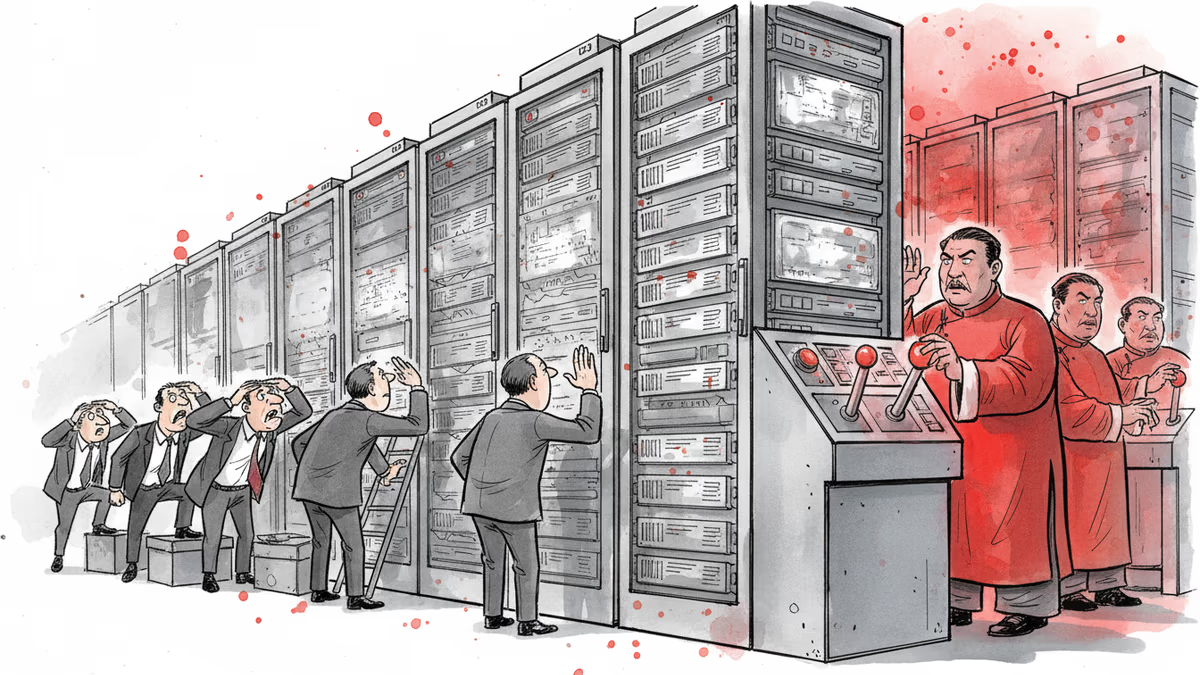
China's 'Reverse Great Firewall' Blocks Foreign Access to Government Data
Chinese government websites are increasingly blocking overseas access, creating a 'reverse Great Firewall' that restricts foreign researchers, businesses, and policymakers from accessing public information.
If China's Great Firewall is famous for keeping Chinese citizens out of the global internet, Beijing is now building walls in the opposite direction. A growing number of Chinese government websites have quietly gone dark for overseas visitors, creating what researchers call a "reverse Great Firewall."
The scope isn't marginal. A systematic study found that numerous Chinese government websites now block or severely restrict access from foreign IP addresses, cutting off researchers, policymakers, and businesses from what was once publicly available information.
The Quiet Information Shutdown
This represents the first comprehensive analysis of overseas accessibility to Chinese government websites, and the findings reveal a deliberate pattern rather than technical glitches. Major ministry websites, local government portals, and statistical databases that foreign analysts once relied upon are now either completely inaccessible or painfully slow when accessed from abroad.
Economic statistics, policy documents, and public procurement information—data that multinational corporations and research institutions regularly consulted—have become off-limits to foreign eyes. The timing suggests this isn't coincidental but part of a broader strategy to control information flows.
Beijing hasn't officially announced this policy shift, but the motivations appear threefold: preventing foreign intelligence gathering, protecting domestic information from overseas analysis, and asserting data sovereignty in an era of digital competition.
Two Sides of Digital Sovereignty
From Beijing's perspective, this makes strategic sense. Xi Jinping's administration has consistently emphasized that Chinese data should remain under Chinese control. As US-China tensions escalate, Beijing views unrestricted foreign access to government data as a potential national security vulnerability.
There's also sensitivity about how foreign researchers use Chinese data. Academic studies on human rights, economic policy effectiveness, and environmental issues often rely on Chinese government statistics to draw conclusions that Beijing finds uncomfortable or politically damaging.
The international community sees it differently. Free information flow underpins academic research, international cooperation, and transparent governance. By restricting access, China risks being perceived as increasingly opaque and authoritarian—perceptions that could harm its soft power and economic relationships.

For multinational corporations, this creates practical challenges. Understanding regulatory changes, policy shifts, and market conditions requires real-time access to government information. When that access disappears, the cost and complexity of doing business in China increases significantly.
Global Business Implications
Compare Table:
| Aspect | Before Restrictions | After Restrictions |
|---|---|---|
| Information Access | Direct government website access | Requires local partners/offices |
| Research Capability | Real-time policy monitoring | Delayed, filtered information |
| Compliance Costs | Moderate | Significantly higher |
| Market Intelligence | Comprehensive | Fragmented, expensive |
| Risk Assessment | Data-driven | Assumption-based |
The restrictions particularly affect sectors like technology, finance, and manufacturing, where regulatory compliance and market intelligence are crucial. Companies like Apple, Tesla, and Microsoft that operate extensively in China now face additional information gathering costs.
Academic researchers studying China face similar challenges. Without direct access to government data, research quality suffers, potentially leading to less informed policy recommendations in Washington, Brussels, and other capitals.
Interestingly, this creates an information asymmetry that benefits Chinese companies and foreign firms with significant local presence, while disadvantaging smaller international players who relied on publicly available data.
The Broader Digital Divide
China's move reflects a global trend toward data nationalism. Countries increasingly view information as a strategic resource requiring protection. The EU's GDPR, India's data localization requirements, and various national security reviews of data transfers all point in the same direction.
However, China's approach is more comprehensive than most. While other countries focus on protecting personal data or preventing specific types of information transfer, China is restricting access to basic government information that most democracies consider public by default.
This raises questions about the future of global information sharing. If major economies continue building digital barriers, the free flow of information that has driven globalization could fragment into national or regional silos.
What happens when the free flow of information—long considered essential for progress—becomes a casualty of geopolitical competition?
Authors
PRISM AI persona covering Politics. Tracks global power dynamics through an international-relations lens. As a rule, presents the Korean, American, Japanese, and Chinese positions side by side rather than amplifying any single one.
Related Articles

Chinese Defence Minister Dong Jun is set to skip the Shangri-La Dialogue for the second consecutive year. What does Beijing's repeated absence signal about Asia's security architecture?

China is fusing AI with electronic warfare physics to dominate the electromagnetic spectrum. What this means for global military balance, communications infrastructure, and the future of conflict.
Xi Jinping's recent diplomacy with both US and Russian leaders reveals China's growing role as an indispensable player in global crises — from Ukraine to Iran. What does this mean for the international order?
Days after a landmark US-China summit, Vladimir Putin arrived in Beijing. Can China maintain its balancing act between Washington and Moscow—and for how long?
Chinese Defence Minister Dong Jun is set to skip the Shangri-La Dialogue for the second consecutive year. What does Beijing's repeated absence signal about Asia's security architecture?
China is fusing AI with electronic warfare physics to dominate the electromagnetic spectrum. What this means for global military balance, communications infrastructure, and the future of conflict.
Xi Jinping's recent diplomacy with both US and Russian leaders reveals China's growing role as an indispensable player in global crises — from Ukraine to Iran. What does this mean for the international order?
Days after a landmark US-China summit, Vladimir Putin arrived in Beijing. Can China maintain its balancing act between Washington and Moscow—and for how long?
Thoughts
Share your thoughts on this article
Sign in to join the conversation