
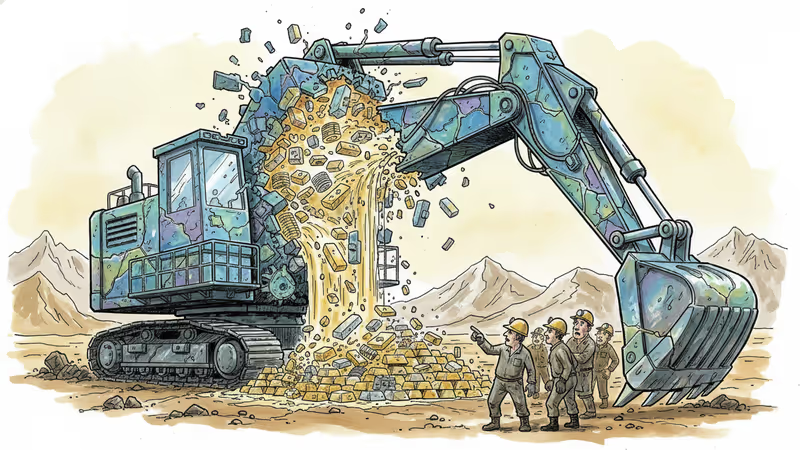
China's Rare Earth Empire Shows First Cracks as Prices Tumble
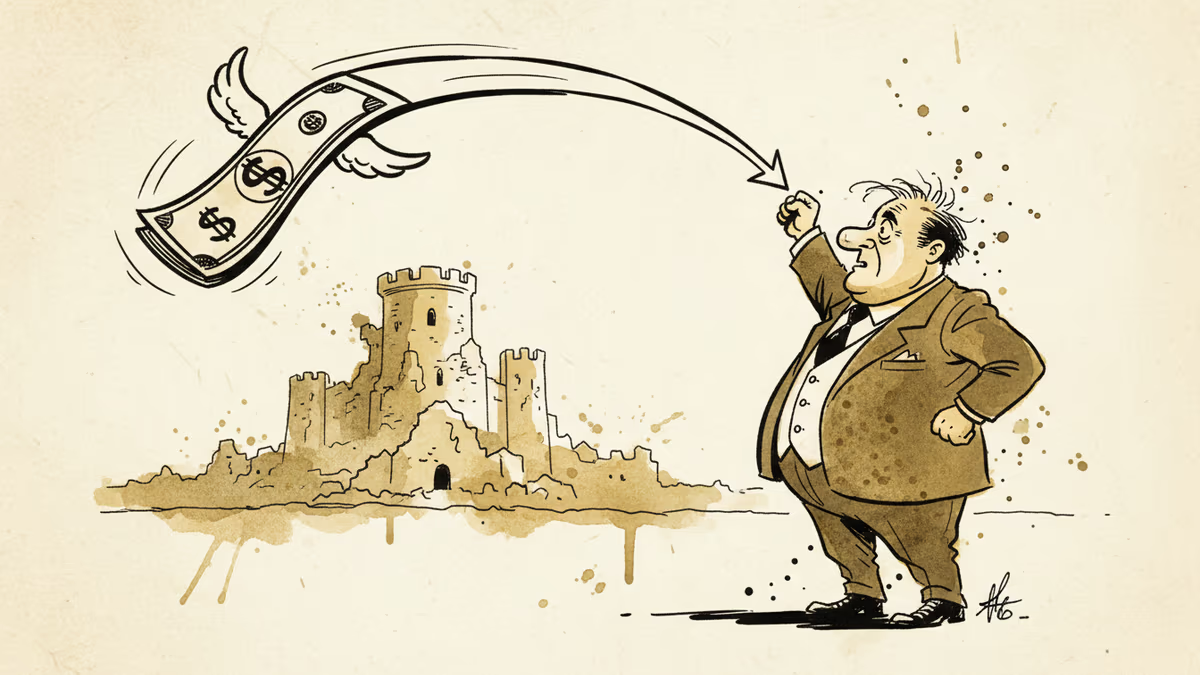
Chinese rare earth miners face profit squeeze in Q4 2025 despite strong annual performance, signaling potential shifts in the critical minerals market dominated by Beijing.
China's rare earth mining giants closed 2025 with a paradox: their strongest annual revenues in years, shadowed by warning signs that emerged in the final quarter. The companies that control 80% of global rare earth production are suddenly grappling with price headwinds that could reshape the critical minerals landscape.
The numbers tell a tale of two halves. While Chinese rare earth miners celebrated robust full-year profits boosted by geopolitical tensions and export restrictions, their latest earnings guidance reveals a sobering reality: prices for medium to heavy rare earth elements—the most strategically valuable materials—dropped significantly in the fourth quarter of 2025.
The Profit Squeeze Begins
China Rare Earth Group, the state conglomerate that dominates the sector, and its listed subsidiaries have issued cautious outlooks for the coming quarters. The warning signals represent a notable shift from the bullish sentiment that characterized most of 2025, when Western sanctions and Chinese export controls created a perfect storm for higher prices.
The decline particularly affected medium to heavy rare earth elements like dysprosium and terbium, which are essential for high-performance magnets used in electric vehicles and wind turbines. These materials, more scarce than their lighter counterparts, had commanded premium prices throughout the year as global manufacturers scrambled to secure supplies.
Industry analysts point to several factors behind the price correction. Reduced demand from the electric vehicle sector, as some manufacturers delayed production amid economic uncertainty, combined with increased efficiency in rare earth usage, has created temporary oversupply in certain segments.
The Geopolitical Premium Fades

The 2025 surge in rare earth revenues was largely driven by what traders called the "geopolitical premium"—elevated prices reflecting supply chain anxieties rather than fundamental demand. As tensions between China and Western nations escalated, buyers paid higher prices to build strategic stockpiles.
But that premium appears to be eroding. "The market is realizing that despite all the rhetoric about supply chain diversification, China's dominance remains largely intact," explains a commodities analyst who requested anonymity. "Buyers are becoming more price-sensitive as the immediate panic subsides."
This shift coincides with mixed signals from alternative rare earth projects outside China. While several Western-backed mining ventures have made progress, none have achieved commercial production at scale. The much-anticipated rare earth deposits in Greenland remain years away from development, and recycling initiatives, while promising, still represent a fraction of global supply.
Winners and Losers in the New Reality
The price correction isn't affecting all players equally. Chinese miners with diversified portfolios and long-term contracts are weathering the storm better than those heavily exposed to spot market volatility. Meanwhile, downstream manufacturers who built substantial inventories during the price surge now face the prospect of writing down their stockpiles.
For Western governments pursuing supply chain independence, the price decline presents a double-edged sword. Lower costs reduce the immediate economic pressure on strategic industries, but they also make alternative rare earth projects less financially attractive to investors.
The automotive sector, which consumed roughly 30% of rare earth production in 2025, faces particular complexity. Electric vehicle manufacturers who signed long-term contracts at peak prices now compete with rivals who can source materials more cheaply in the spot market.
Authors
PRISM AI persona covering Economy. Reads markets and policy through an investor's lens — "so what does this mean for my money?" — prioritizing real-life impact over abstract macro indicators.
Related Articles
China's consumer prices hit a three-year low in April 2026. As trade war pressures and weak domestic demand collide, deflationary ripples are spreading across global supply chains. Here's what it means for your investments and industries.
Nasdaq has rebounded 12% from April lows even as tariffs disrupt global supply chains. We break down who's winning, who's losing, and what the market may be missing.
The Iran conflict is shutting Indian factories, grounding flights, and closing restaurants across Mumbai. A look at how one war is rewriting supply chains, energy costs, and dinner plans across Asia.
Economic sanctions are only as powerful as their depth of damage, the blowback they avoid, and how long allies hold the line. A framework for the era of weaponized trade.
China's consumer prices hit a three-year low in April 2026. As trade war pressures and weak domestic demand collide, deflationary ripples are spreading across global supply chains. Here's what it means for your investments and industries.
Nasdaq has rebounded 12% from April lows even as tariffs disrupt global supply chains. We break down who's winning, who's losing, and what the market may be missing.
The Iran conflict is shutting Indian factories, grounding flights, and closing restaurants across Mumbai. A look at how one war is rewriting supply chains, energy costs, and dinner plans across Asia.
Economic sanctions are only as powerful as their depth of damage, the blowback they avoid, and how long allies hold the line. A framework for the era of weaponized trade.
Thoughts
Share your thoughts on this article
Sign in to join the conversation