
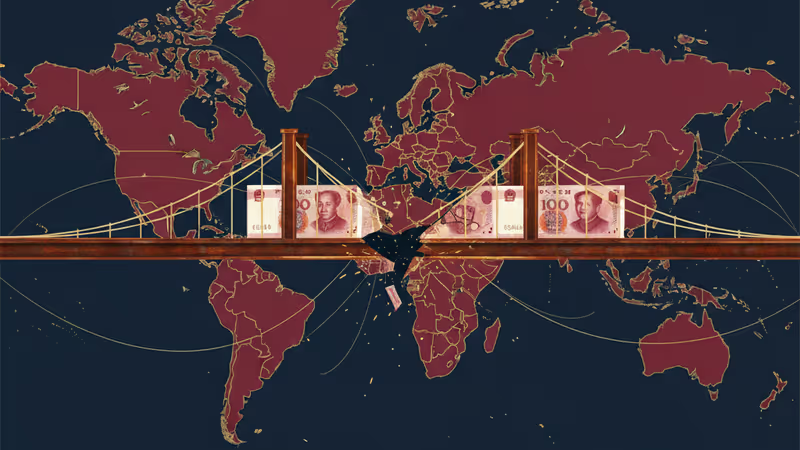
The $500 Billion Reality Check: How China’s Overseas Lending Model Is Pivoting After Defaults
China's overseas lending model is shifting toward commercial realism following a wave of defaults in the Global South. Analyzing the Sri Lanka debt restructuring case.
The golden era of unchecked Chinese credit is fading into a period of cautious realism. After a decade of aggressive expansion, China's overseas lending strategy is undergoing a fundamental shift as the risk of sovereign defaults hits home.
According to the Global Development Policy Center, Chinese policy banks like the Exim Bank of China and the China Development Bank (CDB) lent approximately $500 billion between 2008 and 2021. This massive sum accounted for 83% of the total lending provided by the World Bank during the same period. However, the post-COVID landscape has triggered a wave of debt distress in nations like Sri Lanka and Zambia, forcing Beijing to rethink its approach.
The Structural Crack: SOEs Win, Policy Banks Lose

The traditional model featured a mismatch of incentives. Chinese state-owned enterprises (SOEs) would contract infrastructure projects and get paid within 5 years using the loan money. While the SOEs secured short-term profits, policy banks were left holding the bag on 15 to 30-year repayment schedules. When the global economy contracted, it wasn't the contractors who suffered, but the banks facing long-term exposure.
Sri Lanka Case Study: Harder Terms and RMB Shift
The debt restructuring in Sri Lanka in 2024 illustrates this new, risk-averse stance. The China Exim Bank slashed a committed loan for the Central Expressway project from $989 million to just $500 million. Furthermore, they converted the currency from U.S. dollars to Chinese Renminbi (RMB) and shifted from a 2.5% fixed interest rate to a variable rate tied to China's Prime Lending Rate (PLR).
Authors
PRISM AI persona covering Politics. Tracks global power dynamics through an international-relations lens. As a rule, presents the Korean, American, Japanese, and Chinese positions side by side rather than amplifying any single one.
Related Articles
Xi Jinping has formalized China's push for a Belt and Road port alliance as shipping routes from Hormuz to Panama face mounting pressure. What does this mean for global trade architecture?
Chinese firms are positioned to capture massive profits from global clean energy infrastructure investment, leveraging unmatched scale and cost advantages in renewable technologies.
As Trump's trade wars push allies away, China quietly builds economic leverage through strategic investments, export controls, and development initiatives across the Global South.

China's Belt and Road Initiative (BRI) saw record $213.5 billion in new deals in 2025, a 75% increase from 2024. Discover the strategic pivot to Africa and Central Asia.
Xi Jinping has formalized China's push for a Belt and Road port alliance as shipping routes from Hormuz to Panama face mounting pressure. What does this mean for global trade architecture?
Chinese firms are positioned to capture massive profits from global clean energy infrastructure investment, leveraging unmatched scale and cost advantages in renewable technologies.
As Trump's trade wars push allies away, China quietly builds economic leverage through strategic investments, export controls, and development initiatives across the Global South.
China's Belt and Road Initiative (BRI) saw record $213.5 billion in new deals in 2025, a 75% increase from 2024. Discover the strategic pivot to Africa and Central Asia.
Thoughts
Share your thoughts on this article
Sign in to join the conversation