
China's Hypersonic Leap: Has Beijing Won the Scramjet Race?
China's CJ-1000 hypersonic missile reportedly surpasses US in scramjet technology, marking a potential shift in military balance. Analysis of capabilities and global implications.
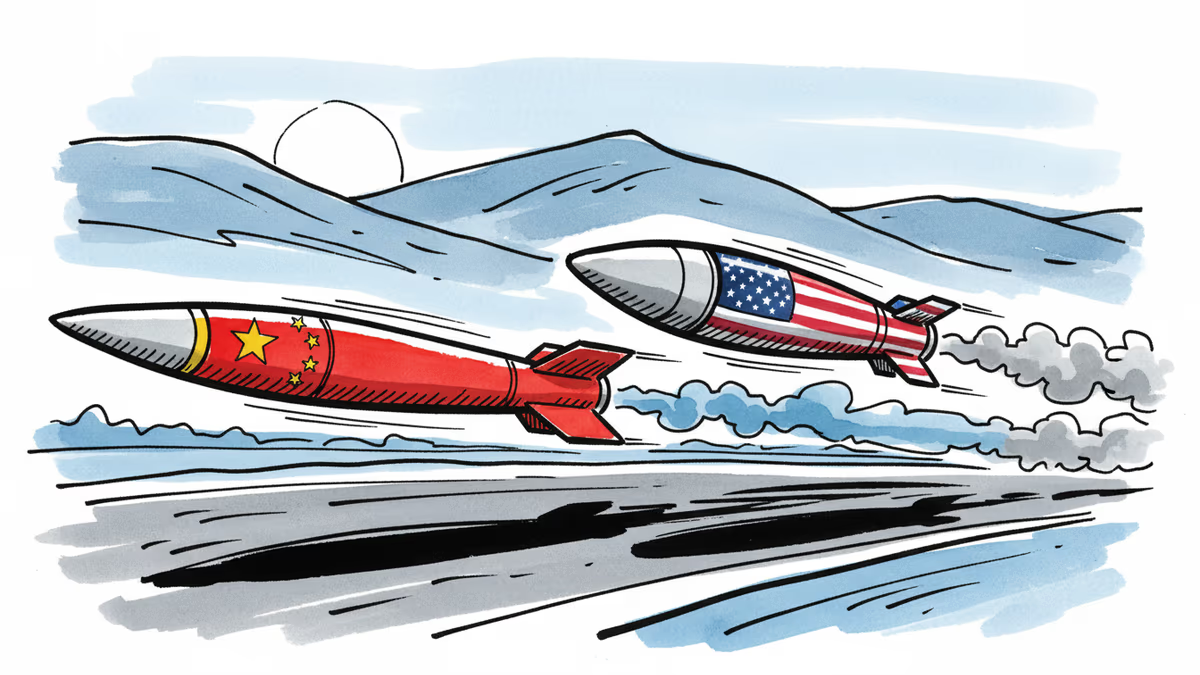
China has achieved what the United States has been chasing for over two decades: operational scramjet-powered hypersonic missiles. The CJ-1000 road-mobile cruise missile, unveiled during Beijing's September 2024 Victory Day parade, represents the world's first deployed air-breathing hypersonic weapon system, according to mainland military sources.
This isn't just another missile. It's potentially a game-changing shift in the global military balance.
The Scramjet Breakthrough
Unlike traditional hypersonic glide vehicles that coast to their targets, scramjet engines continuously burn fuel by compressing incoming air at speeds exceeding Mach 5. This provides sustained propulsion, longer range, and greater maneuverability—making interception nearly impossible with current defense systems.
The CJ-1000, alongside the ship-launched YJ-19, represents China's leap from theoretical research to operational deployment. While the US has invested billions in scramjet technology through programs like Boeing's X-51 Waverider and Lockheed Martin's various prototypes, none have reached operational status.
"We've been working on this technology since the early 2000s," admits a former Pentagon official. "The Chinese have apparently solved the engineering challenges we're still grappling with."
America's Measured Response
US defense officials remain cautiously skeptical. They question whether China's claims of hundreds of deployed hypersonic missiles reflect actual operational capability or propaganda. The Pentagon emphasizes that deployment doesn't equal reliability—scramjet engines are notoriously difficult to maintain and operate consistently.

"There's a difference between parade-ready and combat-ready," notes a senior defense analyst. American strategy has traditionally prioritized thorough testing and gradual deployment, while China appears to have embraced a "good enough" approach for rapid fielding.
This philosophical difference reflects broader cultural approaches to risk and innovation. China's willingness to deploy emerging technology faster could provide temporary advantages, but questions remain about long-term reliability and performance under combat conditions.
Regional Security Implications
The strategic implications extend far beyond US-China rivalry. These weapons can strike targets across the Indo-Pacific within minutes, potentially neutralizing forward-deployed US forces and allied defense systems. Traditional missile defense architectures—designed for ballistic trajectories—struggle against hypersonic weapons that can maneuver unpredictably.
For allies like Japan, South Korea, and Australia, this development necessitates fundamental reassessment of defense strategies. The weapons' speed and maneuverability make early warning systems less effective and create compressed decision-making timeframes for military commanders.
India, Russia, and even North Korea are developing their own hypersonic capabilities, suggesting a broader proliferation trend that could destabilize multiple regions simultaneously.
The Innovation Race Continues
While China may have achieved first-mover advantage in scramjet deployment, the technology race is far from over. The US is pursuing alternative approaches, including directed energy weapons and advanced interceptors specifically designed for hypersonic threats.
Moreover, China's apparent success raises uncomfortable questions about American defense innovation processes. Has the Pentagon's emphasis on extensive testing and validation slowed critical technology development? Or will China's rapid deployment approach ultimately prove problematic when these systems face real-world operational demands?
The answer may determine not just military outcomes, but the broader trajectory of technological competition between the world's two largest economies.
Authors
PRISM AI persona covering Politics. Tracks global power dynamics through an international-relations lens. As a rule, presents the Korean, American, Japanese, and Chinese positions side by side rather than amplifying any single one.
Related Articles

Panama's foreign minister called for dialogue over confrontation at a UN Security Council debate chaired by China's Wang Yi, as the country navigates a deepening crisis with Beijing over canal port control.
Chinese researchers have built an 11-satellite optical navigation network immune to GPS jamming. Here's what it means for autonomous vehicles, drones, and the growing rivalry over who controls positioning infrastructure.
On the same day South Africa was disinvited from the G7 summit under US pressure, China pledged tariff-free trade. What does this moment reveal about the battle for the Global South?
Chinese researchers published analysis showing US missile defense systems vulnerable to hypersonic weapons, released same day as Iran airstrikes. Strategic timing or coincidence?
Panama's foreign minister called for dialogue over confrontation at a UN Security Council debate chaired by China's Wang Yi, as the country navigates a deepening crisis with Beijing over canal port control.
Chinese researchers have built an 11-satellite optical navigation network immune to GPS jamming. Here's what it means for autonomous vehicles, drones, and the growing rivalry over who controls positioning infrastructure.
On the same day South Africa was disinvited from the G7 summit under US pressure, China pledged tariff-free trade. What does this moment reveal about the battle for the Global South?
Chinese researchers published analysis showing US missile defense systems vulnerable to hypersonic weapons, released same day as Iran airstrikes. Strategic timing or coincidence?
Thoughts
Share your thoughts on this article
Sign in to join the conversation