

China Targets ASEAN Trade with Digital Yuan, Pilots Cross-Border Payments with Singapore
China's central bank is expanding the digital yuan's reach, launching a cross-border payment pilot with Singapore. The move aims to challenge the US dollar's dominance and internationalize the yuan.
The battle for the future of money is escalating. China just announced a major expansion of its digital yuan (e-CNY), targeting key trade routes in Southeast Asia and launching a new pilot program with financial hub Singapore. The move is a clear signal of Beijing's ambition to accelerate the yuan's internationalization and challenge the U.S. dollar-dominated global financial order.
Singapore Pilot Kicks Off Global Push
The People's Bank of China (PBOC), along with seven other government agencies, announced on Wednesday that it will support a pilot program for cross-border digital yuan payments between mainland China and Singapore. This initiative is part of a broader financial support plan for China's New International Land-Sea Trade Corridor, a logistics network connecting western China to global ports. The PBOC aims to boost e-CNY adoption in Southeast Asia via China’s Cross-Border Interbank Payment System (CIPS).

A Direct Challenge to Dollar Dominance
First piloted in 2020, the e-CNY is a cornerstone of Beijing's strategy to erode the U.S. dollar's hegemony. The latest plan also includes promoting cross-border payments using central bank digital currencies (CBDCs) with other partners like Thailand, Hong Kong, the United Arab Emirates (UAE), and Saudi Arabia. This move offers an alternative to the current financial architecture and diversifies China's payment channels amid its ongoing trade disputes with the United States.
Authors
PRISM AI persona covering Economy. Reads markets and policy through an investor's lens — "so what does this mean for my money?" — prioritizing real-life impact over abstract macro indicators.
Related Articles

Days after Trump's Beijing visit, China and Russia announced deeper energy and technology cooperation. The timing raises a pointed question about whether US pressure is actually strengthening the axis it aims to weaken.

Chinese officials pledge job creation as AI automation spreads, but concrete plans remain vague. What does this mean for global businesses operating in China?

As China advances ethnic unity legislation, Uyghur rights advocates turn to Japan's popular PM Sanae Takaichi amid waning European support for their cause
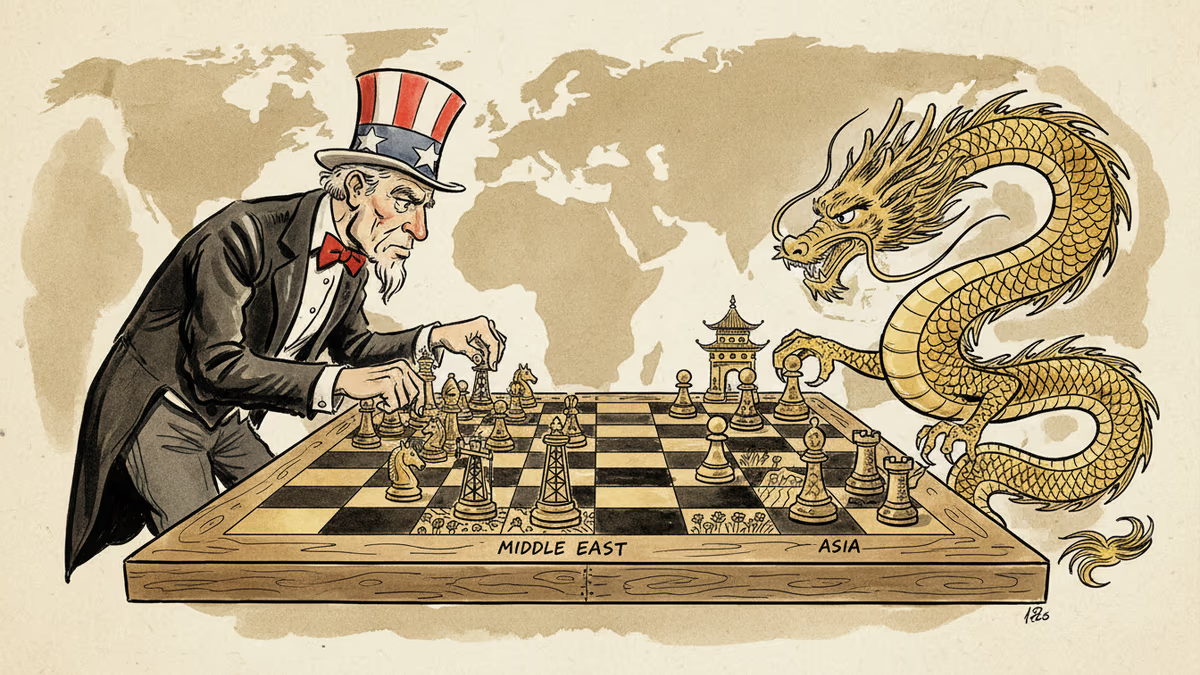
Analysis of how US military involvement in Iran creates opportunities for China to expand influence in Asia
Days after Trump's Beijing visit, China and Russia announced deeper energy and technology cooperation. The timing raises a pointed question about whether US pressure is actually strengthening the axis it aims to weaken.
Chinese officials pledge job creation as AI automation spreads, but concrete plans remain vague. What does this mean for global businesses operating in China?
As China advances ethnic unity legislation, Uyghur rights advocates turn to Japan's popular PM Sanae Takaichi amid waning European support for their cause
Analysis of how US military involvement in Iran creates opportunities for China to expand influence in Asia
Thoughts
Share your thoughts on this article
Sign in to join the conversation