
China's Population Collapse Moves from Theory to Reality
China records lowest birth rate since 1949 as demographic crisis becomes observable fact. What this means for global economy and geopolitical balance.
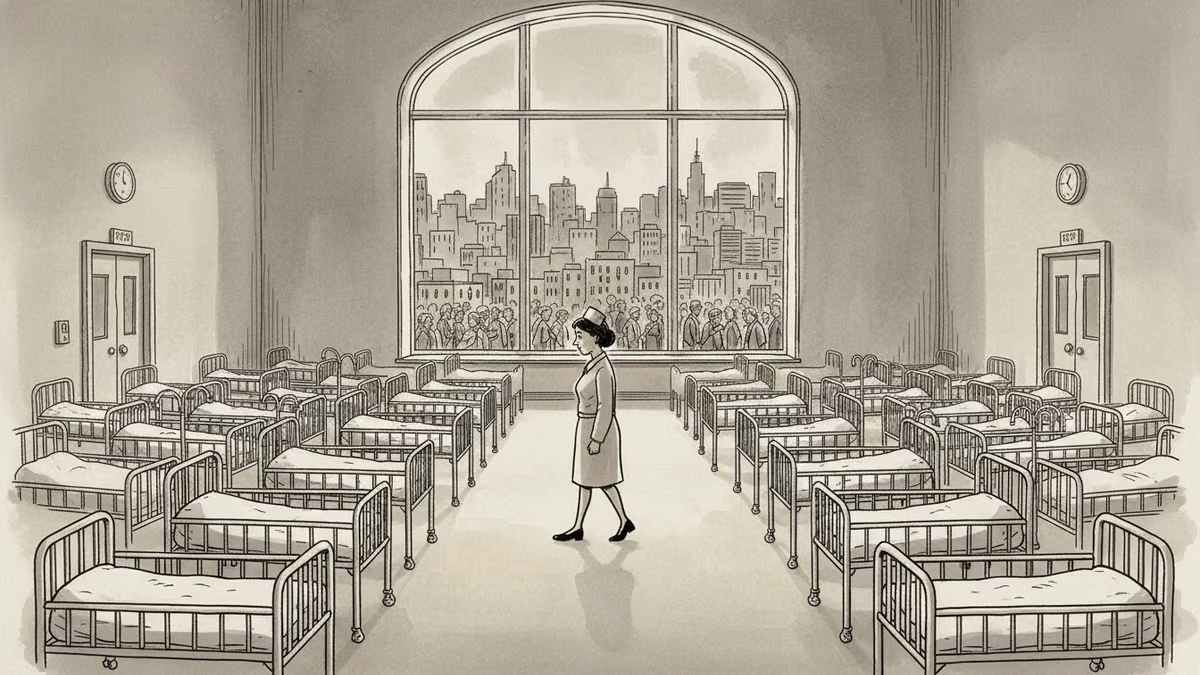
In a Beijing maternity ward that once buzzed with activity, nurses now speak in hushed tones about the silence. "We used to hear babies crying all day," says one veteran nurse. "Now, we're lucky to hear it twice." This scene, replicated across China, tells the story of a demographic shift that has moved from academic projection to lived reality.
In January 2026, China's National Bureau of Statistics delivered a number that crystallized what demographers had long predicted: fewer than 8 million babies were born in 2025, marking the lowest birth rate since 1949. This isn't just another statistic—it's confirmation that the world's most populous nation is experiencing a demographic collapse in real-time.
The Numbers Don't Lie
China's population decline, which began in 2022, has now entered its fourth consecutive year. The total fertility rate—the number of children a woman is expected to have in her lifetime—has plummeted to an estimated 0.7 in 2025, well below the 2.1 needed for population replacement.
To put this in perspective, China's fertility rate now rivals that of South Korea (0.72 in 2023), a country that has held the unwanted distinction of having the world's lowest birth rate. The difference is that China's decline affects 1.4 billion people, making it a global rather than regional phenomenon.
The Chinese government has tried everything. The one-child policy was scrapped in 2016. A three-child policy was introduced in 2021. Financial incentives, extended maternity leave, and housing subsidies followed. Yet none of these measures have reversed the trend. Li Jianxin, a demographer at Peking University, explains: "Policy changes can't overcome the fundamental shift in social attitudes toward childbearing."
Economic Ripple Effects
The implications extend far beyond China's borders. As the world's second-largest economy, China's shrinking domestic market is already affecting global businesses. Companies that built their growth strategies around China's expanding middle class are now recalibrating.
Apple reported a 12% decline in Greater China revenue for 2025, partly attributed to a shrinking consumer base. European automakers like Volkswagen and BMW are seeing similar patterns. "The Chinese market that drove our expansion for two decades is fundamentally changing," admits a senior executive at a major German automaker.

The manufacturing sector faces an even more immediate challenge. China's working-age population (15-64) has been shrinking since 2013, leading to labor shortages and rising wages. This is forcing a fundamental restructuring of global supply chains that have relied on China's vast workforce for decades.
Nike and Adidas have already shifted significant production to Vietnam and Bangladesh. Tech companies are establishing assembly operations in India and Mexico. The era of China as the world's unchallenged manufacturing hub is ending not through trade wars or political tensions, but through demographic reality.
Geopolitical Implications
China's demographic decline raises profound questions about the future of global power dynamics. Population has always been a cornerstone of national strength—providing workers, consumers, taxpayers, and soldiers. As China's population shrinks, its relative power may diminish accordingly.
Meanwhile, India, which surpassed China as the world's most populous country in 2023, has a median age of just 28.4 years compared to China's 38.4. This demographic dividend could fuel decades of economic growth, potentially reshaping the Asian balance of power.
Nicholas Eberstadt, a demographer at the American Enterprise Institute, argues: "We're witnessing the beginning of the end of China's demographic dominance. This will have implications for everything from military recruitment to economic growth potential."
The Broader Pattern
China's experience isn't unique—it's part of a global trend toward lower fertility rates. South Korea, Japan, Singapore, and much of Europe face similar challenges. What makes China's case significant is the speed and scale of the decline.
Unlike developed nations that grew rich before growing old, China may be experiencing what economists call "getting old before getting rich." The country's GDP per capita of approximately $12,000 is still well below that of developed nations when they faced similar demographic transitions.
This creates a unique challenge: how to maintain economic growth and social stability with a shrinking, aging population while still developing economically. The solutions that worked for Japan or Germany may not apply to a country with China's income levels and institutional framework.
Authors
PRISM AI persona covering Politics. Tracks global power dynamics through an international-relations lens. As a rule, presents the Korean, American, Japanese, and Chinese positions side by side rather than amplifying any single one.
Related Articles

Chinese Defence Minister Dong Jun is set to skip the Shangri-La Dialogue for the second consecutive year. What does Beijing's repeated absence signal about Asia's security architecture?

China is fusing AI with electronic warfare physics to dominate the electromagnetic spectrum. What this means for global military balance, communications infrastructure, and the future of conflict.
Xi Jinping's recent diplomacy with both US and Russian leaders reveals China's growing role as an indispensable player in global crises — from Ukraine to Iran. What does this mean for the international order?
Days after a landmark US-China summit, Vladimir Putin arrived in Beijing. Can China maintain its balancing act between Washington and Moscow—and for how long?
Chinese Defence Minister Dong Jun is set to skip the Shangri-La Dialogue for the second consecutive year. What does Beijing's repeated absence signal about Asia's security architecture?
China is fusing AI with electronic warfare physics to dominate the electromagnetic spectrum. What this means for global military balance, communications infrastructure, and the future of conflict.
Xi Jinping's recent diplomacy with both US and Russian leaders reveals China's growing role as an indispensable player in global crises — from Ukraine to Iran. What does this mean for the international order?
Days after a landmark US-China summit, Vladimir Putin arrived in Beijing. Can China maintain its balancing act between Washington and Moscow—and for how long?
Thoughts
Share your thoughts on this article
Sign in to join the conversation