
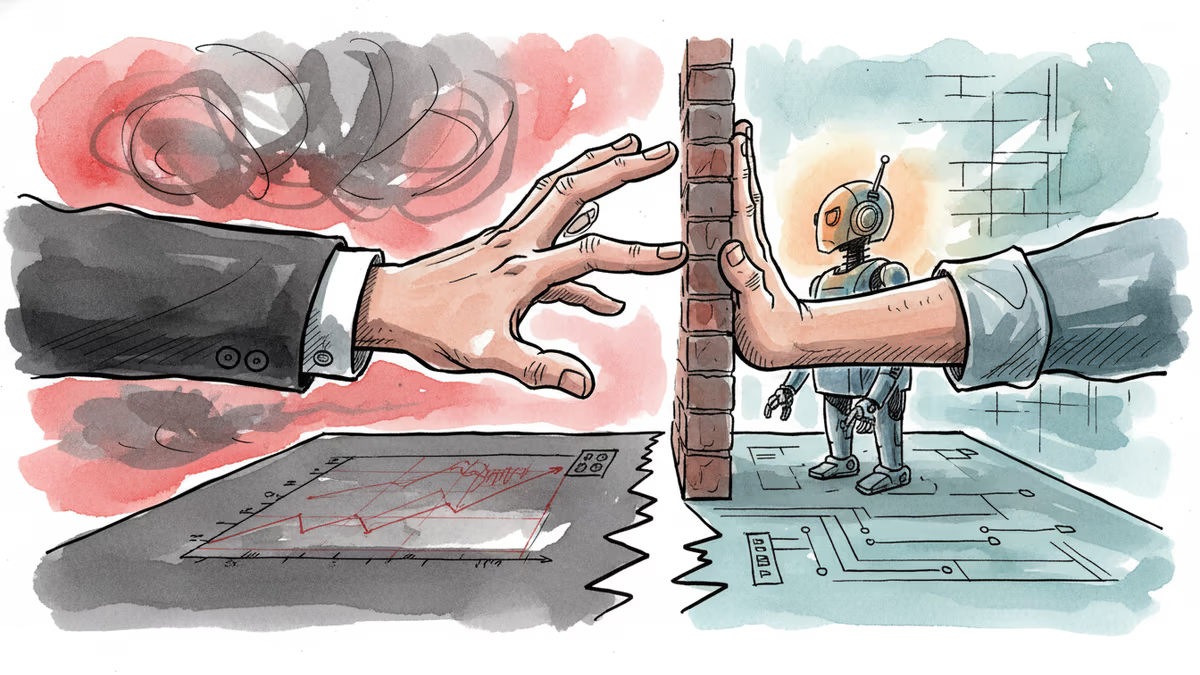
China Blocked Meta's AI Deal. Then Explained It Wasn't a Block.
Beijing stopped Meta from acquiring Chinese AI startup Manus, then state media called it not a restriction on foreign investment. The contradiction reveals everything about AI geopolitics in 2026.
China blocked an American tech giant from buying one of its most promising AI startups. Then state media said it wasn't a block. That contradiction is worth sitting with.
What Happened
Meta moved to acquire Manus, a Chinese AI startup that drew serious attention earlier this year for its autonomous agent capabilities—software that can browse the web, write code, manage files, and coordinate external services without human prompting. Beijing effectively stopped the deal from going through.
The response from Chinese state media was swift and carefully worded. Yuyuan Tantian, the influential social media account run by state broadcaster CCTV, published a commentary Wednesday framing the decision in notably measured terms: this should not be seen as a restriction on foreign investment, it said. What the Manus situation reveals, the account argued, is that "the AI industry is transcending simple commercial logic." Chinese AI companies were advised to "go global when ready" and "pursue partnerships where appropriate."
The language is diplomatic. The implication is anything but.
Why This Deal, Why Now
Manus isn't a chatbot. AI agents—systems capable of executing multi-step tasks autonomously across real software environments—are widely considered the next competitive frontier in AI. OpenAI, Google, and Anthropic are all pouring resources into agent development. When Manus published demos earlier this year, the response from the global AI research community was unusually enthusiastic.

Meta's interest makes sense in this context. The company has committed to spending $60–65 billion on AI in 2025 alone, and acquiring a capable agent startup would compress years of development time. Absorbing Manus would have been a significant shortcut.
Beijing's calculus runs the opposite direction. If Manus's technology transfers to a US company, China loses a competitive asset it helped cultivate—and as AI agents embed deeper into enterprise workflows, who controls that technology stops being a business question and starts being a security one. State media's admission that AI "transcends commercial logic" is a roundabout acknowledgment of exactly that.
Three Ways to Read This
From Beijing's perspective, this is consistent policy, not improvisation. China has been designating strategic technologies—semiconductors, batteries, drones—as off-limits to foreign acquisition for years. The Manus decision extends that logic to AI agents. It also mirrors what the US has been doing for some time: CFIUS has blocked or unwound Chinese acquisitions of American tech companies repeatedly over the past decade. Beijing is applying a framework the West invented.
From Meta and Western companies' perspective, the asymmetry is hard to ignore. Chinese AI firms can expand globally with relatively few structural barriers, while foreign companies face not just acquisition restrictions in China but often outright service bans. State media's advice to Chinese firms to "go global when ready" lands differently when read against that backdrop—it's an invitation extended in one direction only.
From the AI research community's perspective, there's an unexpected wrinkle. When Manus first went public, researchers wanted access to its methods and architecture. Had the acquisition gone through, that technology would likely have been absorbed into Meta's comparatively closed research environment. The block may have inadvertently preserved more openness than the deal would have. That's not an argument for the policy—but it complicates the clean narrative of openness versus restriction.
The Investors' Dilemma
For anyone watching AI deal flow, this raises a structural question that won't go away. If Chinese AI startups are increasingly off-limits to Western acquirers, and Chinese firms can still expand westward, the M&A landscape becomes fundamentally asymmetric. That affects valuations, due diligence calculus, and where venture capital flows in the first place.
It also creates a peculiar incentive: Chinese AI founders who want acquisition exits may face pressure to list domestically or find state-affiliated partners rather than pursue the highest global bid. Whether that produces better or worse technology outcomes is genuinely unclear—but it does change who benefits from the upside.
This content is AI-generated based on source articles. While we strive for accuracy, errors may occur. We recommend verifying with the original source.
Related Articles
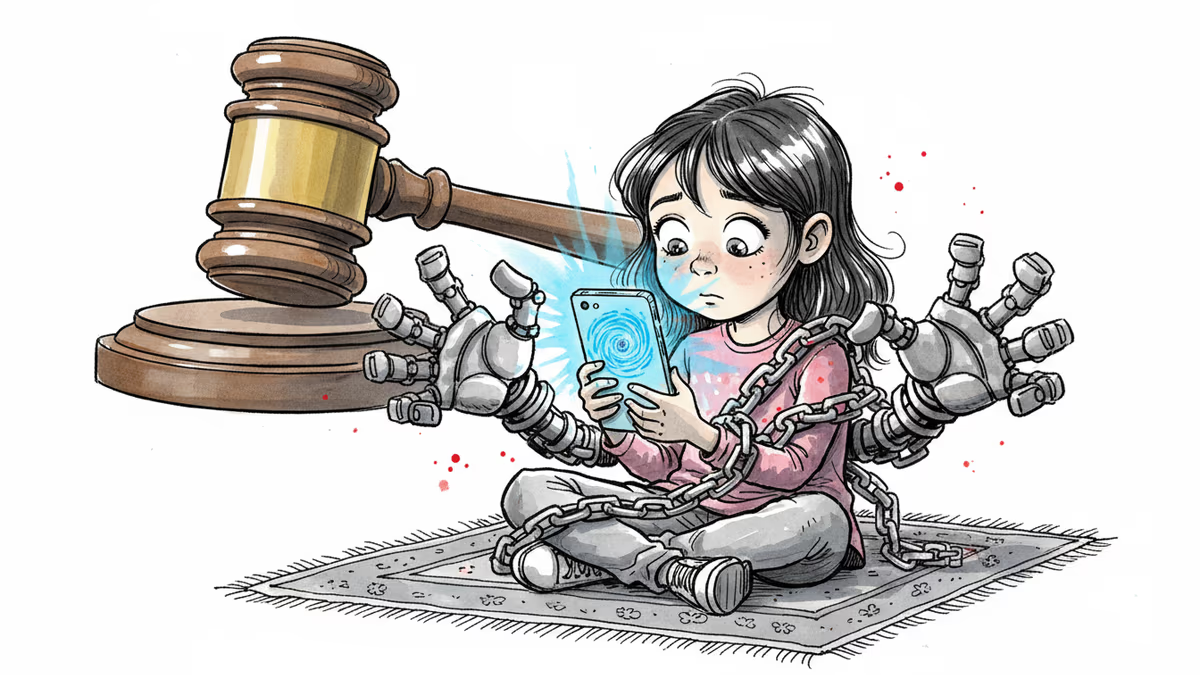
A Los Angeles jury found Meta and YouTube liable for intentionally addicting a child to social media, awarding $6M in damages. What this landmark verdict means for Big Tech, parents, and regulators worldwide.

Meta CEO Mark Zuckerberg testified that Instagram doesn't target children under 13, but internal documents revealed strategies to "bring teens in as tweens." A landmark trial examining social media's impact on youth mental health.
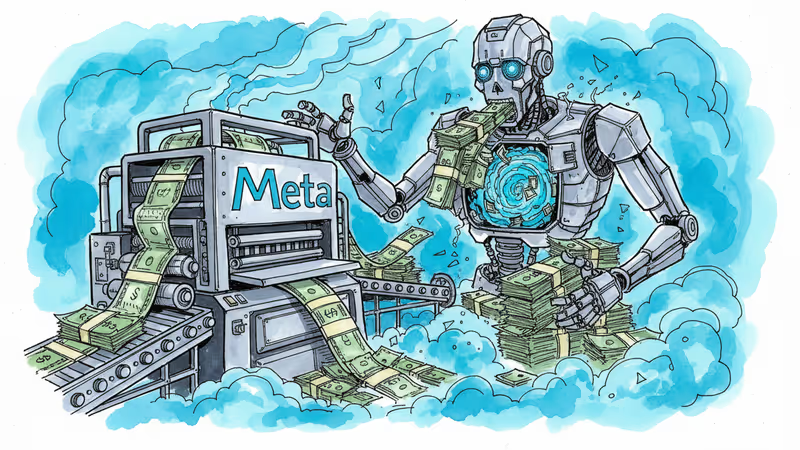
Meta's Q4 results surpassed Wall Street expectations with $59.9B revenue, but 2026 expenses could hit $169B. The social media giant faces a delicate balance between current profits and future AI investments.
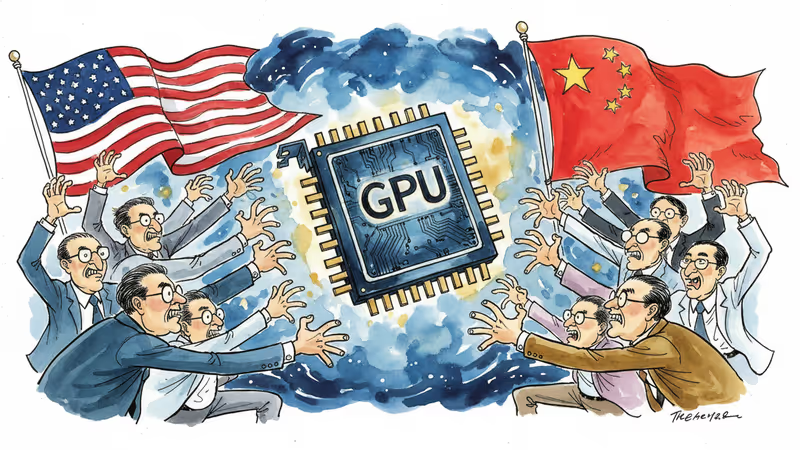
China begins approving Nvidia H200 GPU imports for select companies while maintaining tight control over state-backed firms. This strategic move reshapes US-China AI competition dynamics.
A Los Angeles jury found Meta and YouTube liable for intentionally addicting a child to social media, awarding $6M in damages. What this landmark verdict means for Big Tech, parents, and regulators worldwide.
Meta CEO Mark Zuckerberg testified that Instagram doesn't target children under 13, but internal documents revealed strategies to "bring teens in as tweens." A landmark trial examining social media's impact on youth mental health.
Meta's Q4 results surpassed Wall Street expectations with $59.9B revenue, but 2026 expenses could hit $169B. The social media giant faces a delicate balance between current profits and future AI investments.
China begins approving Nvidia H200 GPU imports for select companies while maintaining tight control over state-backed firms. This strategic move reshapes US-China AI competition dynamics.
Thoughts
Share your thoughts on this article
Sign in to join the conversation