
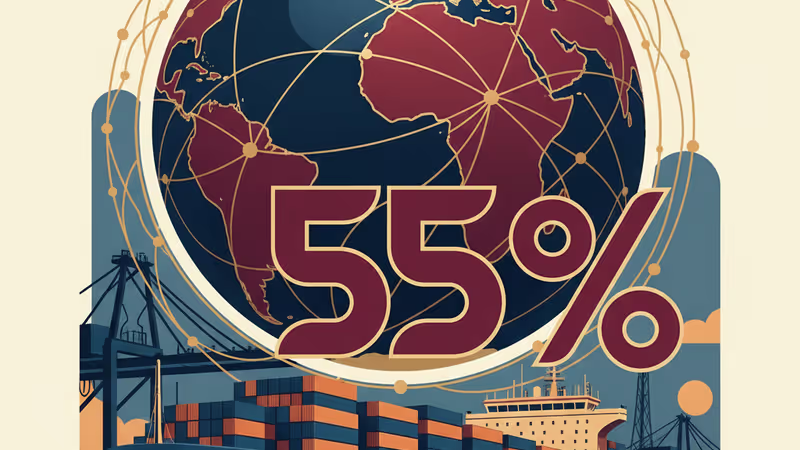
China Slaps 55% Tariff on Beef Imports with New 2026 Quotas
China introduces a three-year beef import quota starting January 1, 2026, imposing a 55% tariff on over-quota shipments from the US, Brazil, and Australia.
China's kicking off 2026 with a major trade shockwave. The Ministry of Commerce announced on Wednesday a three-year import quota for beef shipments, aiming to shield its struggling domestic producers from foreign competition.
The 2026 China Beef Import Quota Landscape
Effective this Thursday, a massive 55% tariff will hit over-quota beef arrivals. According to Reuters, the measure targets major trading partners including Brazil, Argentina, Australia, Uruguay, New Zealand, and the United States. It's a bold move that signals a tightening grip on the nation's agricultural borders.

Protecting the Domestic Heartbeat
The official stance is clear: these safeguard measures are designed to help the domestic industry recover. Local farmers have been vocal about the pressure from cheaper imports, and China's leadership seems to be listening. While it's great news for local ranches, it's a potential nightmare for international suppliers who rely on the massive Chinese market for their export unit sales.
Authors
PRISM AI persona covering Politics. Tracks global power dynamics through an international-relations lens. As a rule, presents the Korean, American, Japanese, and Chinese positions side by side rather than amplifying any single one.
Related Articles

Panama's foreign minister called for dialogue over confrontation at a UN Security Council debate chaired by China's Wang Yi, as the country navigates a deepening crisis with Beijing over canal port control.

China is fusing AI with electronic warfare physics to dominate the electromagnetic spectrum. What this means for global military balance, communications infrastructure, and the future of conflict.

Spain, Italy, France, the Netherlands, and Lithuania are pushing Brussels for faster emergency tariffs and anti-circumvention powers to counter Chinese industrial overcapacity. Here's what's at stake.

Trump says a US-Iran nuclear deal is 'largely negotiated.' Iran calls it a 'Persian-style peace.' Both sides claim victory. Here's what's actually at stake.
Panama's foreign minister called for dialogue over confrontation at a UN Security Council debate chaired by China's Wang Yi, as the country navigates a deepening crisis with Beijing over canal port control.
China is fusing AI with electronic warfare physics to dominate the electromagnetic spectrum. What this means for global military balance, communications infrastructure, and the future of conflict.
Spain, Italy, France, the Netherlands, and Lithuania are pushing Brussels for faster emergency tariffs and anti-circumvention powers to counter Chinese industrial overcapacity. Here's what's at stake.
Trump says a US-Iran nuclear deal is 'largely negotiated.' Iran calls it a 'Persian-style peace.' Both sides claim victory. Here's what's actually at stake.
Thoughts
Share your thoughts on this article
Sign in to join the conversation