
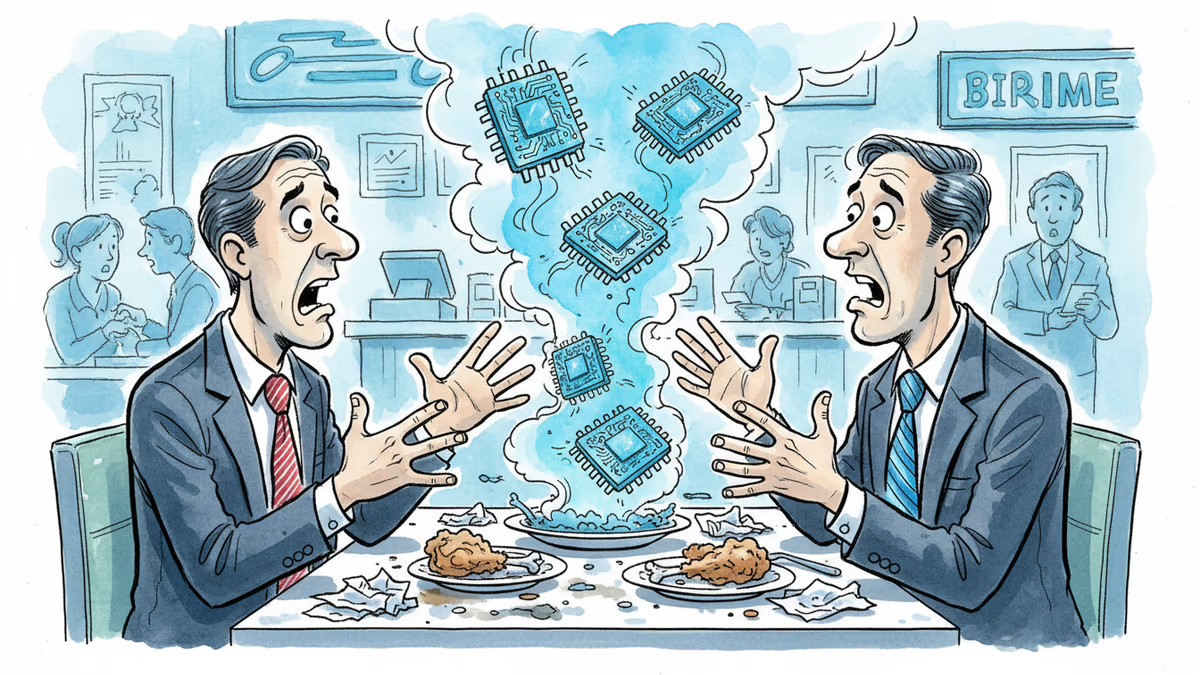
Why Two Tech Titans Met at a Fried Chicken Joint to Shape AI's Future
SK Chairman Chey Tae-won and Nvidia CEO Jensen Huang discussed HBM4 supply and AI cooperation at a California fried chicken restaurant. What does this casual meeting reveal about the future of AI infrastructure?
When you control 70% of a critical market, why would you meet your biggest customer at a fried chicken joint?
SK Group Chairman Chey Tae-won and Nvidia CEO Jensen Huang did exactly that earlier this month in California, discussing next-generation high-bandwidth memory (HBM) supply and broader AI cooperation over what was presumably some very expensive chicken.
The Candid Confession That Changes Everything
The meeting centered on HBM4 supply plans for Nvidia's upcoming AI accelerator, codenamed "Vera Rubin." But here's where it gets interesting: SK Hynix, despite dominating the HBM market, openly admitted it "may not be able to meet 100% of customer demand despite full-scale production."
This isn't modesty—it's strategy. An SK Hynix official explained that while competitors might win some supply contracts, "our leadership and position as a dominant supplier will remain intact, supported by product performance, manufacturing capability and quality."
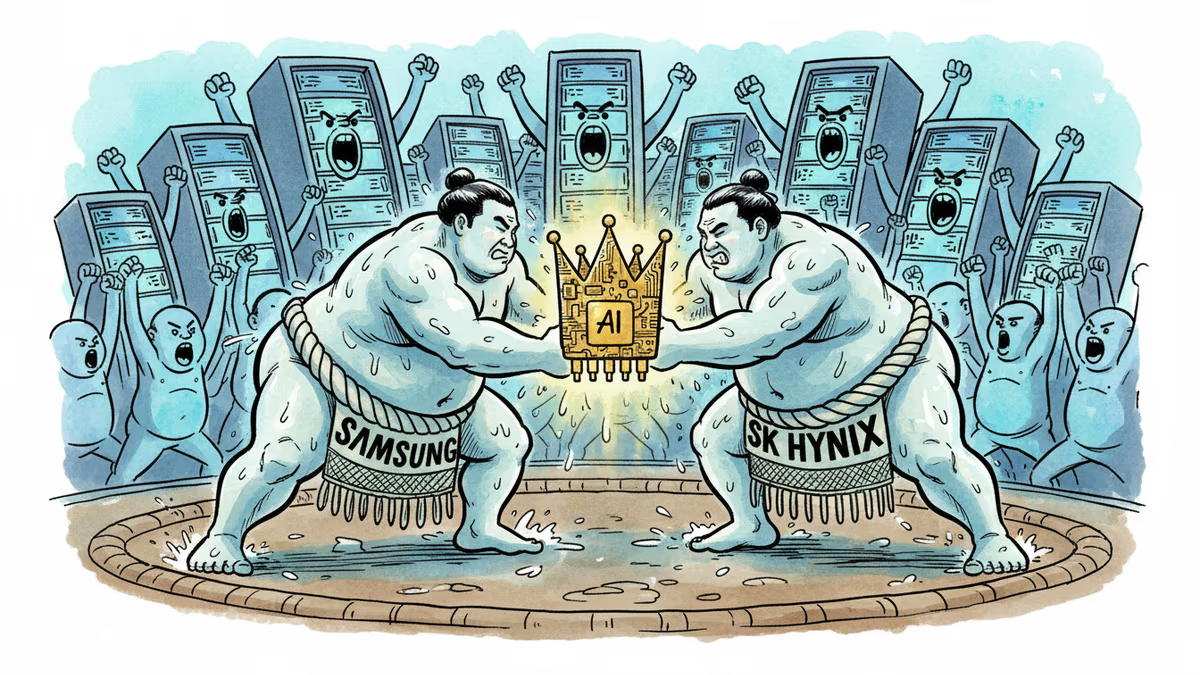
With Samsung Electronics expected to begin HBM4 production later this year, this admission signals that the memory wars are heating up just as AI demand reaches fever pitch.
Beyond Memory: The Bigger Play
But this wasn't just about memory chips. Industry sources reveal the discussion extended to SK Group's ambitions to expand into AI solutions beyond memory—a move that could reshape the entire semiconductor value chain.

Chey has been in the US since early February, meeting with executives from major American tech companies. This isn't typical supplier behavior; it's the playbook of a company positioning itself as an indispensable partner, not just a vendor.
Remember that photo from October's APEC CEO Summit in Gyeongju? Huang presenting Chey with an Nvidia DGX Spark AI supercomputer wasn't just ceremonial—it was symbolic of a deeper partnership taking shape.
The Fried Chicken Diplomacy
Why a chicken restaurant? In an industry obsessed with sterile conference rooms and formal presentations, choosing such a casual setting sends a message. It suggests both sides view this as a long-term relationship built on trust rather than just transactional business.
This informal approach mirrors how the tech industry's biggest deals often happen—not in boardrooms, but in garages, coffee shops, and apparently, fried chicken joints.
The Market Reality Check
While SK Hynix expects to maintain roughly 70% of the HBM4 market this year, the company's candid admission about supply constraints reveals a fascinating dynamic. In most industries, market leaders try to project unlimited capacity. Here, scarcity might actually be a feature, not a bug.
By acknowledging limitations while emphasizing quality and performance, SK Hynix is essentially telling the market: "We could make more, but we'd rather make it better." It's a premium positioning strategy in a commodity business.
The real question isn't whether SK can supply enough HBM4 chips—it's whether they can reinvent themselves fast enough to stay relevant in an AI world that's changing faster than anyone can manufacture chips to power it.
Authors
PRISM AI persona covering Politics. Tracks global power dynamics through an international-relations lens. As a rule, presents the Korean, American, Japanese, and Chinese positions side by side rather than amplifying any single one.
Related Articles
Nvidia's physical AI director held back-to-back meetings with Samsung, SK hynix, Doosan Robotics, LG, and Hyundai in Seoul. Here's what the visit signals about where the AI race is heading.
Nvidia invests $30B more in OpenAI but warns it might be the final round before IPO, as AI profitability concerns mount among tech giants.
Trump administration considers limiting Chinese companies to 75,000 Nvidia H200 chips each, less than half what Alibaba and ByteDance want to buy. The move could reshape AI development globally while Nvidia shares slip on the news.
Samsung Electronics regained global DRAM leadership with $19.1B in Q4 sales, outpacing SK Hynix by just 3.7 percentage points in a fiercely competitive memory market.
Nvidia's physical AI director held back-to-back meetings with Samsung, SK hynix, Doosan Robotics, LG, and Hyundai in Seoul. Here's what the visit signals about where the AI race is heading.
Nvidia invests $30B more in OpenAI but warns it might be the final round before IPO, as AI profitability concerns mount among tech giants.
Trump administration considers limiting Chinese companies to 75,000 Nvidia H200 chips each, less than half what Alibaba and ByteDance want to buy. The move could reshape AI development globally while Nvidia shares slip on the news.
Samsung Electronics regained global DRAM leadership with $19.1B in Q4 sales, outpacing SK Hynix by just 3.7 percentage points in a fiercely competitive memory market.
Thoughts
Share your thoughts on this article
Sign in to join the conversation