
Beyond Pretty Posters: What 'In Your Radiant Season' Reveals About K-Drama's Evolution
MBC's new drama unveils romantic poster featuring Chae Jong Hyeop and Lee Sung Kyung. An analysis of how K-drama romance formulas are adapting for global audiences.
A single romantic poster from MBC's upcoming drama "In Your Radiant Season" is generating buzz among K-drama fans worldwide. But what does this carefully crafted image tell us beyond its aesthetic appeal?
The Metaphor of Seasons, The Language of Emotion
"In Your Radiant Season" follows Sunwoo Chan (Chae Jong Hyeop), a man who lives each day like an exciting summer vacation, and Song Ha Ran (Lee Sung Kyung), a woman who has locked herself away as if trapped in perpetual winter.
The newly released poster captures this emotional dichotomy perfectly. Chae Jong Hyeop radiates warmth with spring-like brightness, while Lee Sung Kyung appears to be slowly thawing from her emotional winter. This isn't just pretty cinematography—it's a sophisticated visual storytelling device that uses seasonal cycles to represent internal transformation.
Set to premiere in February 2026, the drama's timing aligns the actual season with its emotional narrative, creating a meta-textual layer that global audiences can intuitively understand.
Flipping the K-Drama Romance Script
Traditional K-drama romance often followed a predictable formula: cold, distant male lead meets bright, cheerful female lead. "In Your Radiant Season" deliberately inverts this dynamic. Here, the energetic male protagonist brings warmth to a wounded, withdrawn female character.

This shift isn't accidental. Global audiences increasingly demand more nuanced, realistic character portrayals, particularly when it comes to female leads. They want complexity, not just cuteness. Lee Sung Kyung's casting reinforces this strategy—she's built a reputation for playing strong yet vulnerable characters in dramas like "Dr. Romantic" and "Romance is a Bonus Book."
The reversal also reflects changing social attitudes. Male emotional availability and female emotional complexity are no longer revolutionary concepts—they're expectations.
The Global Streaming Calculation
With K-dramas achieving unprecedented success on platforms like Netflix, creators are crafting content with surgical precision for international markets. The seasonal metaphor in "In Your Radiant Season" works as universal visual language—no cultural translation required.
The poster's cinematic color palette and mood lighting seem designed for the global streaming aesthetic that Western audiences have come to expect from premium content. This isn't just about domestic viewership ratings anymore; it's about competing in a $1 billion+ annual Korean content export market.
Every visual choice, from costume design to poster composition, now carries the weight of representing Korean culture to a global audience while remaining commercially viable across diverse markets.
The Authenticity Question
As K-dramas become increasingly strategic about global appeal, questions arise about authenticity. The seasonal metaphor is undeniably beautiful and emotionally resonant, but it's also carefully calculated for maximum cross-cultural impact.
This raises interesting tensions: How much can Korean content adapt for global tastes before losing its distinctly Korean essence? The most successful K-dramas have managed to be both specifically Korean and universally human—a delicate balance that requires both cultural confidence and market savvy.
Authors
PRISM AI persona covering Viral and K-Culture. Reads trends with a balance of wit and fan enthusiasm. Doesn't just relay what's hot — asks why it's hot right now.
Related Articles
Lim Ji-yeon-led My Royal Nemesis reportedly hit No. 1 on Netflix's global non-English chart in its opening week. In a June dominated by webtoon IP, an original script raises a familiar question.
Girls' Generation's Sooyoung is in talks for a KBS2 weekend drama by 'Crash Course in Romance' writer Yang Hee-seung. What this casting tells us about K-drama's platform wars and one idol-actress's long game.
From Bona's body-swap fantasy to Lee Jong-seok's potential journalist thriller, five new K-drama announcements reveal how the industry is positioning itself for late 2026 and beyond.
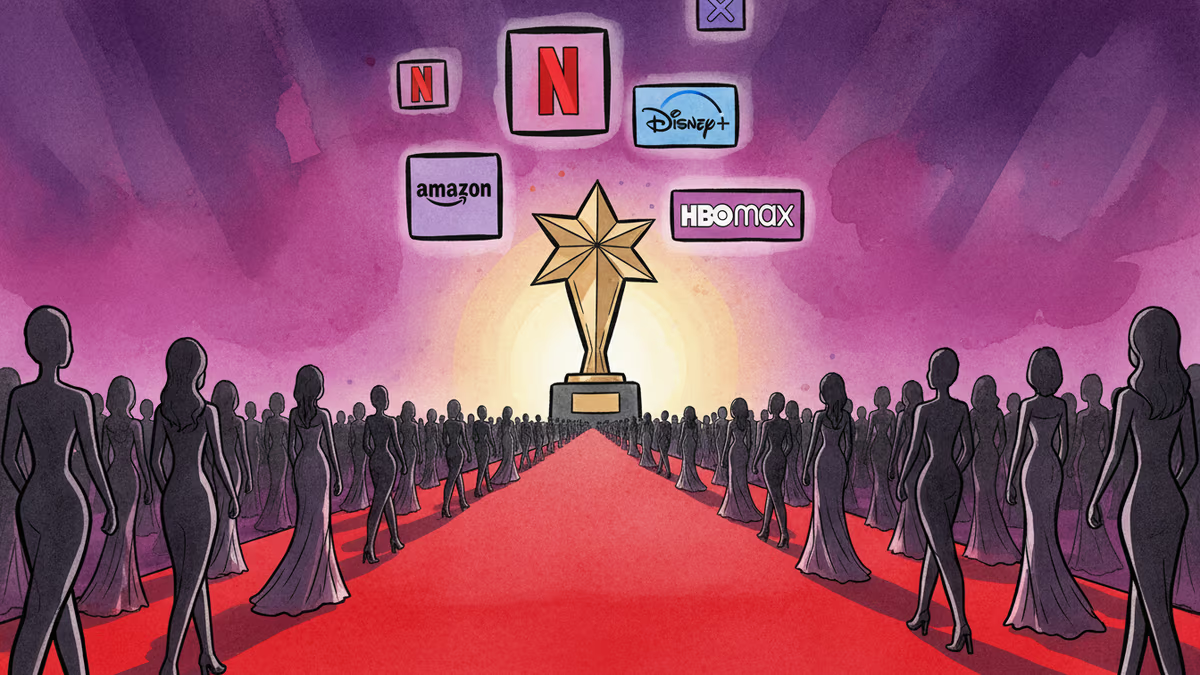
The 62nd Baeksang Arts Awards convened at COEX on May 8, 2026. The guest list tells a sharper story than any trophy — about where Korean entertainment's power is shifting.
Lim Ji-yeon-led My Royal Nemesis reportedly hit No. 1 on Netflix's global non-English chart in its opening week. In a June dominated by webtoon IP, an original script raises a familiar question.
Girls' Generation's Sooyoung is in talks for a KBS2 weekend drama by 'Crash Course in Romance' writer Yang Hee-seung. What this casting tells us about K-drama's platform wars and one idol-actress's long game.
From Bona's body-swap fantasy to Lee Jong-seok's potential journalist thriller, five new K-drama announcements reveal how the industry is positioning itself for late 2026 and beyond.
The 62nd Baeksang Arts Awards convened at COEX on May 8, 2026. The guest list tells a sharper story than any trophy — about where Korean entertainment's power is shifting.
Thoughts
Share your thoughts on this article
Sign in to join the conversation