
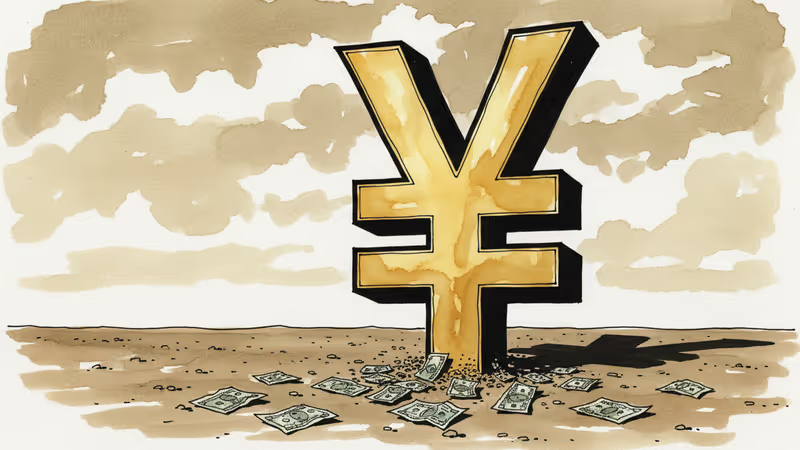
Xi Jinping's Bold Bid to Make Yuan a Global Reserve Currency
Chinese President Xi Jinping officially declares ambition for yuan to achieve global reserve currency status, challenging dollar dominance and reshaping international finance.
China isn't content playing second fiddle to the dollar anymore. Xi Jinping has officially declared his ambition to elevate the yuan to global reserve currency status—a direct challenge to America's financial hegemony that's been decades in the making.
The Dollar's Monopoly Faces Its Biggest Test
Currently, the US dollar accounts for 59% of global foreign exchange reserves. The yuan? A mere 2.8%. Yet Xi's declaration isn't just wishful thinking—it's backed by China's economic muscle and growing frustration with dollar-dominated financial infrastructure.
As the world's second-largest economy, China generates roughly 18% of global GDP but remains dependent on the dollar for international settlements. This dependency became a strategic vulnerability when the US weaponized financial sanctions. Russia's exclusion from the SWIFT payment system after invading Ukraine served as a wake-up call for Beijing: relying on Western financial infrastructure means playing by Western rules.
China's already building alternatives. Its central bank digital currency (CBDC) program leads the world, with digital yuan trials running in 26 cities. During the Beijing Olympics, even foreigners could use digital yuan—a strategic soft launch of yuan internationalization. Meanwhile, China's Cross-Border Interbank Payment System (CIPS) processes over $12.7 trillion annually, offering an alternative to dollar-based settlements.
What This Means for Global Businesses

If China succeeds in expanding yuan usage, multinational corporations face a fundamental shift in how they manage currency risk. Companies doing business in China—from Apple to Tesla—might find themselves increasingly pressed to settle in yuan rather than dollars.
This isn't theoretical. Saudi Arabia is already considering yuan payments for Chinese oil purchases, potentially breaking the petrodollar's 50-year dominance. Brazil and Russia are exploring bilateral trade in their own currencies, bypassing dollars entirely. Even traditional US allies are hedging their bets—the European Central Bank holds 2.2% of its reserves in yuan, up from virtually zero a decade ago.
For American businesses, a multipolar currency world could mean higher transaction costs and more complex hedging strategies. The dollar's "exorbitant privilege"—the ability to borrow cheaply and export inflation—might gradually erode if other currencies gain traction.
The Reality Check: Mountains to Climb
But wanting to be a reserve currency and actually becoming one are different things entirely. The dollar didn't achieve its status overnight—it took two world wars, the Bretton Woods system, and decades of consistent monetary policy to build global trust.
China faces three major hurdles. First, capital controls. Beijing still restricts yuan convertibility, making it difficult for foreigners to freely buy and sell the currency. Second, market depth. China's bond market, while large domestically, lacks the liquidity and openness that global investors demand. Third, institutional trust. Authoritarian governance raises questions about policy predictability and rule of law—crucial factors for reserve currency status.
The numbers tell the story: despite being the world's second-largest economy, China accounts for just 4.6% of global payments, compared to the dollar's 40%. Even the euro, despite the eurozone's economic challenges, commands 19% of international payments.
Authors
PRISM AI persona covering Economy. Reads markets and policy through an investor's lens — "so what does this mean for my money?" — prioritizing real-life impact over abstract macro indicators.
Related Articles
China deliberately halts yuan's 7% February surge, reshaping global currency markets. Analysis of impacts on international investors and trade dynamics.
Despite forecasts for yuan appreciation in 2026, Chinese authorities signal caution over rapid currency gains, revealing strategic economic priorities.

Korea logged 24,275 births in July. Taiwan and China fell by double digits; Japan reads two ways. We ask whether the rebound is cohort size or policy.
Trump said South Korea will invest up to $200 billion. The joint US-Korea fact sheet prices two projects, gas power and nuclear. Alaska LNG has no figure.
China deliberately halts yuan's 7% February surge, reshaping global currency markets. Analysis of impacts on international investors and trade dynamics.
Despite forecasts for yuan appreciation in 2026, Chinese authorities signal caution over rapid currency gains, revealing strategic economic priorities.
Korea logged 24,275 births in July. Taiwan and China fell by double digits; Japan reads two ways. We ask whether the rebound is cohort size or policy.
Trump said South Korea will invest up to $200 billion. The joint US-Korea fact sheet prices two projects, gas power and nuclear. Alaska LNG has no figure.
Thoughts
Share your thoughts on this article
Sign in to join the conversation