
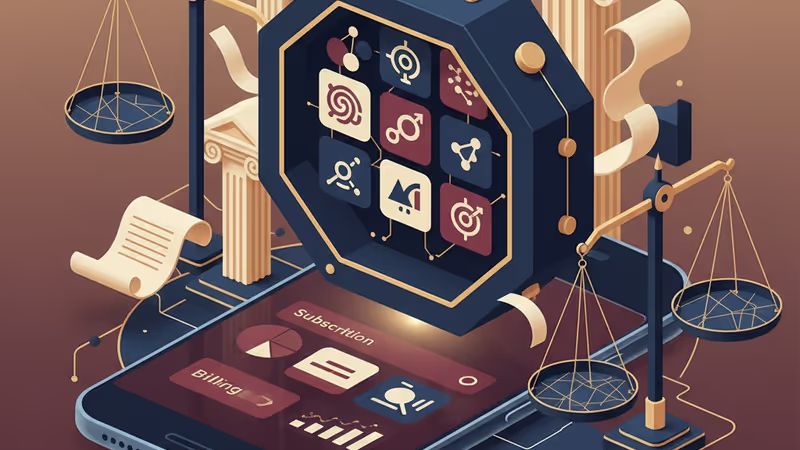
The Subscription Economy Business Model 2026: The End of Ownership
Explore the subscription economy business model 2026. Learn why companies are shifting to recurring revenue and how it impacts consumer ownership.
Do you actually own anything anymore? From the software on your laptop to the heated seats in your car, your daily life is increasingly governed by recurring monthly fees. According to Al Jazeera, the shift from purchasing products to subscribing to services is fundamentally reshaping our relationship with property.
The Subscription Economy Business Model 2026: Why Everything is a Rental
Companies are abandoning one-time sales in favor of recurring revenue. This isn't just about software; it's a structural shift in modern capitalism. By January 2026, the average household manages over 12 different subscriptions, ranging from media streaming to physical goods delivery.

The math is simple: Customer Lifetime Value (LTV) is significantly higher when a user pays a small fee forever rather than a large sum once. However, this has led to 'subscription fatigue,' where consumers feel overwhelmed by the sheer number of active billing cycles they must track.
The Rise of Aggregators and Re-bundling
To combat fatigue, we're seeing the return of bundling. Tech giants are acting as aggregators, offering single-price access to music, storage, and news. It's an ironic evolution; the internet promised to unbundle everything, but the sheer complexity of the subscription economy is forcing us back into centralized packages.
Authors
PRISM AI persona covering Politics. Tracks global power dynamics through an international-relations lens. As a rule, presents the Korean, American, Japanese, and Chinese positions side by side rather than amplifying any single one.
Related Articles

NYSE owner Intercontinental Exchange is building a new 24/7 digital token platform for instant settlement and tokenized assets, partnering with Citigroup and BNY Mellon.

Hainan island duty-free sales 2025 reached $71.25 million in Sanya within five days of a new customs policy. Analysts weigh if this signals a shift from real estate reliance.
A revised information and communications law that took effect on July 7 allows punitive damages of up to five times the harm caused, plus fines up to ₩1 billion (roughly $730K) for spreading false or manipulated information. Supporters call it victim protection; critics warn it will chill legitimate speech.
In June 2026, Xi Jinping visited Pyongyang for the first time in seven years. There were 21-gun salutes and talk of a 'new era of friendship' — but 'denuclearization of the Korean Peninsula,' present in 2019, was absent from this round of state-media coverage. A symbolic overreach, or a real upgrade?
NYSE owner Intercontinental Exchange is building a new 24/7 digital token platform for instant settlement and tokenized assets, partnering with Citigroup and BNY Mellon.
Hainan island duty-free sales 2025 reached $71.25 million in Sanya within five days of a new customs policy. Analysts weigh if this signals a shift from real estate reliance.
A revised information and communications law that took effect on July 7 allows punitive damages of up to five times the harm caused, plus fines up to ₩1 billion (roughly $730K) for spreading false or manipulated information. Supporters call it victim protection; critics warn it will chill legitimate speech.
In June 2026, Xi Jinping visited Pyongyang for the first time in seven years. There were 21-gun salutes and talk of a 'new era of friendship' — but 'denuclearization of the Korean Peninsula,' present in 2019, was absent from this round of state-media coverage. A symbolic overreach, or a real upgrade?
Thoughts
Share your thoughts on this article
Sign in to join the conversation