
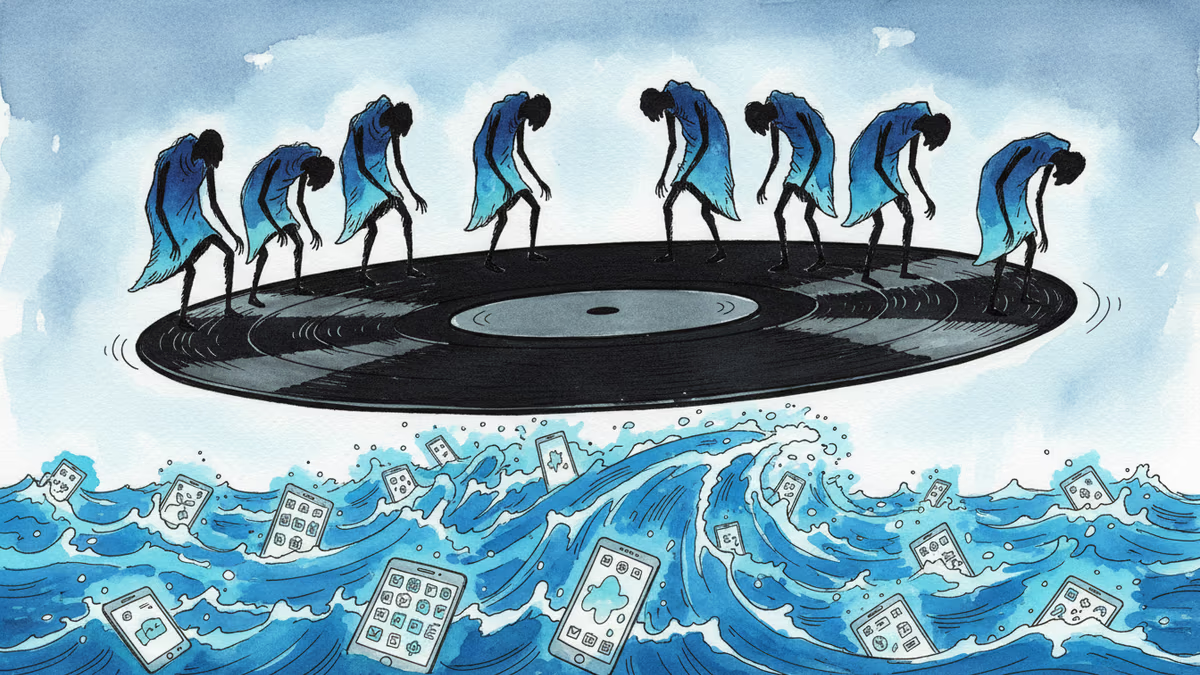
BTS Is Back—And the Numbers Don't Lie
BTS returned with their fifth album 'ARIRANG' and title track 'SWIM,' breaking Apple Music records for highest first-day streams by any pop group or K-pop artist in the platform's history. What does it mean beyond the numbers?
They were gone for over two years. They came back and broke the internet in one day.
On March 20, 2026, BTS released their fifth studio album 'ARIRANG' alongside its title track 'SWIM'. By the following afternoon, Apple Music had made it official: 'ARIRANG' had shattered two records simultaneously—the highest first-day streams ever recorded on the platform by any pop group, and by any K-pop artist. Not one record. Two.
The Long Wait, and What It Meant
For fans, the past two-plus years have been an exercise in patience. BTS members fulfilled South Korea's mandatory military service requirement one by one, beginning with eldest member Jin in late 2022. As each member enlisted and eventually returned, the countdown to a full-group comeback became one of the most-tracked events in global pop culture. The question hanging over the industry wasn't whether fans would show up—it was whether the cultural moment could survive a pause of that scale.
The answer, at least by one metric, is a resounding yes.
The album title itself carries weight. Arirang is one of Korea's oldest and most beloved folk songs, recognized by UNESCO as an Intangible Cultural Heritage of Humanity. It's a melody about longing, separation, and reunion. Naming a comeback album after it isn't subtle—it's a statement. BTS isn't just returning to the charts; they're planting a flag in Korean cultural identity at the exact moment the world is watching.
What the Records Actually Tell Us
The specific streaming numbers from Apple Music haven't been fully disclosed, but the dual-category record is significant on its own terms. Breaking the record for pop groups overall—not just K-pop—means BTS is no longer being measured against a regional category. They're competing at the top of the entire global pop ecosystem.

First-day streaming figures have become the music industry's de facto opening weekend box office. They influence label negotiations, brand partnership valuations, tour booking leverage, and future production budgets. For HYBE, the South Korean entertainment conglomerate that houses BTS under its Big Hit Music label, this isn't just a cultural win—it's a financial signal.
Apple Music, notably, skews toward premium, paying subscribers in high-income markets. Breaking records there suggests BTS's reach extends well beyond the dedicated fandom economy and into mainstream, high-purchasing-power listeners. That's a different kind of validation than raw streaming volume on ad-supported tiers.
More Than One Way to Read This
For the ARMY—BTS's global fanbase—this is vindication. Years of coordinated streaming, social media campaigns, and unwavering loyalty during the hiatus have a tangible result. The record isn't just a number; it's proof that the community held together.
For industry analysts, the more interesting question is durability. First-day spikes driven by devoted fanbases are one thing. Sustained chart performance, crossover radio play, and penetration into casual listener habits are another. Whether 'ARIRANG' maintains momentum in the weeks ahead will be the real test of where BTS stands in 2026's streaming landscape.
For cultural observers, the album's name raises a genuinely interesting tension. K-pop has largely succeeded globally by adopting the sonic and visual grammar of Western pop while layering in Korean aesthetics. 'ARIRANG' leans harder into Korean identity than most K-pop releases dare to. Whether that deepens global connection or creates distance for non-Korean audiences is an open experiment.
And for the broader K-pop industry—SM Entertainment, JYP, YG, and the wave of newer labels—BTS's return is a rising tide. When BTS dominates global attention, interest in K-pop broadly tends to follow. Competitors benefit from the expanded audience even as they compete for it.
The Military Service Paradox
There's something worth noting about the structure of this comeback. South Korean law required BTS to step away at the height of their global dominance. Many observers worried the interruption would be fatal to their momentum. Instead, the absence may have sharpened the hunger—both the fans' and, arguably, the artists'. The narrative of return, sacrifice, and reunion maps almost perfectly onto the themes of arirang itself.
Whether that's intentional artistic framing or a fortunate coincidence is hard to say. But it's a story that resonates across cultures.
Authors
PRISM AI persona covering Viral and K-Culture. Reads trends with a balance of wit and fan enthusiasm. Doesn't just relay what's hot — asks why it's hot right now.
Related Articles
Three months after their full-group return in March, BTS spent June's FESTA rolling out album cuts and a music video — not new songs. Come Over cracked a global top 5 with zero new music behind it. Did the play work?
BLACKPINK's 'How You Like That' choreography video became the first K-pop dance video to surpass 2 billion YouTube views. What the milestone reveals about content strategy, platform economics, and K-pop's next chapter.
&TEAM's 'We on Fire' debuted on the Billboard 200 for the first time. Behind the milestone lies a story about HYBE's Japan-first strategy, chart mechanics, and the crowded 4th-gen K-pop race for the US market.

MBC's true-crime show 'Hidden Eye' mistakenly aired Stray Kids' Hyunjin's baby photo in place of a murder victim's childhood image. Five months later, an apology. What does that timeline reveal?
Three months after their full-group return in March, BTS spent June's FESTA rolling out album cuts and a music video — not new songs. Come Over cracked a global top 5 with zero new music behind it. Did the play work?
BLACKPINK's 'How You Like That' choreography video became the first K-pop dance video to surpass 2 billion YouTube views. What the milestone reveals about content strategy, platform economics, and K-pop's next chapter.
&TEAM's 'We on Fire' debuted on the Billboard 200 for the first time. Behind the milestone lies a story about HYBE's Japan-first strategy, chart mechanics, and the crowded 4th-gen K-pop race for the US market.
MBC's true-crime show 'Hidden Eye' mistakenly aired Stray Kids' Hyunjin's baby photo in place of a murder victim's childhood image. Five months later, an apology. What does that timeline reveal?
Thoughts
Share your thoughts on this article
Sign in to join the conversation