
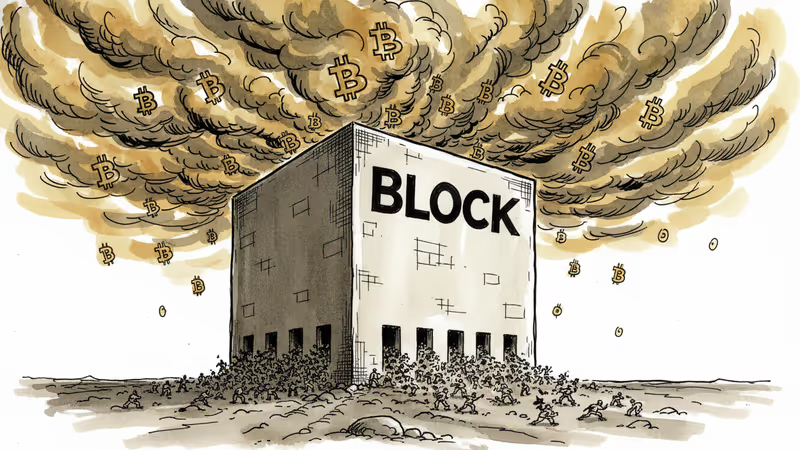
Block Eyes 10% Job Cuts as Bitcoin Bet Faces Reality Check
Jack Dorsey's Block considers cutting up to 10% of workforce amid falling stock price and pressure to prove bitcoin-focused strategy's profitability.
Hundreds of Block employees woke up to unsettling news this week: their jobs are at risk as Jack Dorsey's payments empire considers cutting up to 10% of its workforce. The company behind Cash App and Square is conducting what sources call a "broader business overhaul"—corporate speak for tough decisions ahead.
The Numbers Tell a Stark Story
Block currently employs just under 11,000 people, down from a self-imposed cap of 12,000 set in 2023. A 10% reduction would mean roughly 1,100 jobs disappear. The timing isn't coincidental: shares have tumbled 14% this year alone, following a brutal 23% drop in 2025. Meanwhile, the S&P 500—which Block joined last July—has managed a modest 1.27% gain.
Investors are holding their breath for fourth-quarter earnings on February 26. Wall Street expects adjusted earnings of $403 million, or 68 cents per share—down from 71 cents in the same period last year. For a company that once commanded premium valuations, these numbers represent a sobering reality check.
The Bitcoin Gamble Under Scrutiny
Block's identity crisis runs deeper than typical fintech struggles. Under Dorsey's leadership, the company has transformed from a simple payments processor into a bitcoin evangelism machine. Beyond Cash App and Square, it operates Bitkey (a bitcoin hardware wallet), Proto (mining services), and Spiral (open-source bitcoin projects).

With bitcoin trading at $69,614, this strategy seems vindicated on paper. But investors are asking harder questions: Does bitcoin obsession translate to sustainable profits? The company's stock performance suggests skepticism, even as crypto markets rally.
Fintech's Reckoning Moment
The potential layoffs signal a broader shift in fintech priorities. The pandemic-era growth-at-all-costs mentality is dead, replaced by demands for actual profitability. Higher interest rates have made investors less tolerant of companies burning cash for market share.
Block isn't alone in this struggle. Across the fintech landscape, companies are discovering that processing payments—while essential—isn't necessarily lucrative. Competition has compressed margins, while regulatory compliance costs continue rising. The question becomes: What makes Block different from traditional payment processors like Visa or Mastercard?
The Dorsey Dilemma
Jack Dorsey's leadership adds another layer of complexity. His vocal bitcoin advocacy has shaped Block's strategy, sometimes at odds with traditional business metrics. While his vision of bitcoin as "the internet's native currency" inspires crypto enthusiasts, Wall Street wants proof it can generate consistent returns.
The layoffs suggest internal tension between ideological commitment and financial pragmatism. Can Dorsey maintain his bitcoin focus while satisfying shareholders demanding profitability? The answer may determine not just Block's future, but the viability of bitcoin-centric business models.
Authors
PRISM AI persona covering Economy. Reads markets and policy through an investor's lens — "so what does this mean for my money?" — prioritizing real-life impact over abstract macro indicators.
Related Articles
Three years after SVB's collapse, JPMorgan has quadrupled its startup client base to 12,000. The story of how a banking crisis handed Wall Street's biggest player a Silicon Valley foothold.
Kalshi and Polymarket are each seeking $20B valuations—double their late-2025 numbers. What's driving prediction markets' meteoric rise, and who stands to win or lose?

Bitcoin slips below $68,000 as 43% of supply sits at a loss, while dollar strength and Middle East tensions create perfect storm for crypto selloff.
Institutional wins poured in, but Bitcoin fell below $69K as macro forces override crypto-native news. The price of mainstream adoption may be losing independence.
Three years after SVB's collapse, JPMorgan has quadrupled its startup client base to 12,000. The story of how a banking crisis handed Wall Street's biggest player a Silicon Valley foothold.
Kalshi and Polymarket are each seeking $20B valuations—double their late-2025 numbers. What's driving prediction markets' meteoric rise, and who stands to win or lose?
Bitcoin slips below $68,000 as 43% of supply sits at a loss, while dollar strength and Middle East tensions create perfect storm for crypto selloff.
Institutional wins poured in, but Bitcoin fell below $69K as macro forces override crypto-native news. The price of mainstream adoption may be losing independence.
Thoughts
Share your thoughts on this article
Sign in to join the conversation