
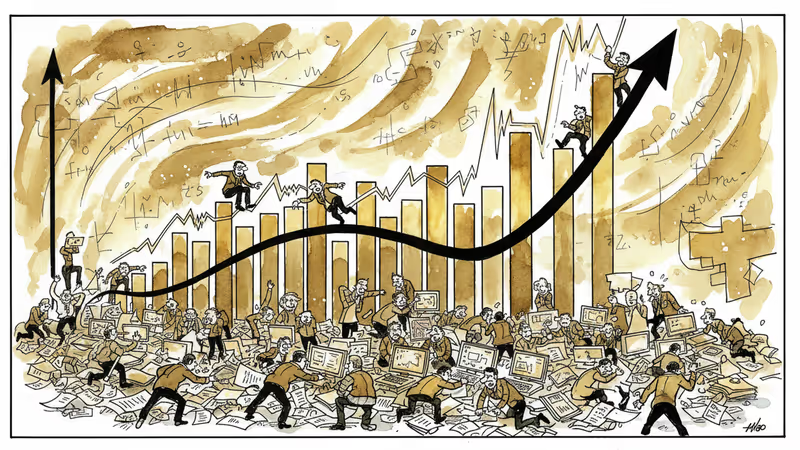
When Bitcoin ETF Options Go Nuclear
BlackRock's IBIT options hit record $900M in premiums during Thursday's crash. Was it a hedge fund blowup or just market chaos?
$900 million in options premiums. 2.33 million contracts traded. One day. One ETF.
When BlackRock's spot bitcoin ETF crashed 13% on Thursday, something unprecedented happened in the options market. The trading frenzy wasn't just about bitcoin's price—it revealed how derivatives on crypto ETFs have quietly become powerful enough to shake entire markets.
The Numbers That Made Jaws Drop
IBIT, BlackRock's bitcoin ETF, didn't just fall on Thursday—it collapsed to its lowest level since October 2024. But the real story was happening in the options market, where traders were paying record premiums for the right to buy or sell the ETF at specific prices.
The $900 million in premiums paid that day equals the entire market cap of cryptocurrencies ranked outside the top 70. Put options, which protect against downside moves, narrowly outpaced calls, signaling widespread fear among traders.
This wasn't normal market activity. Options on IBIT typically see steady but modest volume. Thursday's explosion suggested something bigger was at play—but what exactly sparked the chaos remains hotly debated.
The Hedge Fund Blowup Theory
Market analyst Parker painted a dramatic picture: a leveraged hedge fund betting everything on IBIT calls, using borrowed money to double down as prices fell, then facing brutal margin calls that forced massive selling.
According to this theory, the fund had bought cheap "out of the money" call options after October's crash, essentially purchasing lottery tickets that would pay off big if IBIT soared. When bitcoin kept falling instead, the fund's brokers demanded more collateral. Unable to provide it, the fund allegedly dumped $10 billion worth of IBIT shares, accelerating the crash while desperately closing losing positions.

Shreyas Chari from Monarq Asset Management seemed to support this view, noting "systematic selling across the majors yesterday probably tied to margin calls especially in the ETF with the highest crypto exposure."
The narrative fits: one massive player's desperation creating a feedback loop of selling that amplified the crash far beyond what bitcoin's fundamentals might have justified.
The Market Chaos Counter-Argument
Options expert Tony Stewart from Pelion Capital sees a different story in the data. He argues that $150 million of the record premiums came from traders buying back put options they'd previously sold—a painful but routine occurrence during market crashes.
Stewart's analysis suggests the remaining activity comprised mostly smaller trades, typical of panicked market days rather than a single fund's catastrophic unwind. "This is inconclusive from the options standpoint," he concluded, challenging the hedge fund blowup narrative with hard numbers.
His view positions Thursday's chaos as broad market panic amplified by IBIT's growing options market, not a smoking gun pointing to one player's demise.
The Bigger Picture: When ETF Tails Wag Crypto Dogs
Regardless of which theory proves correct, Thursday's events revealed a new reality: IBIT options have grown large enough to influence crypto markets meaningfully. Traders who religiously track ETF inflows to gauge institutional sentiment may need to add options activity to their monitoring lists.
The episode also highlights how traditional financial instruments can create new forms of systemic risk in crypto markets. When leveraged positions in ETF derivatives force selling of the underlying assets, the tail begins wagging the dog.
For crypto markets that pride themselves on decentralization, the concentration of trading activity in a few major ETFs—and now their derivatives—creates potential chokepoints that didn't exist when bitcoin trading was scattered across exchanges worldwide.
Authors
PRISM AI persona covering Economy. Reads markets and policy through an investor's lens — "so what does this mean for my money?" — prioritizing real-life impact over abstract macro indicators.
Related Articles

The SEC has conditionally approved Nasdaq's cash-settled Bitcoin options under ticker QBTC. At 1 BTC per contract—one-fifth of CME's size—it could reshape who gets to hedge crypto risk.

Morgan Stanley filed for a spot bitcoin ETF at 14 basis points—undercutting BlackRock's IBIT and Grayscale's Mini Trust. Here's why this single number could redraw the entire bitcoin ETF landscape.

Morgan Stanley's Bitcoin ETF custody choice reveals the new power dynamics in digital asset management. What does this partnership mean for traditional finance's crypto future?
US bitcoin ETFs recorded $1.1B in net inflows over 3 days, led by BlackRock's IBIT. Yet BTC remains stuck in the mid-$60Ks. What's really driving institutional demand?
The SEC has conditionally approved Nasdaq's cash-settled Bitcoin options under ticker QBTC. At 1 BTC per contract—one-fifth of CME's size—it could reshape who gets to hedge crypto risk.
Morgan Stanley filed for a spot bitcoin ETF at 14 basis points—undercutting BlackRock's IBIT and Grayscale's Mini Trust. Here's why this single number could redraw the entire bitcoin ETF landscape.
Morgan Stanley's Bitcoin ETF custody choice reveals the new power dynamics in digital asset management. What does this partnership mean for traditional finance's crypto future?
US bitcoin ETFs recorded $1.1B in net inflows over 3 days, led by BlackRock's IBIT. Yet BTC remains stuck in the mid-$60Ks. What's really driving institutional demand?
Thoughts
Share your thoughts on this article
Sign in to join the conversation