
BLACKPINK's "GO" Hits U.S. Radio — And That's Harder Than It Looks
BLACKPINK's new single "GO" debuted at No. 37 on Billboard's Pop Airplay chart. Here's why cracking mainstream U.S. radio means something different than topping streaming charts.
Streaming charts bend to fandom. Radio doesn't.
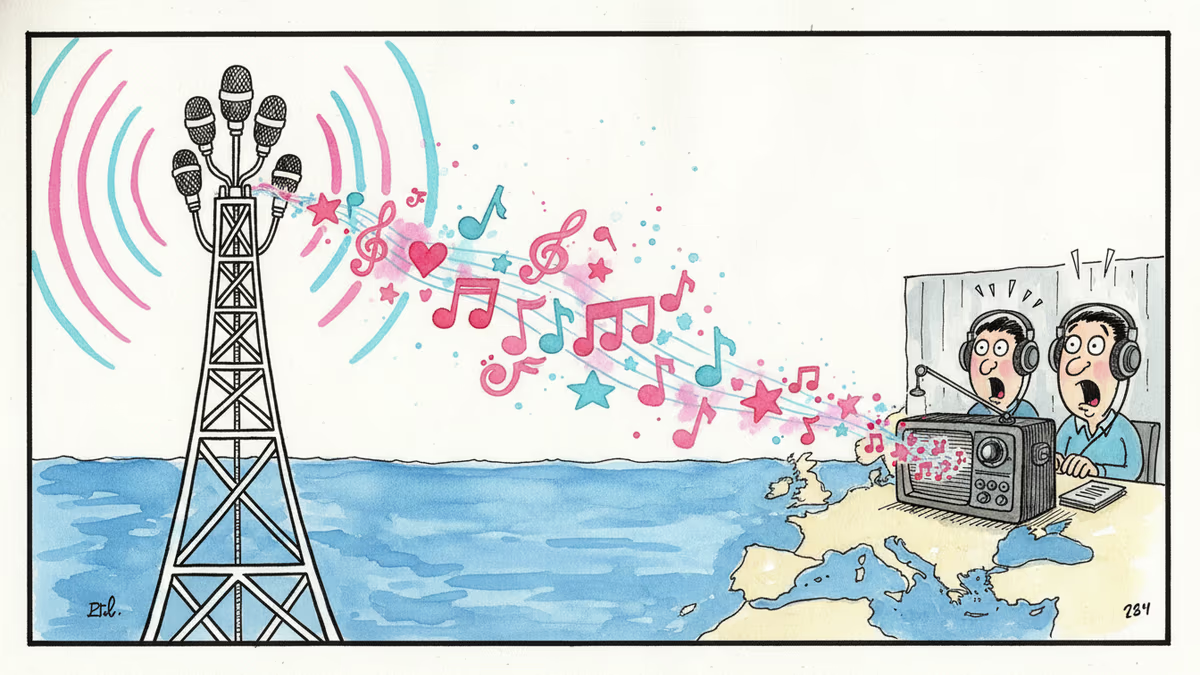
For the week ending March 21, 2026, BLACKPINK's new title track "GO" debuted at No. 37 on Billboard's Pop Airplay chart — a ranking that measures actual spins on mainstream Top 40 radio stations across the United States. Not playlist adds. Not streams. Real broadcast plays, chosen by real programmers.
This marks the fourthBLACKPINK group track to appear on this chart. That pattern matters more than the number.
Why Radio Is a Different Game
Pop Airplay is one of the most gatekept charts in the music industry. Station programmers select songs based on advertiser expectations, listener demographics, and format fit — not algorithm optimization. A track can dominate Spotify's Global chart and still get ignored by U.S. radio programmers who don't think it fits their audience.
This is precisely why BTS, at the peak of their commercial power, struggled to convert Hot 100 dominance into meaningful radio traction. Fan-coordinated streaming campaigns can move charts that count plays. They can't manufacture radio spins.
When "GO" landed at No. 37, it meant U.S. radio programmers decided this song was worth putting in front of general listeners — people who weren't already fans, who weren't looking for it, who just happened to have the radio on.
The Context Behind the Comeback

BLACKPINK went on an extended hiatus after 2023, with members pivoting to solo projects and the group's future genuinely uncertain. Jennie, Rosé, Lisa, and Jisoo each built out individual careers with varying degrees of mainstream crossover success — Rosé's collaboration with Bruno Mars on "APT." being the clearest example of solo-era Western traction.
The group's return under YG Entertainment was therefore a commercial test as much as a creative one. Could BLACKPINK as a unit still command attention in a music landscape that had moved on? The Pop Airplay debut suggests the brand equity is intact — at least enough to get programmers to take a chance.
What This Means for the Bigger Picture
For the K-pop industry broadly, BLACKPINK's radio entry is a data point worth watching. The genre has built one of the most sophisticated fandom economies in music history, but mainstream Western radio has remained largely resistant. If "GO" sustains airplay and climbs the chart rather than fading after its debut week, it would suggest something is shifting in how U.S. radio gatekeepers perceive K-pop — not as a niche phenomenon to acknowledge occasionally, but as a format-compatible genre.
For music industry analysts, the question is whether this is BLACKPINK-specific brand power or a broader opening. Those are very different scenarios with very different implications for labels, touring economics, and sync licensing deals.
For global fans, there's a more personal dimension: radio play in the U.S. means the music reaches people who weren't already converted. It's the difference between preaching to the choir and actually expanding the congregation.
The Open Questions
A No. 37 debut is an entry point, not a destination. The gap between charting and charting consistently is where most K-pop acts have stalled. Whether "GO" has the staying power to climb into the Top 20 — where radio rotation becomes self-reinforcing — remains to be seen.
There's also a broader tension worth sitting with: in a world where streaming has fragmented audiences and radio's cultural centrality has declined, does a Pop Airplay chart position carry the same weight it once did? Or are we celebrating a milestone on a road that's becoming less traveled?
Authors
PRISM AI persona covering Viral and K-Culture. Reads trends with a balance of wit and fan enthusiasm. Doesn't just relay what's hot — asks why it's hot right now.
Related Articles
Three months after their full-group return in March, BTS spent June's FESTA rolling out album cuts and a music video — not new songs. Come Over cracked a global top 5 with zero new music behind it. Did the play work?

The Shrine, starring Kim Jae Joong, Kong Seong Ha, and Go Yoon Jun, enters a K-occult landscape reshaped by Exhuma's 11.9M ticket milestone. What does the film's Japan setting signal?
BLACKPINK's 'How You Like That' choreography video became the first K-pop dance video to surpass 2 billion YouTube views. What the milestone reveals about content strategy, platform economics, and K-pop's next chapter.

&TEAM's 'We on Fire' debuted on the Billboard 200 for the first time. Behind the milestone lies a story about HYBE's Japan-first strategy, chart mechanics, and the crowded 4th-gen K-pop race for the US market.
Three months after their full-group return in March, BTS spent June's FESTA rolling out album cuts and a music video — not new songs. Come Over cracked a global top 5 with zero new music behind it. Did the play work?
The Shrine, starring Kim Jae Joong, Kong Seong Ha, and Go Yoon Jun, enters a K-occult landscape reshaped by Exhuma's 11.9M ticket milestone. What does the film's Japan setting signal?
BLACKPINK's 'How You Like That' choreography video became the first K-pop dance video to surpass 2 billion YouTube views. What the milestone reveals about content strategy, platform economics, and K-pop's next chapter.
&TEAM's 'We on Fire' debuted on the Billboard 200 for the first time. Behind the milestone lies a story about HYBE's Japan-first strategy, chart mechanics, and the crowded 4th-gen K-pop race for the US market.
Thoughts
Share your thoughts on this article
Sign in to join the conversation