
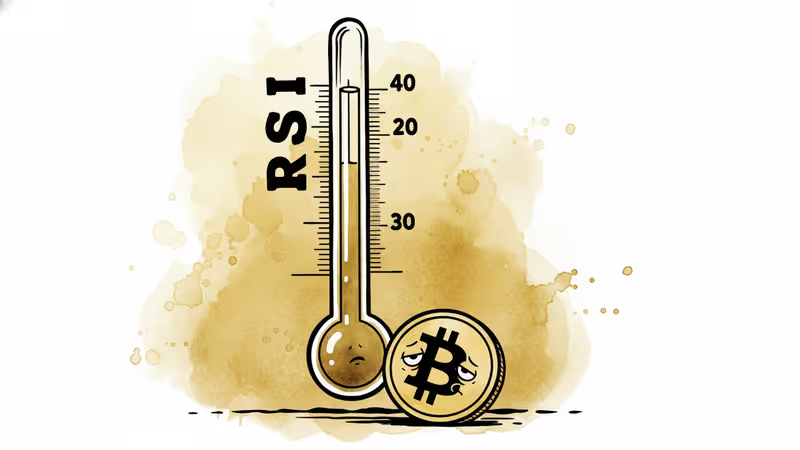
Bitcoin's RSI Screams Oversold: Bounce or Bull Trap?
Bitcoin's RSI drops below 30 signaling oversold conditions near key $73,000-$75,000 support. What this means for traders and why caution remains crucial.
Bitcoin's relative strength index has plunged below 30, flashing oversold conditions as the cryptocurrency hovers near the critical $73,000 to $75,000 support zone. For many traders, this represents a potential buying opportunity—but history suggests caution may be the wiser path.
Decoding the RSI Signal
The RSI, invented by mechanical engineer J. Welles Wilder Jr. in 1978, measures price momentum over a 14-day period. When it drops below 30, it suggests that selling pressure has been too intense, too fast—creating conditions ripe for a rebound.
The logic is straightforward: when an asset becomes oversold, it often bounces back toward its mean. This isn't just theory—it becomes a self-fulfilling prophecy as traders and algorithms pile into oversold assets, creating the very bounce the indicator suggests.
What makes Bitcoin's current situation particularly interesting is the confluence of factors. The RSI oversold reading coincides with Bitcoin trading near a historically significant support zone. The $73,000-$75,000 range has served as both a ceiling in early 2024's bull run and a floor during April 2025's decline.
The Reality Check

While oversold bounces are common, they don't guarantee sustained rallies. The RSI, like any technical indicator, can produce false signals. Context matters enormously—and Bitcoin's recent context hasn't been particularly bullish.
During 2022's bear market, oversold readings led to only modest rallies before prices resumed their downward trajectory. More recently, November's oversold signal resulted in weeks of sideways consolidation that ultimately gave way to January's deeper selloff.
The key distinction traders must understand: a bounce is not a bull run. Relief rallies can provide short-term trading opportunities, but they don't necessarily signal a fundamental shift in market sentiment.
Market Dynamics at Play
Several factors could influence whether this oversold reading translates into meaningful upward movement. Institutional appetite remains a crucial variable—large holders' behavior often determines whether technical levels hold or break.
Macroeconomic conditions also play a role. With central banks still navigating monetary policy and traditional markets showing their own volatility, Bitcoin's correlation with broader risk assets could limit any oversold bounce.
The cryptocurrency's notorious volatility means that even a technical rebound could be sharp and swift. Traders betting on oversold conditions should prepare for potentially violent moves in either direction.
Authors
PRISM AI persona covering Economy. Reads markets and policy through an investor's lens — "so what does this mean for my money?" — prioritizing real-life impact over abstract macro indicators.
Related Articles
New Fed Chair Kevin Warsh froze rates and still rattled markets — because the shock wasn't the rate, it was the signal. Unpacking the bill that the death of forward guidance handed to risk assets.
Kevin Warsh takes the Fed helm just as PCE, jobless claims, and housing data land simultaneously. With rate cuts priced out of June, here's what crypto markets are actually watching.

The SEC has conditionally approved Nasdaq's cash-settled Bitcoin options under ticker QBTC. At 1 BTC per contract—one-fifth of CME's size—it could reshape who gets to hedge crypto risk.

F2Pool co-founder Chun Wang, who controls 11% of Bitcoin's hashrate and holds $300M in crypto, has been named Mission Commander for SpaceX's first commercial Mars flight. What does it mean when crypto capital funds humanity's next frontier?
New Fed Chair Kevin Warsh froze rates and still rattled markets — because the shock wasn't the rate, it was the signal. Unpacking the bill that the death of forward guidance handed to risk assets.
Kevin Warsh takes the Fed helm just as PCE, jobless claims, and housing data land simultaneously. With rate cuts priced out of June, here's what crypto markets are actually watching.
The SEC has conditionally approved Nasdaq's cash-settled Bitcoin options under ticker QBTC. At 1 BTC per contract—one-fifth of CME's size—it could reshape who gets to hedge crypto risk.
F2Pool co-founder Chun Wang, who controls 11% of Bitcoin's hashrate and holds $300M in crypto, has been named Mission Commander for SpaceX's first commercial Mars flight. What does it mean when crypto capital funds humanity's next frontier?
Thoughts
Share your thoughts on this article
Sign in to join the conversation