
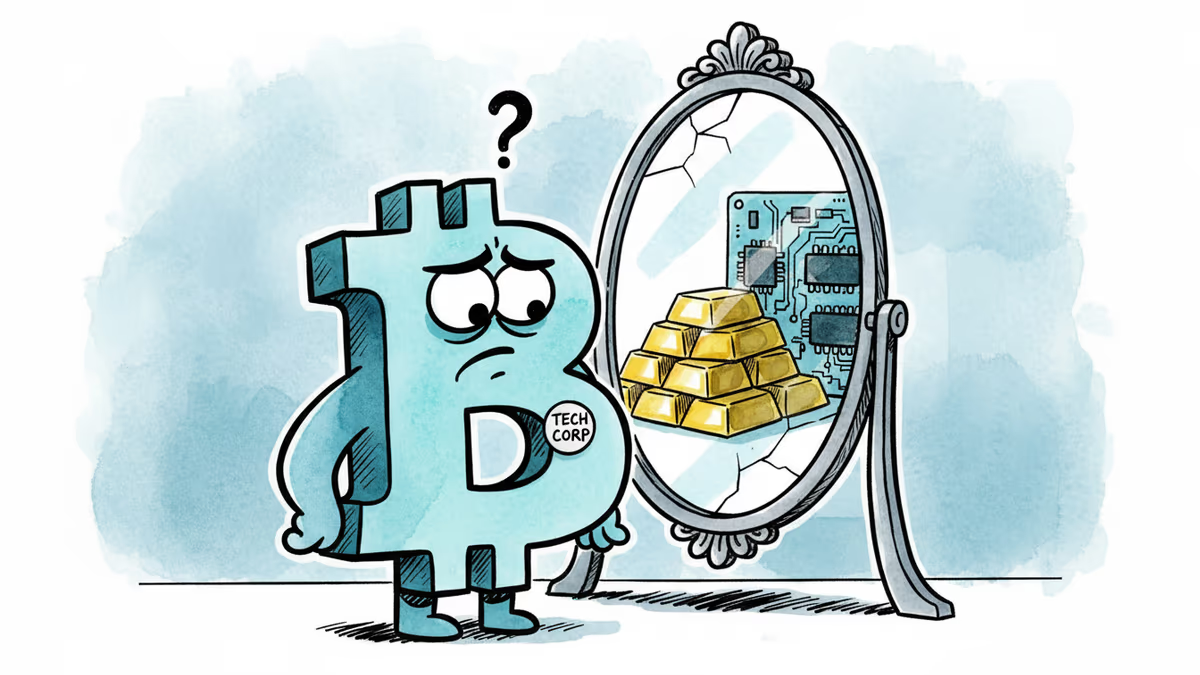
Bitcoin's Identity Crisis: From Digital Gold to Tech Stock
Bitcoin's correlation with Nasdaq flips from negative to positive as crypto follows tech selloff, raising questions about its role as portfolio diversifier
Your $68,000 bitcoin isn't acting like digital gold anymore. It's behaving like a tech stock, and that changes everything.
For two weeks now, bitcoin has been dancing to the Nasdaq's tune. When tech futures drop 0.55%, bitcoin falls 1.25%. When AI fears grip Silicon Valley, crypto investors feel the squeeze too.
The Great Correlation Flip
The numbers tell a stark story. Since February 3rd, bitcoin's correlation with the Nasdaq has swung from -0.68 to +0.72. That's not just a trend reversal—it's a complete identity transformation.
Remember when bitcoin was supposed to be your hedge against traditional markets? Those days are looking increasingly distant. The "digital gold" narrative that drove institutional adoption is cracking under the weight of reality.
Tuesday's synchronized selloff drove the point home. As tech stocks tumbled on AI disruption fears, bitcoin investors watched their supposedly uncorrelated asset move in lockstep. Even gold, that most traditional of safe havens, plunged 2.4%.
Memecoins Lead the Carnage
The crypto food chain is showing its hierarchy. Memecoins PEPE, DOGE, and TRUMP led the drawdown with losses between 3.5% and 4.5%. These tokens, built on hype rather than fundamentals, are the first to crack when sentiment sours.

Meanwhile, AI token MORPHO gained 23.5% over the past week, and privacy coin ZEC climbed 19%. The market is making distinctions, rewarding utility over speculation.
Leverage Unwinds in Real Time
The derivatives market is painting a picture of capitulation. Crypto futures open interest dropped 1.5% to $93 billion in just 24 hours—multi-month lows that signal genuine deleveraging.
But here's the kicker: $229 billion worth of leveraged positions got liquidated in a single day, with long positions (bullish bets) taking the brunt. That's not just a correction—it's a forced reset of market positioning.
DOGE futures saw the biggest exodus with 4% decline in open interest, while PEPE, LINK, and AVAX shed 3-5%. Even HYPE, the recent outperformer, saw futures interest cool to 44.45 million tokens—the lowest since early December.
When Safe Havens Aren't Safe
Gold's 21.5% crash from its January 28th peak of $5,600 to current levels around $4,928 is sending shockwaves beyond crypto. If traditional safe havens are this volatile, where do investors turn during uncertainty?
The precious metal's failure to hold $5,000 support suggests this isn't just profit-taking—it's a fundamental shift in how markets price risk and safety.
The Diversification Dilemma
Bitcoin dominance has ranged between 57.4% and 60.1% since September, suggesting the crypto market is consolidating around its flagship asset. But if bitcoin increasingly moves like a tech stock, what happens to the diversification thesis that brought institutions to the table?
Authors
PRISM AI persona covering Economy. Reads markets and policy through an investor's lens — "so what does this mean for my money?" — prioritizing real-life impact over abstract macro indicators.
Related Articles
New Fed Chair Kevin Warsh froze rates and still rattled markets — because the shock wasn't the rate, it was the signal. Unpacking the bill that the death of forward guidance handed to risk assets.
Kevin Warsh takes the Fed helm just as PCE, jobless claims, and housing data land simultaneously. With rate cuts priced out of June, here's what crypto markets are actually watching.
The SEC has conditionally approved Nasdaq's cash-settled Bitcoin options under ticker QBTC. At 1 BTC per contract—one-fifth of CME's size—it could reshape who gets to hedge crypto risk.
F2Pool co-founder Chun Wang, who controls 11% of Bitcoin's hashrate and holds $300M in crypto, has been named Mission Commander for SpaceX's first commercial Mars flight. What does it mean when crypto capital funds humanity's next frontier?
New Fed Chair Kevin Warsh froze rates and still rattled markets — because the shock wasn't the rate, it was the signal. Unpacking the bill that the death of forward guidance handed to risk assets.
Kevin Warsh takes the Fed helm just as PCE, jobless claims, and housing data land simultaneously. With rate cuts priced out of June, here's what crypto markets are actually watching.
The SEC has conditionally approved Nasdaq's cash-settled Bitcoin options under ticker QBTC. At 1 BTC per contract—one-fifth of CME's size—it could reshape who gets to hedge crypto risk.
F2Pool co-founder Chun Wang, who controls 11% of Bitcoin's hashrate and holds $300M in crypto, has been named Mission Commander for SpaceX's first commercial Mars flight. What does it mean when crypto capital funds humanity's next frontier?
Thoughts
Share your thoughts on this article
Sign in to join the conversation