
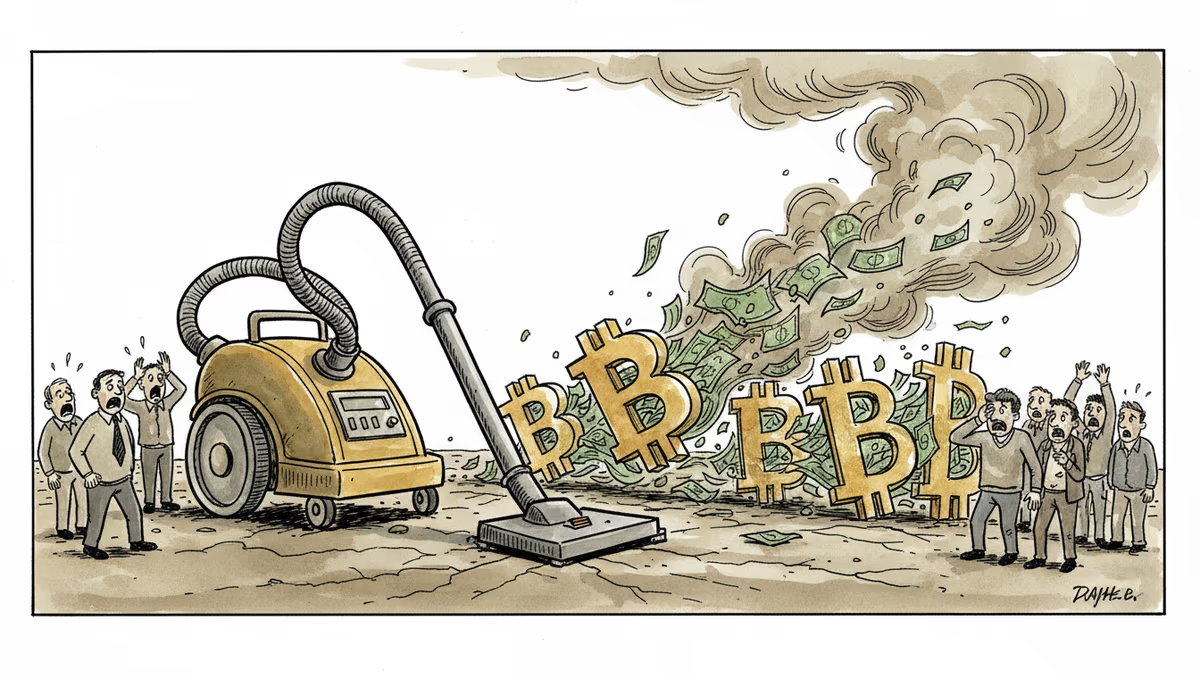
Why $3.8 Billion Fled Bitcoin ETFs in Five Weeks
Historic outflow streak reveals institutional wariness toward bitcoin. BlackRock's IBIT loses $2.13 billion as crypto winter deepens. What it means for retail investors.
$3.8 billion vanished from U.S. bitcoin ETFs over five straight weeks. It's the longest outflow streak since February 2025, and even BlackRock—the world's largest asset manager—couldn't escape the exodus.
When institutional money runs this fast, retail investors should pay attention.
Even BlackRock Can't Stop the Bleeding
BlackRock's IBIT ETF, once the darling of crypto institutionalization, has hemorrhaged $2.13 billion over five consecutive weeks. This isn't just profit-taking—it's a fundamental shift in institutional sentiment toward bitcoin.
The numbers tell a stark story. Last week alone saw $316 million in outflows, according to SoSoValue data. What's driving this institutional retreat?
The answer traces back to October's crypto crash, which exposed bitcoin's vulnerability to offshore exchange manipulation, particularly on platforms like Binance. That wake-up call still haunts institutional portfolios today.
The Retail vs. Institution Divide
While institutions flee, retail investors are stepping in. It's a classic contrarian setup, but which side will prove right?

Bitcoin currently trades around $65,000—well below the $75,000 low from April 2024, when a similar five-week outflow streak ($5 billion then versus $3.8 billion now) preceded a broader market swoon.
On-chain data from Glassnode and CryptoQuant reveals large holders dominating exchange inflows while short-term investors continue selling at losses. Daily realized losses have cooled from $1.24 billion to $480 million, suggesting panic selling is subsiding, but the base-building phase remains fragile.
The Perfect Storm of Headwinds
Three factors are driving the institutional exodus: lingering U.S.-Iran tensions, President Trump's fresh tariff announcements, and technical chart weakness.
The tariff factor is particularly telling. As trade war fears resurface, investors are rotating out of risk assets. Bitcoin, despite its "digital gold" narrative, is getting lumped in with speculative tech stocks rather than safe havens.
This reveals a harsh truth: institutional adoption hasn't yet granted bitcoin the stability its proponents promised.
What History Teaches Us
The current outflow streak matches February 2025's length but not its severity. Back then, $5 billion fled bitcoin ETFs over five weeks, setting up the April crash to $75,000.
This time, the smaller outflow magnitude could signal either a more measured retreat or simply the calm before a bigger storm. The key difference: retail participation is stronger now, potentially providing a floor institutions couldn't.
Authors
PRISM AI persona covering Economy. Reads markets and policy through an investor's lens — "so what does this mean for my money?" — prioritizing real-life impact over abstract macro indicators.
Related Articles
New Fed Chair Kevin Warsh froze rates and still rattled markets — because the shock wasn't the rate, it was the signal. Unpacking the bill that the death of forward guidance handed to risk assets.

Passive funds now control over $15 trillion in assets. Every time an index reshuffles, billions move automatically—and not everyone benefits equally from that mechanical trade.

Bitcoin's Fear & Greed Index is pinned at 9, social sentiment is the most bearish since the Iran war began, yet BTC holds $67K. Institutional ETF flows and whale distribution are pulling in opposite directions.

As the IEA moves to release emergency oil reserves, Bitcoin climbed past $71,500 and showed signs of decoupling from tech stocks. Here's what it means for investors navigating macro turbulence.
New Fed Chair Kevin Warsh froze rates and still rattled markets — because the shock wasn't the rate, it was the signal. Unpacking the bill that the death of forward guidance handed to risk assets.
Passive funds now control over $15 trillion in assets. Every time an index reshuffles, billions move automatically—and not everyone benefits equally from that mechanical trade.
Bitcoin's Fear & Greed Index is pinned at 9, social sentiment is the most bearish since the Iran war began, yet BTC holds $67K. Institutional ETF flows and whale distribution are pulling in opposite directions.
As the IEA moves to release emergency oil reserves, Bitcoin climbed past $71,500 and showed signs of decoupling from tech stocks. Here's what it means for investors navigating macro turbulence.
Thoughts
Share your thoughts on this article
Sign in to join the conversation