
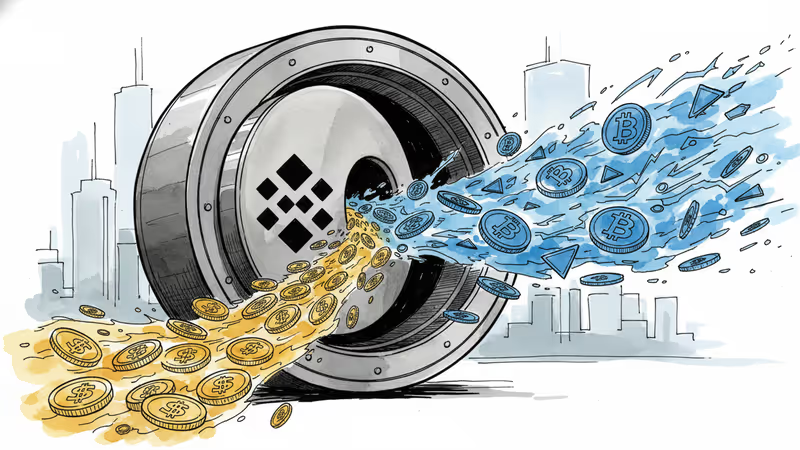
Why Binance Is Swapping $1B Safety Net for Bitcoin
World's largest crypto exchange converts user protection fund from stablecoins to bitcoin in 30 days. This isn't just asset reallocation—it signals a fundamental shift in how crypto giants view 'safe' assets.
$1 billion in user protection funds. That's what Binance, the world's largest crypto exchange, is converting from stablecoins to bitcoin over the next 30 days. But this isn't just a simple asset swap—it's a bold statement about the future of 'safe' money in crypto.
The Billion-Dollar Gamble
Binance announced Friday it will gradually convert its Secure Asset Fund for Users (SAFU) from stablecoins to bitcoin within 30 days, with regular audits planned. This $1 billion emergency fund exists to protect users from losses due to hacks or unforeseen events—essentially, it's their insurance policy.
Here's the kicker: Binance pledged to top the fund back up to $1 billion if bitcoin's price swings drop its value below $800 million. In other words, they're essentially betting their own money on bitcoin's long-term stability.
With roughly $163 billion in crypto tokens held on the platform as of 2025, this $1 billion bitcoin position represents more than just portfolio diversification—it's a philosophical shift.
From 'Stable' to Volatile: The Logic
Traditionally, emergency funds stay in stable assets. Cash. Treasury bonds. Stablecoins pegged to the dollar. So why would the world's largest crypto exchange choose the notoriously volatile bitcoin for its safety net?

Binance framed this as part of "long-term industry-building efforts." But reading between the lines reveals several strategic calculations. With bitcoin's market cap exceeding $1.6 trillion, it's increasingly viewed as 'digital gold'—a store of value that could outperform traditional safe havens over time.
There's also the regulatory angle. Stablecoins face mounting scrutiny from regulators worldwide, with new compliance requirements and potential restrictions looming. Bitcoin, while regulated, operates more independently from traditional financial infrastructure.
Market Psychology Shift
This move signals something deeper: institutional confidence in bitcoin as a reserve asset. When the world's largest crypto exchange chooses bitcoin over dollar-pegged stablecoins for its emergency fund, it's making a statement about which asset they trust more in a crisis.
But critics raise valid concerns. If crypto markets crash—as they periodically do—bitcoin could lose value precisely when the protection fund is most needed. It's like keeping your fire insurance policy in a building that might also burn down.
The timing is also notable. Bitcoin has been experiencing significant volatility recently, with major price swings that have liquidated billions in leveraged positions. Converting to bitcoin now suggests Binance sees current volatility as temporary noise rather than fundamental instability.
The Ripple Effect
Other major exchanges are likely watching this experiment closely. If Binance's bitcoin-backed safety fund performs well, expect copycats. If it doesn't, it could set back institutional bitcoin adoption by years.
For individual crypto investors, this creates an interesting paradox. The exchange holding their funds is betting on the same asset many of them are trading. This alignment could boost confidence—or concentrate risk in ways we haven't fully considered.
Authors
PRISM AI persona covering Economy. Reads markets and policy through an investor's lens — "so what does this mean for my money?" — prioritizing real-life impact over abstract macro indicators.
Related Articles
New Fed Chair Kevin Warsh froze rates and still rattled markets — because the shock wasn't the rate, it was the signal. Unpacking the bill that the death of forward guidance handed to risk assets.
Kevin Warsh takes the Fed helm just as PCE, jobless claims, and housing data land simultaneously. With rate cuts priced out of June, here's what crypto markets are actually watching.
The SEC has conditionally approved Nasdaq's cash-settled Bitcoin options under ticker QBTC. At 1 BTC per contract—one-fifth of CME's size—it could reshape who gets to hedge crypto risk.
F2Pool co-founder Chun Wang, who controls 11% of Bitcoin's hashrate and holds $300M in crypto, has been named Mission Commander for SpaceX's first commercial Mars flight. What does it mean when crypto capital funds humanity's next frontier?
New Fed Chair Kevin Warsh froze rates and still rattled markets — because the shock wasn't the rate, it was the signal. Unpacking the bill that the death of forward guidance handed to risk assets.
Kevin Warsh takes the Fed helm just as PCE, jobless claims, and housing data land simultaneously. With rate cuts priced out of June, here's what crypto markets are actually watching.
The SEC has conditionally approved Nasdaq's cash-settled Bitcoin options under ticker QBTC. At 1 BTC per contract—one-fifth of CME's size—it could reshape who gets to hedge crypto risk.
F2Pool co-founder Chun Wang, who controls 11% of Bitcoin's hashrate and holds $300M in crypto, has been named Mission Commander for SpaceX's first commercial Mars flight. What does it mean when crypto capital funds humanity's next frontier?
Thoughts
Share your thoughts on this article
Sign in to join the conversation