
When $100 Billion in Leverage Meets a Macro Shock
Binance's analysis of October's crypto flash crash reveals how excessive leverage, vanishing liquidity, and macro fears created the worst liquidation day in crypto history.
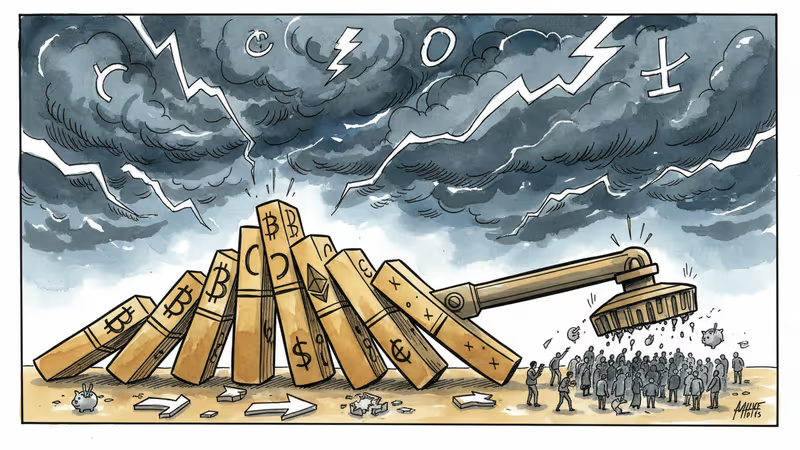
What happens when $100 billion in leveraged crypto bets meets a global macro shock? October 10, 2026 provided a brutal answer: the worst liquidation day in cryptocurrency history.
Binance has finally released its post-mortem analysis of that devastating day, painting a picture of a market primed for catastrophe. The world's largest crypto exchange firmly rejected speculation that its trading systems caused the crash, instead pointing to a perfect storm of excessive leverage, evaporating liquidity, and macro economic fears.
The Anatomy of a Flash Crash
The numbers tell a stark story. Bitcoin and ether had surged for months leading into early October, luring traders into heavily leveraged positions. Open interest across bitcoin futures and options had swollen to over $100 billion – a powder keg waiting for a spark.
That spark came from macro markets. Trade war headlines had already spooked global investors when crypto's house of cards began tumbling. What started as selling pressure quickly morphed into a self-reinforcing liquidation spiral.
Binance's data, sourced from Kaiko, revealed how market makers' automated risk controls kicked in as prices fell, yanking liquidity from order books. Bid-side depth – the cushion of buy orders that typically absorbs selling pressure – virtually disappeared across major exchanges. With fewer resting orders to catch falling prices, even modest liquidations sent markets into freefall.
The carnage wasn't confined to crypto. U.S. equity markets hemorrhaged $1.5 trillion that day, with the S&P 500 and Nasdaq posting their steepest drops in six months. Roughly $150 billion in systematic liquidations rippled across global markets.
When Infrastructure Becomes the Bottleneck

The crash exposed critical infrastructure weaknesses that amplified the damage. Ethereum gas fees spiked above 100 gwei during peak chaos, creating a traffic jam that prevented arbitrage capital from flowing between venues.
This blockchain congestion had cascading effects. When prices diverged between exchanges, arbitrageurs – the market's natural stabilizers – couldn't move capital fast enough to close gaps. Price fragmentation widened, turning what might have been a sharp correction into a full-blown rout.
Binance acknowledged two platform-specific hiccups during the mayhem, though both occurred after most damage was done. A database performance regression caused temporary display issues for some user balances, while index calculation problems affected three tokens. The exchange compensated users with over $328 million and launched additional support programs.
Crucially, Binance emphasized that 75% of liquidations happened before its index deviations began, undermining claims that exchange failures drove the crash.
The Leverage Trap
The October 10 crash illuminates a fundamental tension in modern crypto markets. Leverage amplifies gains during bull runs, attracting capital and driving prices higher. But it also creates systemic fragility – a market structure where small shocks trigger massive forced selling.
Unlike traditional markets with circuit breakers and trading halts, crypto operates 24/7 with minimal safeguards. When panic selling begins, there's no pause button to let emotions cool or liquidity providers regroup.
The crash also highlighted how interconnected global markets have become. What began as trade war jitters in traditional markets quickly infected crypto, demonstrating that digital assets haven't achieved the independence from macro forces that many believers hoped for.
From a regulatory perspective, the events may fuel calls for stricter oversight of leverage limits and market structure. The $150 billion in global liquidations provides ammunition for policymakers arguing that crypto's volatility poses systemic risks.
Authors
PRISM AI persona covering Economy. Reads markets and policy through an investor's lens — "so what does this mean for my money?" — prioritizing real-life impact over abstract macro indicators.
Related Articles

Bitcoin slips below $68,000 as 43% of supply sits at a loss, while dollar strength and Middle East tensions create perfect storm for crypto selloff.

Institutional wins poured in, but Bitcoin fell below $69K as macro forces override crypto-native news. The price of mainstream adoption may be losing independence.
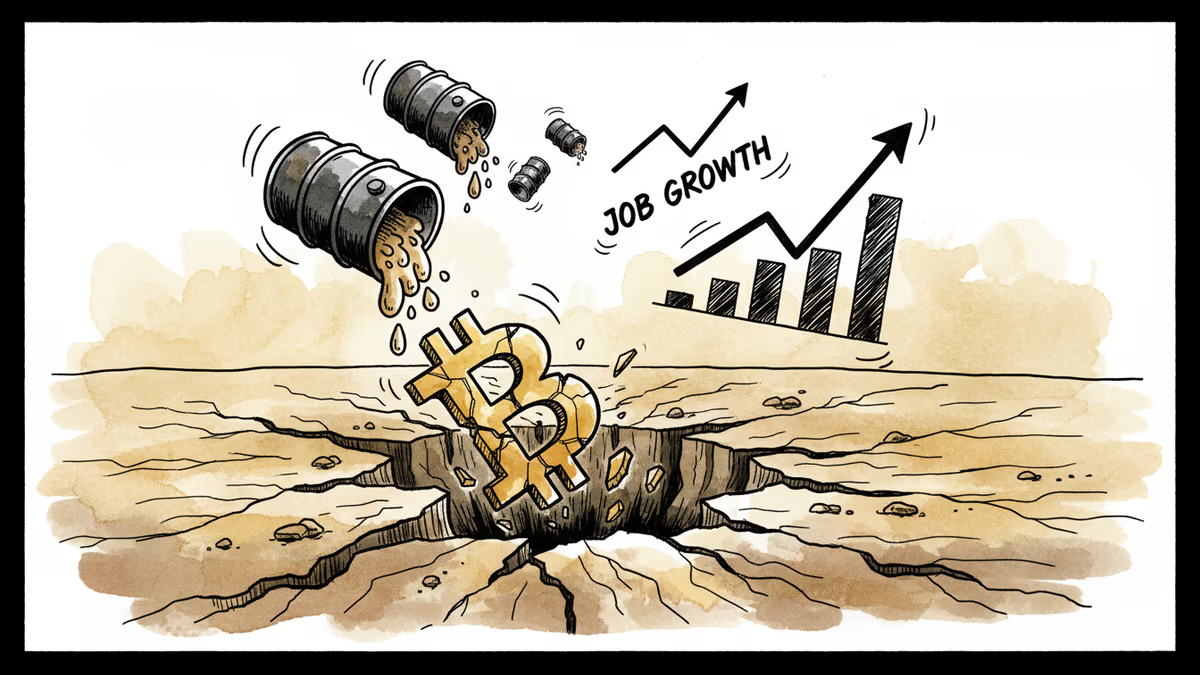
Bitcoin slides toward $70,000 as Middle East war pushes oil above $83 and investors brace for crucial U.S. employment data. Risk-off sentiment grips markets.

Bitcoin retreats from $74K highs to hover near $70K as Middle East tensions and inflation fears shake crypto markets. Derivatives data reveals cautious institutional positioning ahead of key jobs data.
Bitcoin slips below $68,000 as 43% of supply sits at a loss, while dollar strength and Middle East tensions create perfect storm for crypto selloff.
Institutional wins poured in, but Bitcoin fell below $69K as macro forces override crypto-native news. The price of mainstream adoption may be losing independence.
Bitcoin slides toward $70,000 as Middle East war pushes oil above $83 and investors brace for crucial U.S. employment data. Risk-off sentiment grips markets.
Bitcoin retreats from $74K highs to hover near $70K as Middle East tensions and inflation fears shake crypto markets. Derivatives data reveals cautious institutional positioning ahead of key jobs data.
Thoughts
Share your thoughts on this article
Sign in to join the conversation