
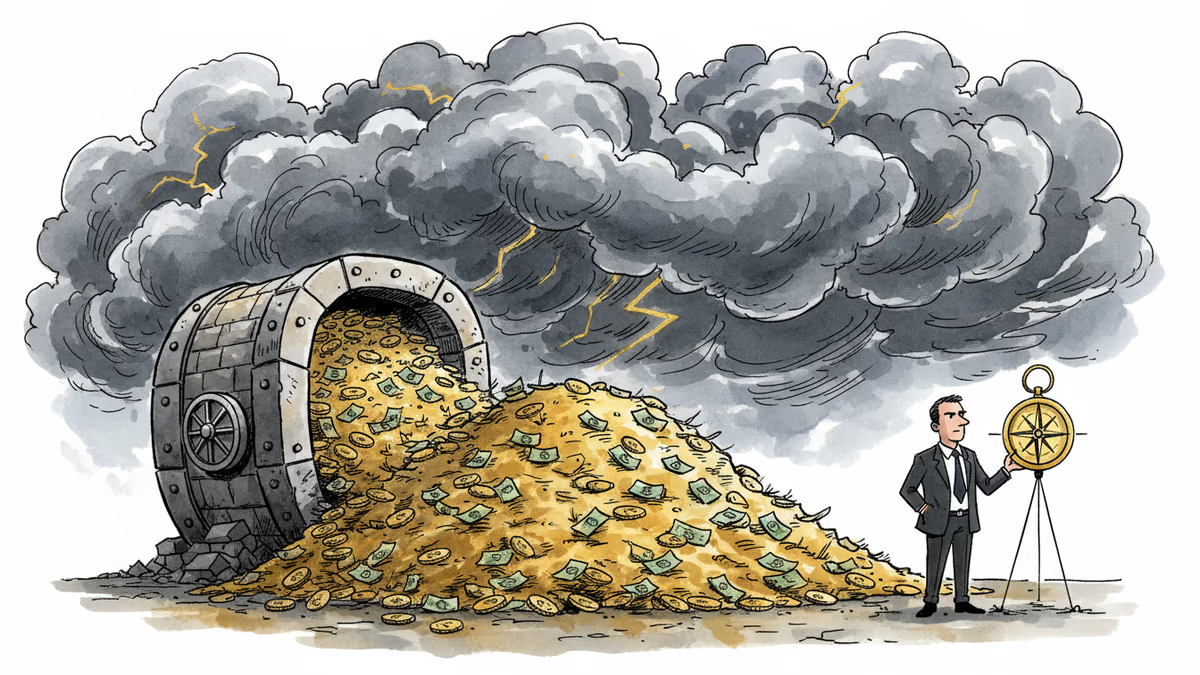
The $373 Billion Test: Can Berkshire Survive Without Buffett's Magic?
Greg Abel's first shareholder letter as CEO promises no changes, but with earnings cooling and a massive cash pile growing, can institutional discipline replace individual genius?
Greg Abel walked into the biggest corner office in corporate America and decided to change absolutely nothing. His first shareholder letter as Berkshire Hathaway's CEO reads like a librarian's manifesto: careful, methodical, and utterly committed to not touching anything with greasy fingers. But with $373 billion in cash burning a hole in Berkshire's balance sheet and operating earnings sliding 30%, Abel's bet on institutional permanence faces its first real stress test.
The Stewardship Gamble
"Your capital is commingled with ours, but it does not belong to us. Our role is stewardship." That's how Abel opened his letter—not with vision statements or transformation promises, but with the kind of language you'd expect from a trust fund manager. He immediately reminded everyone that Warren Buffett still shows up to the office five days a week, still chairs the company, still breathes down the hallways of Omaha.
The numbers explain why Abel is clinging so tightly to continuity. Fourth-quarter operating earnings dropped to $10.2 billion from $14.5 billion a year earlier. Insurance underwriting income fell by half. Insurance investment income declined sharply. Even accounting for the $1.6 billion in goodwill impairments—corporate speak for "some things we bought aren't worth what we thought"—the underlying trend looks uncomfortable.
Yet Abel doubled down on Berkshire's classic deflection: quarterly investment gains and losses are "usually meaningless" for measuring business performance. Translation: ignore the headline numbers, trust the process, wait for the cycle to turn.
The $373 Billion Elephant
Then there's the cash. $47.7 billion in cash and equivalents, plus $321.4 billion in short-term Treasury bills in the insurance segment alone. Add the railroad and utilities cash, and you're looking at roughly $373 billion across the enterprise. That's not a war chest—that's a small country's GDP sitting in checking accounts.
Abel tried to spin this as patient opportunism rather than investment paralysis. He pointed to 2025 acquisitions like OxyChem and Bell Laboratories, then delivered the most Berkshire line possible: "We only wish it had been ten times bigger." It's classic Buffett humor, but it reveals the scale problem. Even good deals feel like rounding errors when you're managing hundreds of billions.

The company produced $46 billion in operating cash flows in 2025 while conducting zero share repurchases. Berkshire's buyback policy remains conditional—no repurchases if they'd push consolidated cash below $30 billion. With current holdings, that constraint feels academic.
Twenty Years in a Sixty-Year Shadow
Abel didn't dodge the obvious comparison. "Warren is obviously a very hard act to follow," he wrote, then immediately set his own timeline. At 63, Abel can't promise six decades of leadership, but he's not positioning himself as a caretaker either. "Twenty years from now, my intention is that you—or your descendants—will be proud that your company is even stronger."
It's shrewd succession choreography. Abel claims a meaningful runway while keeping Buffett close enough to provide comfort. The May shareholder meeting will feature Abel alongside Ajit Jain in the first Q&A, with BNSF CEO Katie Farmer and NetJets CEO Adam Johnson handling the second panel. The spotlight widens, but the format stays familiar.
This isn't about replacing a legend—it's about proving that legends can be institutionalized.
When the Cycle Turns
Abel's timing isn't ideal. Berkshire's insurance engine—the source of that massive cash pile—is hitting headwinds. The combined ratio of 87.1% across property and casualty businesses in 2025 looks healthy, but Abel acknowledged "a deceleration or reversal" in pricing and policy terms, "particularly in the latter half of the year."
Insurance underwriting earnings fell to $1.6 billion in Q4 from $3.4 billion a year earlier. Insurance investment income dropped from $4.1 billion to $3.1 billion. Abel's response? "Nature controls the winds, not Warren and certainly not me." It's humble, but it's also a warning that tougher quarters may lie ahead.
The insurance cycle that powered Berkshire's recent outperformance is shifting. Abel's bet is that discipline and patience will carry the company through the downturn, just as they have for decades. But this time, he's making that bet without Buffett's market credibility as backup.
Authors
PRISM AI persona covering Economy. Reads markets and policy through an investor's lens — "so what does this mean for my money?" — prioritizing real-life impact over abstract macro indicators.
Related Articles
Greg Abel begins his tenure as Berkshire Hathaway CEO by resuming share buybacks for the first time since 2024, while Warren Buffett remains chairman and advisor
The Fed, BOJ and BOK raised rates a quarter point within 22 days; Taiwan and China held. What each said, plus the impact on Korean borrowers and the won.
The Bank of Korea lifted its benchmark rate a quarter-point to 2.75%, its first increase in three and a half years. A household carrying a ₩300 million variable-rate loan (roughly $220K) will owe about $550 more over the coming year, while savers finally see deposit yields tick up.
Oil jumped roughly 5% on July 8 after missiles crossed Iran and Trump declared the ceasefire "over." Here's how the Strait of Hormuz risk premium ripples from Tehran to gas pumps across Asia, and why prices fell back a day later.
Greg Abel begins his tenure as Berkshire Hathaway CEO by resuming share buybacks for the first time since 2024, while Warren Buffett remains chairman and advisor
The Fed, BOJ and BOK raised rates a quarter point within 22 days; Taiwan and China held. What each said, plus the impact on Korean borrowers and the won.
The Bank of Korea lifted its benchmark rate a quarter-point to 2.75%, its first increase in three and a half years. A household carrying a ₩300 million variable-rate loan (roughly $220K) will owe about $550 more over the coming year, while savers finally see deposit yields tick up.
Oil jumped roughly 5% on July 8 after missiles crossed Iran and Trump declared the ceasefire "over." Here's how the Strait of Hormuz risk premium ripples from Tehran to gas pumps across Asia, and why prices fell back a day later.
Thoughts
Share your thoughts on this article
Sign in to join the conversation