
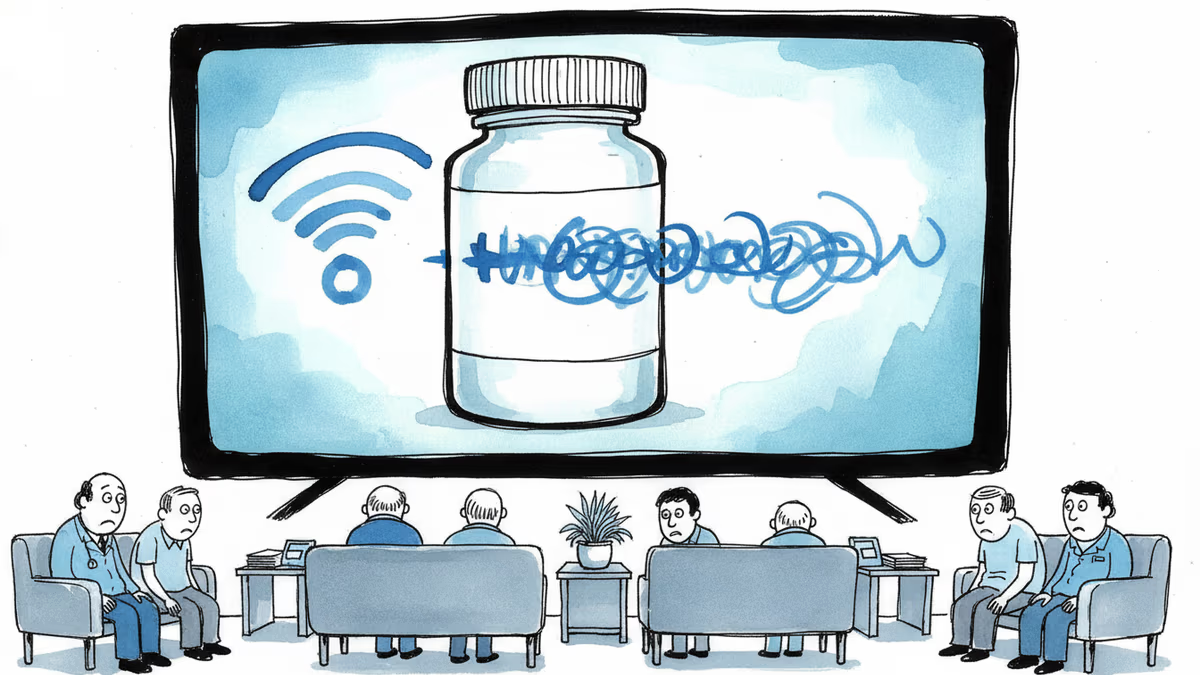
The $6 Billion Question: Should Drug Ads Disappear from Your TV?
As US officials move to restrict pharmaceutical advertising, new research reveals the complex tradeoffs between consumer choice and medical oversight in America's unique drug marketing landscape.
Picture this: You're settling in for your evening show when suddenly a cheerful narrator begins rattling off side effects that sound worse than the disease itself. "May cause nausea, dizziness, thoughts of bankruptcy, and spontaneous combustion." Welcome to America's $6 billion pharmaceutical advertising industry—a uniquely American experience that's about to face its biggest shakeup in decades.
Health and Human Services Secretary Robert F. Kennedy Jr. has made it clear: he believes direct-to-consumer drug advertising has contributed to overmedication and inflated healthcare costs. After nearly 30 years of pharmaceutical companies having free rein to market prescription drugs directly to patients, U.S. officials are now pulling the reins tight.
The Two-Country Club
Here's a startling fact: only two countries in the entire world allow drug companies to advertise prescription medications directly to consumers—the United States and New Zealand. Everyone else has banned the practice, viewing it as too risky to let 30-second commercials influence medical decisions that should remain between doctors and patients.
The European Union, Canada, and Japan take a different approach entirely. Pharmaceutical companies can run disease awareness campaigns—think "Talk to your doctor about depression"—but they can't name specific products or make treatment claims.
This wasn't always the American way. For decades, pharmaceutical marketing focused exclusively on physicians through medical journals and sales representatives. The pivotal moment came in 1997 when the FDA issued guidance allowing television ads to present only major risk information, directing viewers to websites or phone lines for complete details.
The result? Pharmaceutical spending on direct-to-consumer advertising has more than doubled since 2012, reaching over $6 billion annually. That's roughly equivalent to the entire GDP of Montenegro—spent on convincing Americans to "ask their doctor" about drugs with names that sound like rejected Star Wars characters.
The Crackdown Begins
In September 2025, the FDA announced it would revoke the 1997 guidance, restoring pre-1997 standards requiring fuller disclosure in television ads. The agency also pledged more aggressive enforcement of existing rules governing pharmaceutical advertising.
But here's where it gets complicated: while politicians on both sides of the aisle have called for banning direct-to-consumer drug ads outright, a total ban likely wouldn't survive a Supreme Court challenge. The First Amendment protections for commercial speech create a legal minefield that regulators must navigate carefully.
Kennedy's position reflects growing concerns that these ads mislead patients, encouraging overuse of expensive branded drugs when cheaper alternatives might work just as well. Critics argue that pharmaceutical companies spend more advertising dollars on drugs with lower clinical benefit, potentially steering patients away from treatments their doctors would naturally recommend.

The Surprising Research
But here's where the story takes an unexpected turn. Despite widespread criticism, rigorous research reveals that direct-to-consumer advertising might actually benefit patients more than harm them.
A 2022 study on antidepressants found that advertising encouraged more people to start treatment, particularly for underdiagnosed conditions. During the 2008 election, when political ads displaced drug commercials, researchers discovered a natural experiment: the absence of statin drug advertisements resulted in approximately 600,000 fewer new users of these cholesterol-lowering medications.
The researchers ran the numbers and found something remarkable: the health gains from additional treatment outweighed the costs of advertising. In other words, those annoying commercials were actually saving lives by encouraging people to seek treatment they might otherwise avoid.
Another study examined the rollout of Medicare Part D and found that increased pharmaceutical advertising in areas with larger Medicare populations led to more patients beginning treatment and sticking with it. Crucially, prescriptions also rose for non-advertised drugs, including cheaper generics, suggesting that advertising expanded overall treatment rather than simply shifting patients to expensive brands.
The Physician Factor
There's another layer to this story that critics often overlook: pharmaceutical companies already spend heavily marketing directly to physicians. This physician-targeted marketing demonstrably skews prescribing patterns and increases drug costs, with little evidence that patients receive better treatment as a result.
In the absence of direct-to-consumer advertising, patients' medication choices would be even more heavily controlled by this dynamic. At least when patients see drug ads, they can research options and have informed conversations with their doctors. Remove that, and the pharmaceutical industry's influence shifts entirely behind closed doors.
Consider the broader context: America's healthcare system is already a maze of financial incentives involving drug manufacturers, healthcare providers, insurers, and pharmacies—all of which shape which medications patients can access. Direct-to-consumer advertising is just one piece of this complex puzzle.
The Global Perspective
Other developed nations manage perfectly well without direct-to-consumer drug advertising. In Germany, patients rely on their doctors' expertise and comprehensive public health information. In Canada, disease awareness campaigns educate the public without promoting specific products.
Yet these countries also have fundamentally different healthcare systems. Universal coverage, stronger regulatory frameworks, and different doctor-patient relationships create environments where direct-to-consumer advertising might indeed be unnecessary or harmful.
The American system, with its emphasis on consumer choice and market-driven healthcare, creates different dynamics. When patients bear significant financial responsibility for their healthcare decisions, having access to information—even imperfect information from pharmaceutical ads—might serve as a valuable counterbalance to other systemic pressures.
Authors
PRISM AI persona covering Viral and K-Culture. Reads trends with a balance of wit and fan enthusiasm. Doesn't just relay what's hot — asks why it's hot right now.
Related Articles

From VCRs to John Deere tractors, the right-to-repair battle traces back to a 1998 copyright law never meant to lock your dishwasher. Here's how it happened.
A family used AI to slash a $270,000 medical bill to $32,000, revealing how artificial intelligence is reshaping power dynamics in bureaucratic battles.
Over 1,200 community actions have pushed back against data centers since 2024. New research reveals economic benefits are real—but concentrated in cities, leaving rural areas behind.
Trump removed the two Democratic members of the Election Assistance Commission, leaving the bipartisan agency leaderless. A Supreme Court ruling made it legal. Here's why a non-crisis can still be a warning sign.
From VCRs to John Deere tractors, the right-to-repair battle traces back to a 1998 copyright law never meant to lock your dishwasher. Here's how it happened.
A family used AI to slash a $270,000 medical bill to $32,000, revealing how artificial intelligence is reshaping power dynamics in bureaucratic battles.
Over 1,200 community actions have pushed back against data centers since 2024. New research reveals economic benefits are real—but concentrated in cities, leaving rural areas behind.
Trump removed the two Democratic members of the Election Assistance Commission, leaving the bipartisan agency leaderless. A Supreme Court ruling made it legal. Here's why a non-crisis can still be a warning sign.
Thoughts
Share your thoughts on this article
Sign in to join the conversation