

Beyond the Barrel: Decoding the US-Venezuela Oil Standoff and Its Global Ripple Effect
An analysis of US sanctions on Venezuelan oil, exploring the impact on global energy markets, geopolitical alignments with China and Russia, and investment risks.
The Lede: More Than Just Another Sanction
A US threat to block Venezuelan oil sales is not a regional political spat; it's a critical stress test for the global energy supply chain and a high-stakes move in the geopolitical chess match between the US, China, and Russia. For global executives, this signals imminent volatility in commodity prices, heightened supply chain risks, and a stark reminder that economic policy is now a primary weapon of statecraft. Understanding the second-order effects is crucial for navigating the turbulence ahead.
Why It Matters: The Global Domino Effect
While Venezuelans, accustomed to crisis, may view this as another hardship, the global implications are far-reaching and complex. The immediate focus on oil prices masks deeper, more structural shifts:
- Energy Market Realignment: A full-scale block on Venezuelan heavy crude would tighten the global supply, particularly for specialized US Gulf Coast refineries. This creates an opening for competitors. Canadian heavy crude producers, Middle Eastern suppliers, and even US shale companies could see increased demand. The key question becomes: who can fill the gap, and at what price? This disruption benefits rival producers, including Russia and Saudi Arabia, granting them greater influence over market dynamics.
- Geopolitical Entrenchment: Far from isolating the Maduro regime, severe sanctions are likely to push it further into the arms of Washington's strategic rivals. China and Russia have already extended billions in oil-for-loan deals to Caracas. Sanctions make Venezuela even more dependent on these lifelines, solidifying Moscow's and Beijing's economic and military foothold in the Western Hemisphere.
- Regional Destabilization: An economic collapse accelerated by sanctions would exacerbate the ongoing humanitarian crisis, fueling greater refugee flows into neighboring Colombia, Brazil, and beyond. This strains regional resources, creates security challenges, and can destabilize an entire continent—a significant risk for any multinational operating in Latin America.
The Analysis: A Familiar Playbook with New Players
Washington's use of economic sanctions as a foreign policy tool is well-established, but the Venezuelan context is unique. Unlike sanctions against Iran, which were part of a broader multinational effort, unilateral US action against Venezuela risks being less effective and alienating allies. Furthermore, Venezuela's crisis is not solely the result of external pressure. The country's oil industry, managed by state-owned PDVSA, was crumbling long before recent threats due to chronic mismanagement, corruption, and a severe lack of investment in infrastructure.
The US sanctions, therefore, act as an accelerant on a pre-existing fire. This dynamic pits the US's 'maximum pressure' strategy against the strategic patience of China and Russia. These powers view Venezuela not just as an ally, but as a strategic asset—a source of cheap oil and a thorn in Washington's side. They have the means and the motive to help the regime weather the storm, using shadowy ship-to-ship transfers and alternative payment systems to bypass US financial controls.
PRISM Insight: The Tech and Investment Fallout
This geopolitical conflict is increasingly being fought on a technological battlefield. Satellite imagery firms and AI-driven maritime intelligence platforms are now critical assets for tracking sanctioned 'ghost tankers' that turn off their transponders to hide their movements. Simultaneously, sanctioned states are exploring cryptocurrencies and opaque digital payment networks to circumvent the US-dominated SWIFT banking system. This is a new frontier of digital cat-and-mouse with significant implications for financial compliance and cybersecurity.
For investors, the takeaway is clear: geopolitical risk is a primary driver of market allocation. Capital will likely flow away from assets exposed to Venezuelan instability and toward more secure energy producers. This includes US shale companies, LNG exporters, and developers in emerging oil provinces like Guyana. The smart money will be on companies that provide the picks and shovels for this new energy landscape—from pipeline infrastructure to the satellite-tracking tech that monitors it all.
PRISM's Take: The Limits of Economic Warfare
The threat of cutting off Venezuela's oil is a powerful lever, but it is a blunt instrument with a high potential for backfiring. History shows that such measures often inflict the most pain on ordinary citizens while allowing entrenched regimes to consolidate power by blaming external enemies. The ultimate success or failure of this policy will not be determined in Washington, but by the resilience of the global energy market and the commitment of rival powers to prop up their ally in Caracas.
For global leaders, this episode underscores a fundamental truth of the 21st century: we are operating in an era of persistent economic competition where supply chains are battlegrounds. Building resilience—through diversification, technological foresight, and a deep understanding of geopolitical undercurrents—is no longer a strategic advantage; it is a prerequisite for survival.
Related Articles
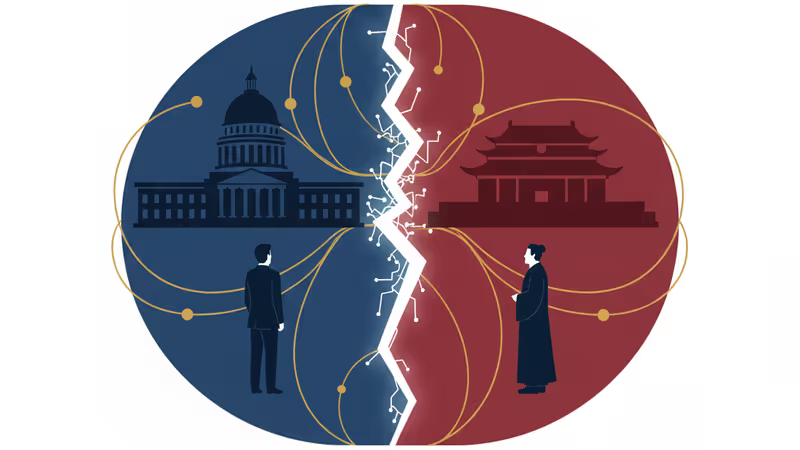
The 2025 US defense bill codifies a tech and capital blockade against China. This analysis explores the impact on biotech, VC, and global supply chains.
President Trump quietly signed a record defense bill, but its contents reveal a major policy clash with Congress over Ukraine aid and NATO, signaling deep US strategic uncertainty.
Kazakhstan's new 'LGBT propaganda' law isn't just a domestic issue. It's a geopolitical signal with major implications for tech firms and foreign investors.

Beyond a talent grab, OpenAI's hiring of George Osborne is a geopolitical play to shape global AI regulation. PRISM analyzes the implications for tech and state power.