
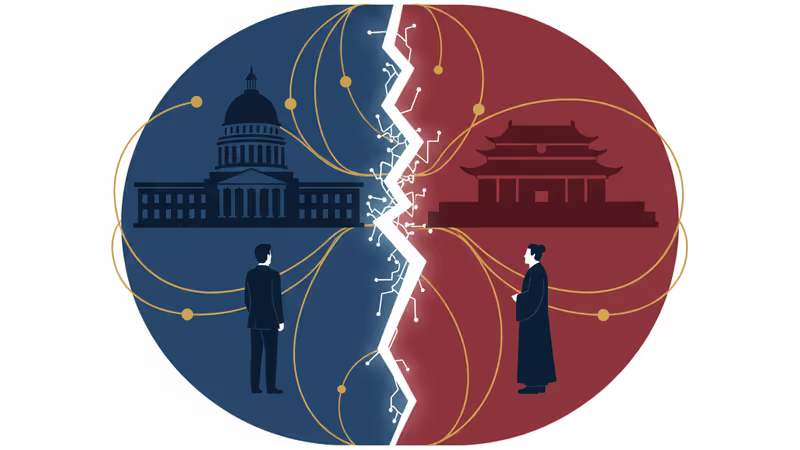
The New Tech Iron Curtain: US Law Now Mandates a US-China Decoupling
The 2025 US defense bill codifies a tech and capital blockade against China. This analysis explores the impact on biotech, VC, and global supply chains.
The Lede: Beyond Tariffs, a New Era of Legislated Tech Rivalry
The latest US National Defense Authorization Act (NDAA) for 2025 is far more than a military budget. For global executives and investors, it represents a pivotal moment: the transition from temporary trade tactics to permanent, legislated strategy. By restricting US capital flows into Chinese tech and severing federal ties with Chinese biotech firms, Washington has codified the US-China tech rivalry into law. This isn't a negotiating position; it's the new baseline for global commerce, signaling that the era of unfettered tech and capital exchange is definitively over, regardless of who occupies the White House.
Why It Matters: The Ripple Effects Across Industries
This legislation creates immediate, tangible friction in two critical sectors, with second-order effects that will cascade globally.
- Biotech Supply Chains Face a Reckoning: The Biosecure Act provision effectively walls off targeted Chinese biotech firms from the lucrative US federal market, including contracts with the NIH and Defense Department. This forces global pharmaceutical and research organizations to re-evaluate their supply chains, accelerating a costly and complex shift towards 'friend-shoring' or reshoring R&D and manufacturing. The reputational risk extends beyond federal contracts, pressuring private sector partners to divest from Chinese biotech collaborators.
- A 'Digital Berlin Wall' for Venture Capital: The FIGHT China Act puts US venture capital and private equity on notice. Investing in Chinese AI, quantum computing, or advanced semiconductor firms is no longer just a business decision but a matter of national security compliance. This creates a significant chilling effect, forcing funds to either bifurcate their operations—one for China, one for the rest of the world—or withdraw from the Chinese market entirely. The era of frictionless global tech investment is over.
The Analysis: From Trade War to Enduring Strategy
This moment represents the maturation of US policy towards China. What began under the Trump administration as a disruptive trade war focused on tariffs and trade deficits has evolved into a durable, bipartisan consensus centered on strategic competition. The inclusion of these measures in a 'must-pass' bill like the NDAA demonstrates that this is no longer a partisan issue but a foundational element of American foreign policy for the foreseeable future.
This legislative action deliberately bypasses the noise of temporary 'trade truces'. While diplomats may negotiate tariff levels, Congress is building a permanent structural barrier. This is a shift from a defensive posture (blocking Chinese companies like Huawei from US markets) to an offensive one: actively impeding China's technological advancement by starving it of US capital and expertise. Beijing will undoubtedly view this not as a trade measure, but as an act of strategic containment. Its response is unlikely to be symmetrical tariffs, but rather an acceleration of its 'dual circulation' strategy to achieve technological self-sufficiency and the implementation of its own 'unreliable entity' lists, further fracturing the global tech landscape.
PRISM Insight: Geopolitical Risk is Now a Due Diligence Line Item
The key trend this legislation solidifies is the fusion of technology and geopolitics. The decoupling is no longer confined to hardware and 5G. It is moving simultaneously 'up the stack' into advanced software like AI and 'down the stack' into foundational sciences like biotechnology. The focus is squarely on dual-use technologies where the line between commercial innovation and military application is irrevocably blurred.
For investors, this means geopolitical risk assessment is no longer a niche consideration but a mandatory component of due diligence. Investment committees must now include analysts who can interpret legislation like the NDAA and forecast retaliatory measures from Beijing. The most valuable tech will now be judged not just on its innovation, but on its geopolitical alignment.
PRISM's Take: The Decoupling is No Longer a Debate, It's an Implementation Plan
The passage of the 2025 NDAA should be seen as a point of no return. It silences the debate over *whether* a US-China decoupling will happen and instead focuses policy on *how* it will be implemented. This act transforms the economic competition from a series of tactical skirmishes into a long-term strategic reality embedded in US law.
For business leaders, the implication is clear: operating a single, seamless global strategy across the US and China is now untenable. The future belongs to those who can build resilient, bifurcated, or regionalized operations. The 'trade truce' is a diplomatic mirage; the real story is the construction of a new iron curtain, this one forged not from steel, but from silicon, genetic code, and capital controls.
Related Articles

An aggressive US maritime campaign against Venezuela is more than a drug war; it's a geopolitical flashpoint challenging international law and risking a wider conflict.

The EU's €90B loan for Ukraine is more than aid; it's a strategic pivot. We analyze the decision to avoid Russian assets and its global financial impact.

As the US rethinks its global role, China sees a leadership vacuum. But top advisors admit its bid is failing to win 'hearts and minds.' An analysis.

The TikTok US deal is more than a sale. It's a new geopolitical playbook for big tech, creating a blueprint for techno-nationalism and a fractured internet.