
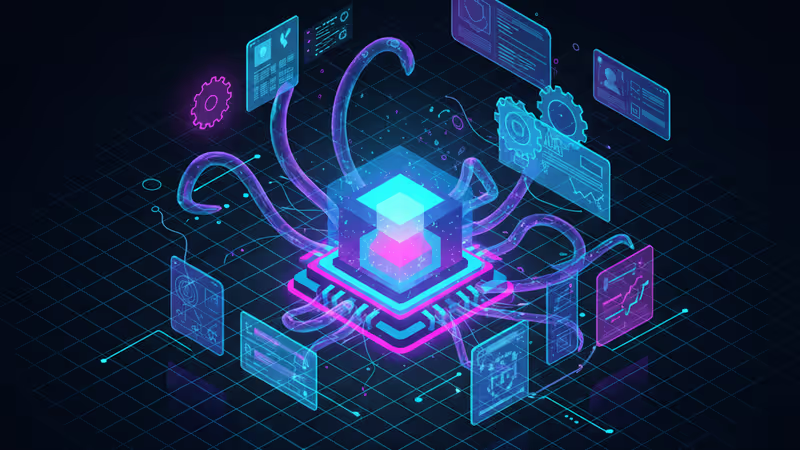
Beyond Chat: Why OpenAI's GPT-5.2 Is a Strategic Play for the Agentic AI Future
Our analysis of OpenAI's GPT-5.2 reveals a major strategic pivot from AI copilots to autonomous agents, fundamentally altering the future of work and enterprise AI.
The Lede: OpenAI Declares the Copilot Era is Over
OpenAI's announcement of GPT-5.2 isn't about a marginally better chatbot. It's a declaration that the next frontier of artificial intelligence lies in autonomous systems that execute professional work. By explicitly targeting "faster, more reliable agentic workflows," OpenAI is signaling a strategic pivot from AI as a passive assistant to AI as an active, digital worker. For any enterprise leader, developer, or investor, this marks a critical inflection point: the era of the 'copilot' is giving way to the age of the 'agent,' and the implications for productivity and market disruption are profound.
Why It Matters: The Automation Stack is Being Built
For the past two years, the dominant enterprise AI narrative has been the 'copilot'—an AI companion that helps humans work better. Microsoft built its entire AI strategy around this concept. GPT-5.2's positioning challenges this paradigm directly. It's not about helping you write an email; it's about an AI system that can manage your entire inbox, schedule meetings, and execute follow-up tasks based on email content.
The second-order effects are significant:
- B2B SaaS Under Threat: Companies providing single-purpose automation tools (e.g., scheduling assistants, report generators) are now competing with a foundational model designed to orchestrate these tasks natively.
- The Labor Market Redefined: The target for automation is no longer just rote tasks. 'Agentic workflows' implies the automation of multi-step, complex processes currently handled by project managers, analysts, and developers.
- A New Arms Race: The competitive benchmark is no longer about chatbot fluency or creative prowess. It's about reliability in execution. Who can build the agent that fails the least often when performing a 10-step task? This is where the enterprise battle will be won or lost.
The Analysis: A Calculated Move to Own the Future of Work
From Reasoning Engine to Action Engine
The evolution of OpenAI's models tells a clear story. GPT-3 was a text generator, a probabilistic parrot of unprecedented scale. GPT-4 introduced a new level of reasoning, allowing it to function as a knowledge worker's thought partner. Now, GPT-5.2 is being explicitly framed as an action engine. The emphasis on 'reliability' and 'workflows' is a direct appeal to the enterprise, where hallucinations are not a quirky bug but a critical business failure. By focusing on dependability, OpenAI is addressing the primary barrier to deploying AI for mission-critical, autonomous tasks.
Commoditizing Autonomy, Forcing a New Value Layer
By integrating state-of-the-art agentic capabilities into its core API, OpenAI is effectively commoditizing the base layer of AI autonomy. This puts immense pressure on rivals like Google and Anthropic, as well as the swarm of startups building AI agent platforms. The game is no longer about having an agent; it's about what your agent can uniquely do. Value will now shift to:
- Vertical Specialization: Agents tailored for specific industries (e.g., a legal agent that can perform discovery, or a financial agent that can execute portfolio analysis).
- Proprietary Data & Tool Integration: The ability to connect agents securely to internal company systems and proprietary tools will be the key differentiator.
- User Experience & Trust: Designing interfaces that allow humans to safely manage, oversee, and trust teams of digital agents.
PRISM Insight: The Impact on Enterprise & Investment Strategy
For Enterprise Leaders (CIOs/CTOs): Your AI roadmap needs to evolve immediately. The question is no longer "How can we give our teams a copilot?" It is now "Which business units can we revolutionize by deploying autonomous agentic workflows?" Proof-of-concept projects should shift from internal knowledge base chatbots to automating complex processes like supply chain logistics, customer support escalations, or even software development and deployment pipelines. The key metric for ROI is no longer just time saved on individual tasks, but entire workflows made redundant.
For Investors: The landscape for AI investment has just tilted. Startups that are merely thin wrappers around a foundational model's agent capabilities face an extinction-level event. The premium opportunities now lie with companies building the picks and shovels for this new era: monitoring and security tools for AI agents, specialized agent development platforms for high-stakes industries like healthcare and finance, and companies that are creating defensible 'moats' through proprietary data that can train agents for tasks no generic model can perform.
PRISM's Take: The Training Wheels Are Off
GPT-5.2 is less a product launch than a statement of intent. OpenAI is making a calculated bet that the exponential value of AI will be unlocked not by making humans incrementally more efficient, but by creating a new class of digital labor that can be deployed at scale. The focus on 'reliable agentic workflows' is a clear signal that the company is moving beyond the experimental phase of AI and building the foundational infrastructure for the automated enterprise. The copilots were the training wheels; OpenAI has just taken them off. The race to build, deploy, and manage a digital workforce has officially begun.
Related Articles

BNY is arming 20,000 employees with OpenAI. This isn't just about efficiency—it's a new blueprint for enterprise AI that will create a new class of winners and losers.

Chai Discovery's $130M raise at a $1.3B valuation isn't about a single drug. It's a strategic move by OpenAI's ecosystem to build the dominant AI platform for biotech.

OpenAI's quiet GPT-5.2 update is a strategic signal. Our analysis reveals why this shift from hype to stability marks a new, more mature era for the AI industry.
OpenAI's GPT-5.2 isn't just another upgrade. Its mastery of math and science signals a fundamental shift from creative AI to a new era of automated discovery.