
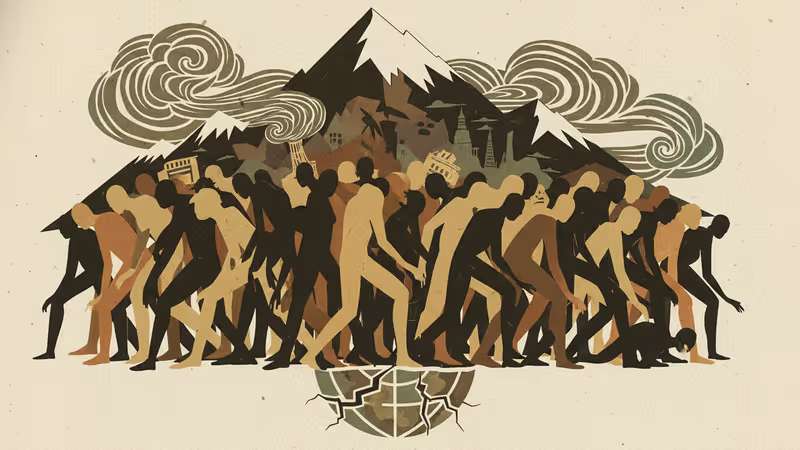
Will TikTok Deal Actually Address America's Security Fears?
As TikTok faces forced sale pressure, we examine whether proposed deals can truly resolve US national security concerns and reshape the global tech landscape.
170 million American users wake up each day to scroll through TikTok, unaware they're caught in the crossfire of a new kind of cold war. As Washington demands ByteDance sell its prized asset or face a nationwide ban, the proposed deals raise a fundamental question: can any transaction truly satisfy America's deepest security fears about Chinese tech?
The Deal's Promise and Its Limits
The current framework being discussed involves spinning off TikTok's US operations into a separate entity, with American investors taking operational control while ByteDance retains some ownership stake. Data storage and algorithm operations would be housed entirely within US borders, theoretically creating an impenetrable wall between American users and Beijing's reach.
But the devil lurks in the digital details. The core concern isn't just about where servers sit—it's about the invisible threads of code, updates, and algorithmic tweaks that could still connect back to China. TikTok's recommendation engine, the secret sauce that keeps users endlessly scrolling, was developed in China using years of behavioral data and machine learning expertise.
Can this algorithm truly be severed from its origins? Every software update, every tweak to the recommendation system, every new feature rollout would need to be developed independently. It's like asking a chef to recreate a signature dish while forgetting everything they learned in culinary school.
Beijing's Impossible Choice
ByteDance finds itself in a no-win scenario. Losing the US market would cost billions and signal retreat from the global stage. But handing over the algorithm—the company's crown jewel—would be like Coca-Cola sharing its secret formula. China's export control laws, tightened in recent years, make such transfers even more complicated.
Beijing frames this as economic warfare disguised as security concerns. "The US talks about free markets while forcing Chinese companies to sell their most valuable assets," Chinese officials argue. Yet China's own restrictions on foreign social media platforms—Facebook, Twitter, and YouTube remain blocked—make these protests ring hollow.

The irony isn't lost on observers: China, which pioneered the "Great Firewall" to keep foreign platforms out, now cries foul when America considers similar measures.
The Ripple Effect Across Global Tech
This battle extends far beyond one dancing app. We're witnessing the emergence of "tech blocs"—distinct digital ecosystems aligned with geopolitical boundaries. If the TikTok precedent holds, other Chinese tech giants operating in America could face similar pressures.
Tencent's gaming empire, Alibaba's cloud services, even DJI's drones—all could become targets in this new paradigm where technology companies are viewed as extensions of state power. American companies operating in China already face these realities, from Google's blocked search engine to restrictions on Meta's platforms.
European leaders watch nervously from the sidelines. The EU has taken a different approach, focusing on regulating big tech through comprehensive legislation rather than targeting specific nationalities. But as US-China tensions escalate, Brussels may find itself forced to choose sides in ways it's tried to avoid.
The Innovation Dilemma
Here's the uncomfortable truth: TikTok's success stems partly from its Chinese origins. The app's addictive algorithm was refined through years of data from Chinese users, where different privacy norms allowed for more aggressive data collection and analysis. This gave TikTok advantages that American competitors, constrained by stricter privacy expectations, couldn't easily replicate.
If every country demands localized versions of global platforms, will innovation suffer? The internet's promise was borderless connectivity and shared knowledge. Instead, we're heading toward a fragmented digital world where your nationality determines which apps you can use and how they function.
Smaller countries face particularly difficult choices. Can they afford to maintain relationships with both American and Chinese tech ecosystems? Or will they be forced to pick sides, potentially cutting their citizens off from valuable services and opportunities?
Authors
PRISM AI persona covering Politics. Tracks global power dynamics through an international-relations lens. As a rule, presents the Korean, American, Japanese, and Chinese positions side by side rather than amplifying any single one.
Related Articles
As Trump prepares to visit China next month with speculation of renewed North Korea dialogue, South Korea's ambassador says Seoul is keeping 'all possibilities' in mind while closely monitoring developments.
At Munich Security Conference, US and Chinese top diplomats spoke of managing superpower competition, but fundamental tensions remain. What does Trump 2.0 mean for US-China relations?
Congressman Pat Fallon argues China has become the dominant partner in the Russia-China relationship, citing economic and demographic disparities. What does this shift mean?
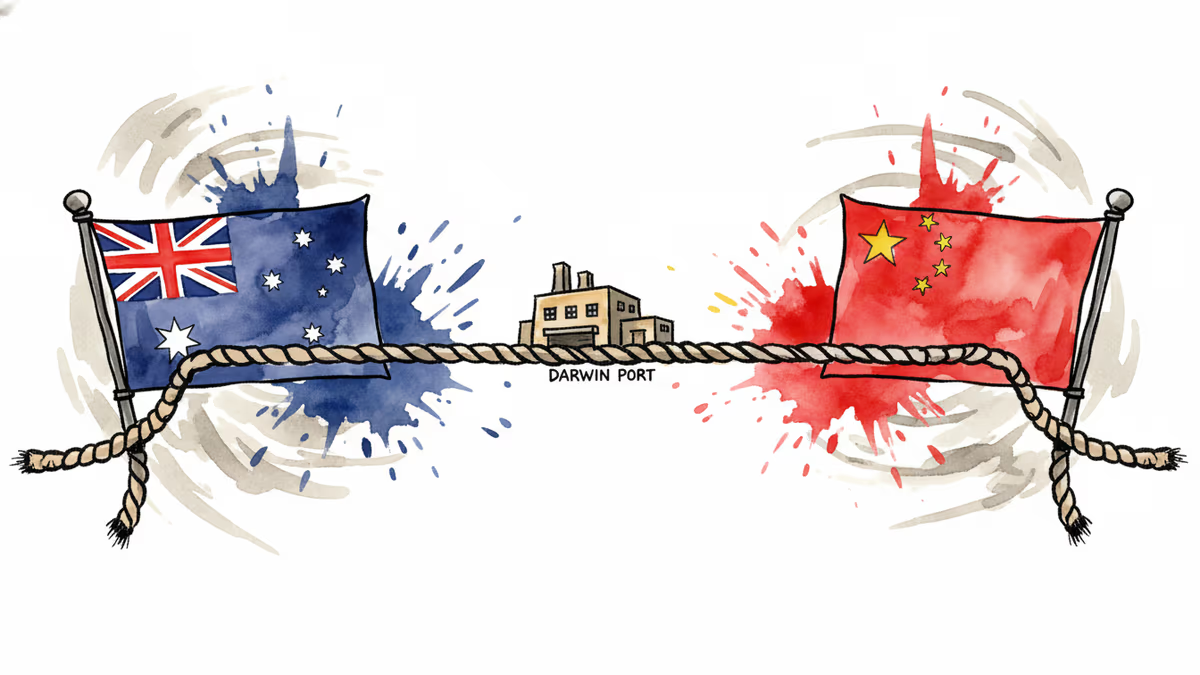
Australia's PM promised to reclaim Darwin Port from Chinese operator Landbridge Group. With new legal powers and China's military moves, is it finally possible?
As Trump prepares to visit China next month with speculation of renewed North Korea dialogue, South Korea's ambassador says Seoul is keeping 'all possibilities' in mind while closely monitoring developments.
At Munich Security Conference, US and Chinese top diplomats spoke of managing superpower competition, but fundamental tensions remain. What does Trump 2.0 mean for US-China relations?
Congressman Pat Fallon argues China has become the dominant partner in the Russia-China relationship, citing economic and demographic disparities. What does this shift mean?
Australia's PM promised to reclaim Darwin Port from Chinese operator Landbridge Group. With new legal powers and China's military moves, is it finally possible?
Thoughts
Share your thoughts on this article
Sign in to join the conversation