
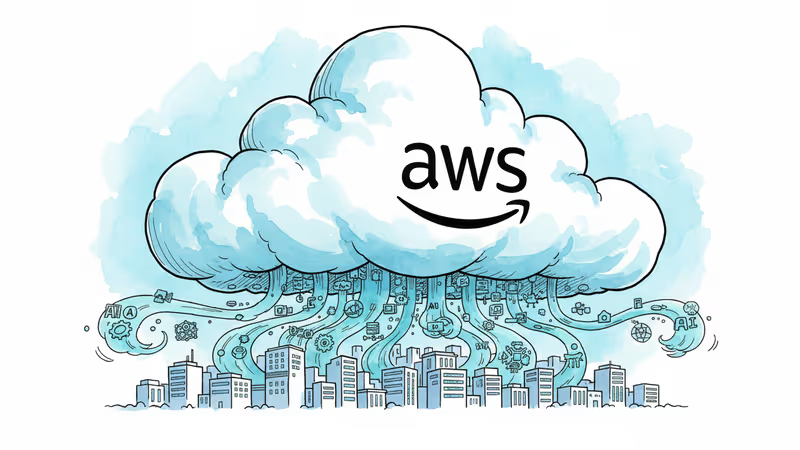
Why AWS Hit Its Strongest Growth in 13 Quarters
AWS recorded 24% growth in Q4 2025, its highest rate in 13 quarters, driven by AI workloads and enterprise cloud migration. What this means for the cloud computing landscape.
What does it mean to grow 24% on a $142 billion annual run rate? That's exactly what Amazon Web Services delivered in Q4 2025, marking its strongest quarterly growth in 13 quarters. But the real story isn't just about impressive numbers—it's about how AWS is capitalizing on two massive shifts happening simultaneously in enterprise computing.
The Scale Behind the Numbers
AWS reported $35.6 billion in Q4 revenue, up 24% year-over-year. To put that in perspective, the company added roughly $6.9 billion in quarterly revenue compared to the same period in 2024. That's more than many entire companies generate in a year.
Operating income jumped to $12.5 billion from $10.6 billion in Q4 2024, representing an 18% increase. Andy Jassy, Amazon's CEO, made a pointed comment during the earnings call: "It's very different having 24% year-over-year growth on $142 billion annualized run rate than to have a higher percentage growth on a meaningfully smaller base, which is the case with our competitors."
The quarter was fueled by major new agreements with Salesforce, BlackRock, Perplexity, and the U.S. Air Force. Jassy noted that "more of the top 500 U.S. startups use AWS as their primary cloud provider than the next two providers combined."
The Perfect Storm: Legacy Migration Meets AI Boom
AWS's growth is being driven by two powerful trends that are converging at just the right moment. First, there's still a massive wave of enterprises moving from on-premises infrastructure to the cloud. Despite years of cloud adoption, many companies are still in the middle of this transition.
Second, the AI revolution is creating unprecedented demand for cloud computing resources. Jassy explained that customers "want to run their AI workloads where the rest of their applications and data are." More importantly, he noted that "as customers run large AI workloads on AWS, they're adding to their core AWS footprint as well."
This creates a virtuous cycle: AI workloads bring customers to AWS, and once they're there, they expand their overall cloud usage. The company added more than a gigawatt of power to its data center network in Q4 alone—a testament to the massive computing demands of AI applications.

Market Reaction: Success with a Side of Skepticism
Despite AWS's strong performance, Amazon shares fell 10% in after-hours trading. The culprit? Investors were spooked by the company's plans to increase capital expenditures and disappointed by earnings per share that missed Wall Street expectations.
This reaction highlights a key tension in the cloud computing space: the massive investments required to stay competitive in the AI era. AWS is essentially betting billions on infrastructure buildout, gambling that AI demand will justify the costs.
AWS represents 16.6% of Amazon's total $213.4 billion quarterly revenue, but it's arguably the most profitable and strategically important segment. The cloud division's success has allowed Amazon to invest heavily in other areas, from logistics to entertainment.
The Competitive Landscape Shifts
Jassy's comment about competitors having "higher percentage growth on a meaningfully smaller base" wasn't accidental. It's a direct shot at Microsoft Azure and Google Cloud, both of which have been reporting impressive growth rates but from much smaller revenue bases.
The reality is that in cloud computing, scale creates more scale. AWS's massive infrastructure allows it to offer more services, better pricing, and higher reliability—which attracts more customers, which justifies more infrastructure investment. It's a flywheel that's becoming increasingly difficult for competitors to disrupt.
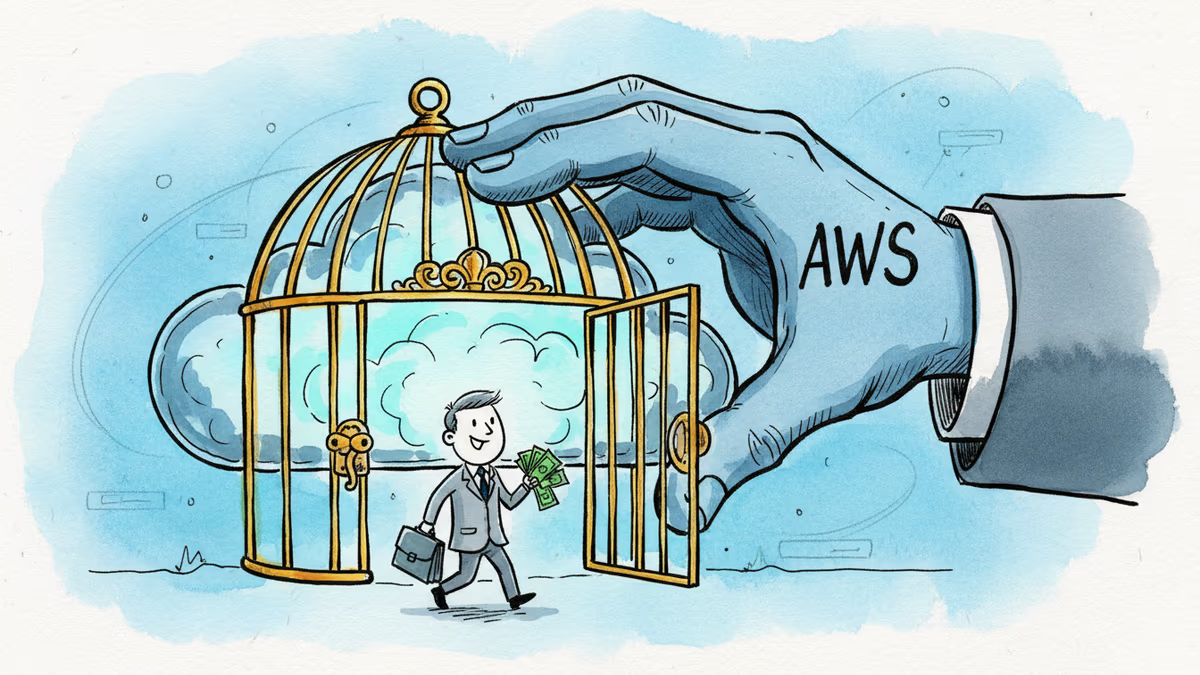
For enterprise customers, this presents both opportunities and risks. On one hand, AWS's continued investment means access to cutting-edge services and infrastructure. On the other hand, increasing dependence on a single provider raises questions about vendor lock-in and competitive pricing.
What This Means for the Industry
The implications extend far beyond Amazon's bottom line. AWS's success is accelerating the shift toward cloud-native architectures and AI-first business strategies. Companies that haven't yet made the transition are finding themselves at an increasing disadvantage.
For startups, AWS's dominance among the top 500 U.S. startups suggests that cloud infrastructure choice is becoming less about technical features and more about ecosystem effects. Being where other innovative companies are creates networking effects and partnership opportunities.
The AI angle is particularly significant. As Jassy noted, AWS offers a "top-to-bottom AI stack," meaning companies can build entire AI applications using AWS services. This integration makes it harder for customers to switch providers and creates deeper technical dependencies.
Authors
Related Articles

Snowflake's new $6 billion AWS contract is about more than cloud spending. It signals a shift in AI infrastructure—away from Nvidia GPUs and toward cheaper, homegrown chips for the agent era.

Amazon has poured an additional $5 billion into Anthropic, bringing its total stake to $13 billion—with up to $20 billion more on the table. Here's what the deal really signals about the AI infrastructure race.
Amazon's fresh $5B investment in Anthropic brings its total to $13B. But the real story is a $100B AWS spending pledge and a bet on Amazon's own AI chips over Nvidia.

Iran's drone strikes on AWS data centers and its naming of 18 tech firms as military targets expose a structural flaw in AI infrastructure: civilian and military data sit on the same physical servers.
Snowflake's new $6 billion AWS contract is about more than cloud spending. It signals a shift in AI infrastructure—away from Nvidia GPUs and toward cheaper, homegrown chips for the agent era.
Amazon has poured an additional $5 billion into Anthropic, bringing its total stake to $13 billion—with up to $20 billion more on the table. Here's what the deal really signals about the AI infrastructure race.
Amazon's fresh $5B investment in Anthropic brings its total to $13B. But the real story is a $100B AWS spending pledge and a bet on Amazon's own AI chips over Nvidia.
Iran's drone strikes on AWS data centers and its naming of 18 tech firms as military targets expose a structural flaw in AI infrastructure: civilian and military data sit on the same physical servers.
Thoughts
Share your thoughts on this article
Sign in to join the conversation