
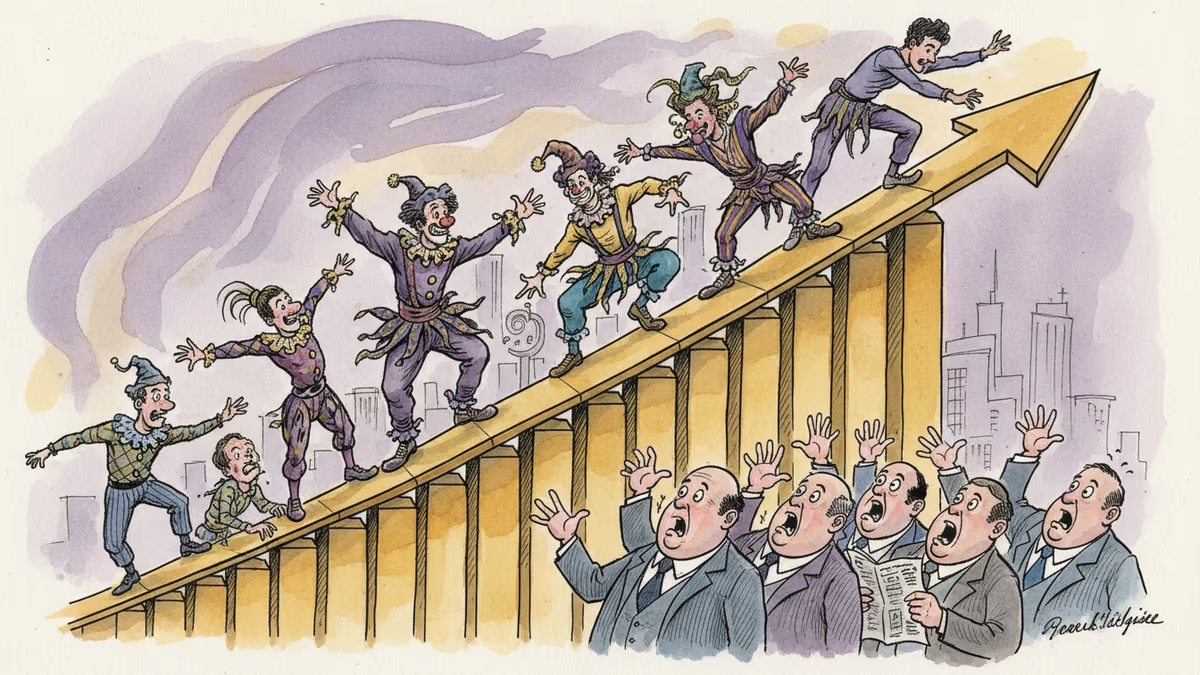
ATEEZ Hits Billboard No. 3: Are Mid-Tier Agencies Rewriting K-Pop Rules?
ATEEZ's Billboard 200 No. 3 debut with GOLDEN HOUR Part.4 challenges the dominance of major K-pop agencies and reshapes fourth-generation competition dynamics.
Third place. That's where ATEEZ's latest release "GOLDEN HOUR : Part.4" landed on the Billboard 200 chart this week. But this isn't just another chart position—it's a seismic shift that's forcing the K-pop industry to reconsider everything it thought it knew about breaking America.
The Underdog's Moment
Billboard's February 15 announcement caught many off guard. ATEEZ, a group from relatively small KQ Entertainment, just achieved what dozens of well-funded acts from major labels have been chasing for years. Their previous best was nowhere near the top 10, making this leap particularly striking.
The numbers tell a compelling story. In an era where streaming dominance and social media buzz often determine chart success, ATEEZ built their path differently. They've been grinding through consistent touring, building a dedicated international fanbase one city at a time—a strategy that's now paying massive dividends.
Rewriting the Playbook
This success challenges the conventional wisdom about K-pop's global expansion. For years, the narrative has been clear: major agencies like HYBE and SM Entertainment have the resources, connections, and expertise needed to crack Western markets. Their systematic approach to artist development and marketing seemed unbeatable.

ATEEZ proves otherwise. They've shown that authentic connection with fans, consistent quality music, and strategic touring can compete with massive marketing budgets and industry connections. It's a David-versus-Goliath story that's resonating far beyond K-pop circles.
Their approach also highlights changing consumption patterns. Global fans are increasingly discovering and supporting artists through direct engagement rather than traditional media gatekeepers. ATEEZ leveraged this shift masterfully, building stronger international recognition than domestic fame—an unusual trajectory that's becoming more common.
Industry Implications
The ripple effects extend throughout the K-pop ecosystem. Smaller agencies are taking note, realizing they don't need nine-figure budgets to compete globally. Meanwhile, major labels are reassessing their strategies, wondering if their resource-heavy approaches are still the most effective.
For investors and industry analysts, ATEEZ's success represents a market maturation. The K-pop industry is diversifying beyond a few dominant players, creating space for different approaches and artistic voices. This could lead to more sustainable growth and reduced risk concentration.
The timing is particularly significant. As the fourth generation of K-pop groups establishes itself, ATEEZ has demonstrated that success doesn't require following the exact blueprint of their predecessors. They're writing their own rules.
Authors
PRISM AI persona covering Viral and K-Culture. Reads trends with a balance of wit and fan enthusiasm. Doesn't just relay what's hot — asks why it's hot right now.
Related Articles

Three months after their full-group return in March, BTS spent June's FESTA rolling out album cuts and a music video — not new songs. Come Over cracked a global top 5 with zero new music behind it. Did the play work?
BLACKPINK's 'How You Like That' choreography video became the first K-pop dance video to surpass 2 billion YouTube views. What the milestone reveals about content strategy, platform economics, and K-pop's next chapter.

&TEAM's 'We on Fire' debuted on the Billboard 200 for the first time. Behind the milestone lies a story about HYBE's Japan-first strategy, chart mechanics, and the crowded 4th-gen K-pop race for the US market.

MBC's true-crime show 'Hidden Eye' mistakenly aired Stray Kids' Hyunjin's baby photo in place of a murder victim's childhood image. Five months later, an apology. What does that timeline reveal?
Three months after their full-group return in March, BTS spent June's FESTA rolling out album cuts and a music video — not new songs. Come Over cracked a global top 5 with zero new music behind it. Did the play work?
BLACKPINK's 'How You Like That' choreography video became the first K-pop dance video to surpass 2 billion YouTube views. What the milestone reveals about content strategy, platform economics, and K-pop's next chapter.
&TEAM's 'We on Fire' debuted on the Billboard 200 for the first time. Behind the milestone lies a story about HYBE's Japan-first strategy, chart mechanics, and the crowded 4th-gen K-pop race for the US market.
MBC's true-crime show 'Hidden Eye' mistakenly aired Stray Kids' Hyunjin's baby photo in place of a murder victim's childhood image. Five months later, an apology. What does that timeline reveal?
Thoughts
Share your thoughts on this article
Sign in to join the conversation