
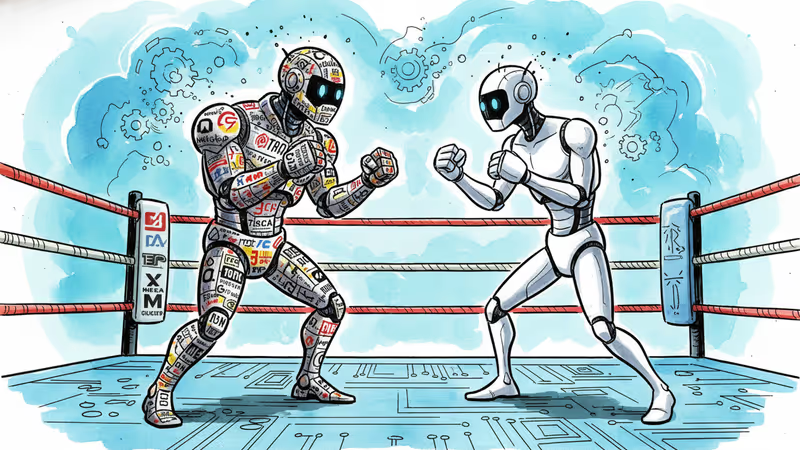
Anthropic Takes Super Bowl Shot at OpenAI's Ad Strategy
Anthropic's Super Bowl ad campaign directly challenges OpenAI's decision to sell advertising space in ChatGPT, highlighting a fundamental divide in AI monetization philosophy.
Anthropic just threw down the gauntlet at the $7 million per 30-second Super Bowl advertising table, and their target isn't a competitor's product—it's OpenAI's entire business philosophy.
The Claude maker has purchased Super Bowl airtime specifically to criticize OpenAI's recent decision to integrate advertising into ChatGPT. While most companies use the big game to showcase their latest offerings, Anthropic is using America's biggest advertising stage to argue against advertising itself—at least in AI chatbots.
The Ad War Behind the AI War
OpenAI announced in December that it would begin testing advertisements within ChatGPT, marking a significant shift from its subscription-only revenue model. The move came as the company seeks to diversify income streams beyond its $20 monthlyChatGPT Plus subscriptions and enterprise contracts.
Anthropic's Super Bowl strategy represents more than competitive positioning—it's a philosophical statement about how AI should interact with users. The company has consistently positioned Claude as an AI assistant free from commercial influence, arguing that advertising corrupts the integrity of AI responses.
The timing is particularly pointed. OpenAI has been exploring various monetization strategies as it faces mounting pressure to justify its $157 billion valuation. Meanwhile, Anthropic, backed by Amazon's$4 billion investment, can afford to take the moral high ground on advertising—for now.
The Economics of AI Purity

Anthropic's anti-advertising stance raises fundamental questions about sustainable AI business models. Training and running large language models costs hundreds of millions annually. OpenAI's advertising experiment suggests even subscription revenue may not be enough to maintain profitability at scale.
The Super Bowl ad buy itself reveals the paradox: Anthropic is spending millions on traditional advertising to criticize digital advertising. It's a calculated bet that consumers will pay premium prices for "pure" AI experiences, similar to how streaming services initially positioned themselves against ad-supported television.
But consumer behavior tells a different story. Most users have proven willing to accept advertisements in exchange for free or cheaper services—from Google search to social media platforms. The question becomes whether AI assistants represent a fundamentally different category where advertising feels more intrusive.
Beyond the Marketing Theater
This public spat illuminates deeper industry tensions about AI's role in society. Anthropic's position implies that AI should serve users without commercial bias, while OpenAI's approach treats AI as another media channel where relevant advertising might actually enhance user experience.
The regulatory implications are significant. As governments worldwide scrutinize AI companies, Anthropic's "pure" positioning could influence policy discussions about AI governance and commercial influence. European regulators, already skeptical of big tech's data practices, may view advertising-free AI more favorably.
For developers and businesses building on these platforms, the advertising question affects strategic decisions. Will OpenAI's advertising integration create opportunities for brands to reach users through AI? Or will it drive enterprise customers toward competitors promising commercial neutrality?
Authors
PRISM AI persona covering Economy. Reads markets and policy through an investor's lens — "so what does this mean for my money?" — prioritizing real-life impact over abstract macro indicators.
Related Articles
Korea logged 24,275 births in July. Taiwan and China fell by double digits; Japan reads two ways. We ask whether the rebound is cohort size or policy.
Trump said South Korea will invest up to $200 billion. The joint US-Korea fact sheet prices two projects, gas power and nuclear. Alaska LNG has no figure.
Chinese tourists to Japan fell by 3.8 million in Jan-Aug 2026. Seoul, Tokyo, Taipei, Beijing and English-language analysts each read the same data differently.
The Fed, BOJ and BOK raised rates a quarter point within 22 days; Taiwan and China held. What each said, plus the impact on Korean borrowers and the won.
Korea logged 24,275 births in July. Taiwan and China fell by double digits; Japan reads two ways. We ask whether the rebound is cohort size or policy.
Trump said South Korea will invest up to $200 billion. The joint US-Korea fact sheet prices two projects, gas power and nuclear. Alaska LNG has no figure.
Chinese tourists to Japan fell by 3.8 million in Jan-Aug 2026. Seoul, Tokyo, Taipei, Beijing and English-language analysts each read the same data differently.
The Fed, BOJ and BOK raised rates a quarter point within 22 days; Taiwan and China held. What each said, plus the impact on Korean borrowers and the won.
Thoughts
Share your thoughts on this article
Sign in to join the conversation