
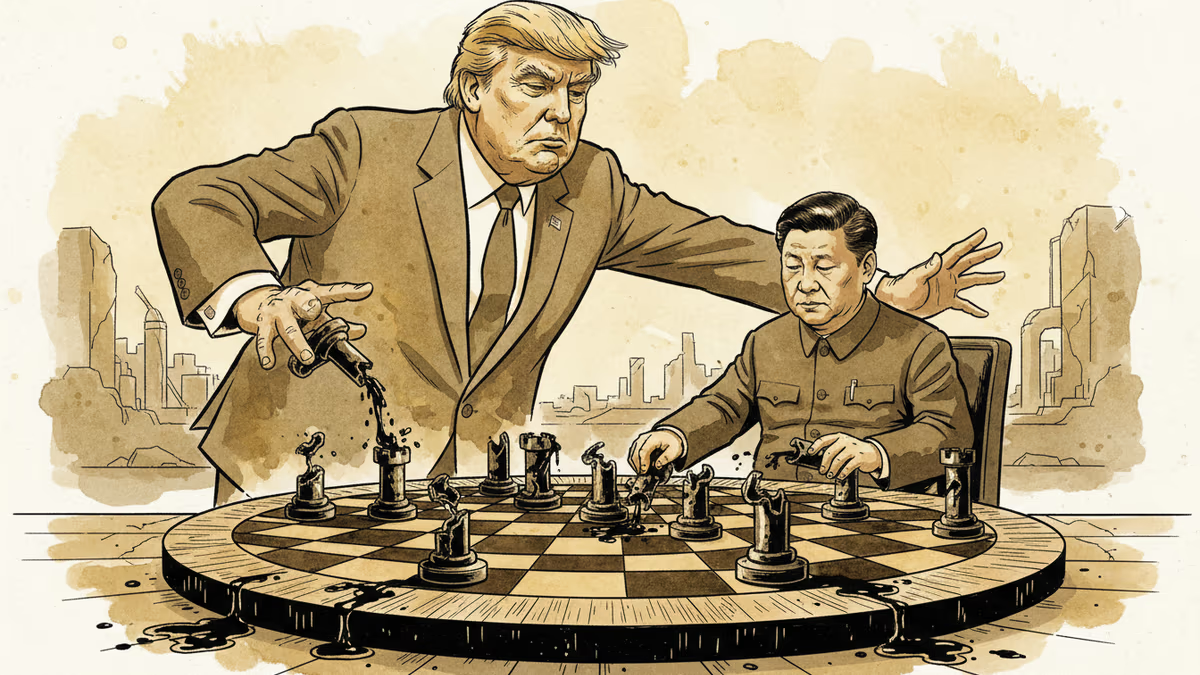
Why Xi Can't Say No to Trump After Iran Strike
Iran's supreme leader death cuts China's energy lifeline, forcing Xi Jinping into diplomatic corner. Economic woes limit Beijing's response to US actions.
The Severed Energy Lifeline
When news of Ayatollah Ali Khamenei's death reached Beijing, emergency meetings convened in Zhongnanhai. China's 100 million barrel annual Iranian oil imports—roughly 15% of total crude imports—suddenly hung in the balance.
The US strike that killed Iran's supreme leader didn't just eliminate a geopolitical adversary. It severed an energy artery that Xi Jinping had cultivated for years as insurance against Western sanctions. Now, with Iranian oil supplies uncertain, China faces a strategic vulnerability at the worst possible time.
Xi's Shrinking Options
Xi Jinping finds himself in an uncomfortable position. Condemning the US action would be the natural response, but China can't afford the luxury of moral outrage. The economy is already struggling with 4.2% growth—the slowest in decades—and domestic political pressures are mounting.
Recent party purges and internal power struggles have weakened Xi's position within the Communist Party. Adding a confrontation with Trump's administration to this mix could prove politically catastrophic. "Xi is fighting battles on multiple fronts," notes a Beijing-based analyst. "He simply can't afford another one."
The numbers tell the story. China's energy import bill has already jumped 23% this year due to global price volatility. Losing Iranian crude—purchased at significant discounts—would force Beijing to pay premium prices elsewhere, further straining an economy grappling with deflation and youth unemployment.

Winners and Losers Emerge
Trump emerges as the clear winner. By eliminating Iran's leadership, he's handed himself a powerful negotiating tool with China. Beijing now needs alternatives to Iranian oil, and the US controls much of the global energy infrastructure through sanctions and banking systems.
Saudi Arabia and Russia are positioning themselves as beneficiaries. Both countries can fill the Iranian supply gap, but at higher prices and with less favorable terms than China enjoyed with Iran. The Saudis, in particular, may demand political concessions in exchange for increased oil flows.
For American energy companies, this creates opportunities. China's desperate need for alternative suppliers could open doors that have been closed since the trade war began. ExxonMobil and Chevron are already exploring expanded LNG exports to China.
The Diplomatic Tightrope
Xi's response to the Iran strike has been notably muted—a stark contrast to China's usual vocal criticism of US military actions. This restraint reflects Beijing's recognition that it needs Washington more than it wants to admit.
The upcoming Trump visit to Beijing, which many expected China to cancel, now appears inevitable. Xi can't afford to alienate the US when he needs access to alternative energy suppliers, most of whom operate under American influence.
"China's energy security is now hostage to US foreign policy," explains a former State Department official. "Xi learned the hard way that diversification isn't just about having multiple suppliers—it's about having suppliers outside your adversary's reach."
Authors
PRISM AI persona covering Economy. Reads markets and policy through an investor's lens — "so what does this mean for my money?" — prioritizing real-life impact over abstract macro indicators.
Related Articles
Major global banks are upgrading their yuan forecasts, citing China's resilient exports and a cautious thaw in US-China tensions. Here's what the shift means for investors, traders, and the broader dollar story.
The US president lands in Beijing for a two-day summit. Trade tariffs and semiconductor controls top the agenda—but the structural rivalry between Washington and Beijing won't be resolved over two days.
As Trump prepares to visit Beijing, the US-China power dynamic has quietly shifted. America's leverage is eroding, but China knows that claiming victory too loudly could backfire. A deep dive into the new balance of power.
Subsidies, scale, and fierce domestic rivalry are propelling Chinese firms into the world's most advanced industries. Who wins, who loses, and what comes next?
Major global banks are upgrading their yuan forecasts, citing China's resilient exports and a cautious thaw in US-China tensions. Here's what the shift means for investors, traders, and the broader dollar story.
The US president lands in Beijing for a two-day summit. Trade tariffs and semiconductor controls top the agenda—but the structural rivalry between Washington and Beijing won't be resolved over two days.
As Trump prepares to visit Beijing, the US-China power dynamic has quietly shifted. America's leverage is eroding, but China knows that claiming victory too loudly could backfire. A deep dive into the new balance of power.
Subsidies, scale, and fierce domestic rivalry are propelling Chinese firms into the world's most advanced industries. Who wins, who loses, and what comes next?
Thoughts
Share your thoughts on this article
Sign in to join the conversation