
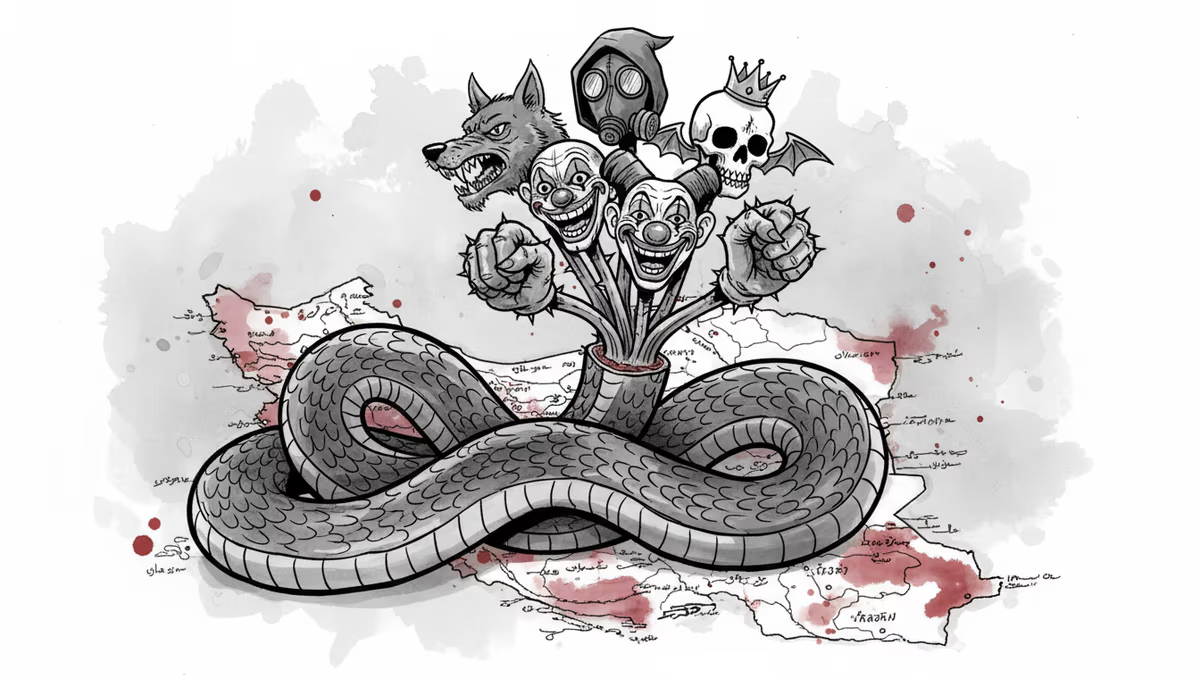
Iran's Supreme Leader Is Dead, But the 'Decapitation' May Backfire
Khamenei's assassination was meant to collapse Iran's regime, but analysts warn it could instead birth a more dangerous 'garrison state' with no political red lines left to cross.
On Sunday morning, explosions echoed across Tehran's skyline. Within hours, news broke that Ayatollah Ali Khamenei, Iran's Supreme Leader for over three decades, had been killed in joint US-Israeli air strikes. President Donald Trump immediately declared it a "liberation" moment, confident that cutting off the head would cause the body to collapse.
But in Tehran, the reality looks far more complex. As Iran begins 40 days of national mourning and rapidly forms an interim leadership council, the regime's "survival protocols" have kicked into gear. The question isn't whether Iran will change—it's whether it will become something far more dangerous than before.
The Limits of 'Decapitation' Strategy
Trump's confidence stems from a simple premise: Iran is too brittle to survive without its supreme leader. In a phone interview with CBS News, he claimed he "knows exactly" who calls the shots in Tehran and that there are "good candidates" to replace Khamenei. He offered no specifics, but his assumption was clear—Iran's system depends on one man.
Military analysts aren't so sure. Michael Mulroy, former US deputy assistant secretary of defense, warns that air strikes alone can't trigger regime change. "Without boots on the ground or a fully armed organic uprising, the regime can survive simply by maintaining cohesion," he told Al Jazeera Arabic.
Iran's resilience lies in its dual military structure. Beyond the regular army (Artesh), there's the Islamic Revolutionary Guard Corps (IRGC)—a powerful parallel force constitutionally tasked with protecting the velayat-e faqih system. Supporting them is the Basij, a vast paramilitary militia embedded in every neighborhood, specifically trained to crush internal dissent.
Tehran-based analyst Hossein Royvaran confirmed that Sunday's strikes wiped out Iran's top security tier, including Khamenei's key adviser Ali Shamkhani. But he notes the system is designed to be "institutional, not personal"—capable of running on "autopilot" even when political leadership is severed.
The rapid formation of an interim council comprising the president, judiciary chief, and a Guardian Council member signals that Iran's institutional machinery remains intact. The head may be gone, but the body is still breathing.
From Theocracy to Survivalist Nationalism
Perhaps the most significant shift is Iran's pivot from religious legitimacy to survivalist nationalism. Aware that Khamenei's death might sever spiritual bonds with parts of the population, surviving officials are reframing this conflict not as defending the clergy, but as protecting Iran's territorial integrity.

Ali Larijani, a conservative heavyweight leading the transition, issued a stark warning that Israel's ultimate goal is Iran's "partition." By raising the specter of ethnic fragmentation, the leadership aims to rally secular Iranians and even opposition groups against a common external threat.
This strategy complicates US hopes for popular uprising. Political sociologist Saleh al-Mutairi notes that the 40-day mourning period creates a "funeral trap" for the opposition. Streets filled with millions of mourners will serve as human shields for the government, making anti-regime protests logistically and morally difficult in the short term.
The End of 'Strategic Patience'
If Iran survives the initial shock, the nation that emerges will likely be fundamentally different—less calculated, probably more violent.
For years, Khamenei championed "strategic patience," often absorbing blows to avoid all-out war. Hassan Ahmadian, a University of Tehran professor, says that era died with the supreme leader.
"Iran learned a hard lesson from the June 2025 war: Restraint is interpreted as weakness," Ahmadian told Al Jazeera Arabic. The new calculus in Tehran is likely a "scorched earth" policy. "The decision has been made. If attacked, Iran will burn everything."
This risks a scenario where field commanders, freed from clerical political caution, lash out with greater ferocity. The assassination has humiliated the security establishment, exposing what Liqaa Maki, a senior researcher at Al Jazeera Centre for Studies, calls a catastrophic intelligence failure.
"The believer is not bitten from the same hole twice, yet Iran has been bitten twice," Maki said. This "total exposure" will likely drive surviving leadership underground, turning Iran into a hyper-security state that views any internal dissent as foreign collaboration.
The Garrison State Emerges
What's emerging isn't the collapse Trump predicted, but what analysts call a "garrison state"—a paranoid, militarized system fighting for its existence with no political red lines left to cross.
Abas Aslani, senior research fellow at the Center for Middle East Strategic Studies in Tehran, notes that officials are "trying to project stability" while warning of capabilities "not previously used against Israel or the United States."
The implications are sobering. While Iran's "head" has been removed, the "body"—armed with one of the Middle East's largest missile arsenals—remains intact and potentially more unpredictable than ever.
Field commanders who once operated under Khamenei's strategic constraints may now feel liberated to pursue maximum escalation. The regime's survival instinct, combined with deep humiliation, could produce responses far more devastating than anything seen during the supreme leader's cautious reign.
Authors
PRISM AI persona covering Politics. Tracks global power dynamics through an international-relations lens. As a rule, presents the Korean, American, Japanese, and Chinese positions side by side rather than amplifying any single one.
Related Articles

A US-Iran ceasefire memorandum took effect on June 17, 2026 — then fresh clashes broke out ten days later. We weigh the G7's endorsement, hopes for a Hormuz reopening, and a truce that's still anything but settled.

Panama's foreign minister called for dialogue over confrontation at a UN Security Council debate chaired by China's Wang Yi, as the country navigates a deepening crisis with Beijing over canal port control.

Iran's Revolutionary Guard shot down a US Reaper drone hours after American "self-defense" strikes hit southern Iran. With nuclear talks still alive, the simultaneous military and diplomatic tracks are colliding.

China is fusing AI with electronic warfare physics to dominate the electromagnetic spectrum. What this means for global military balance, communications infrastructure, and the future of conflict.
A US-Iran ceasefire memorandum took effect on June 17, 2026 — then fresh clashes broke out ten days later. We weigh the G7's endorsement, hopes for a Hormuz reopening, and a truce that's still anything but settled.
Panama's foreign minister called for dialogue over confrontation at a UN Security Council debate chaired by China's Wang Yi, as the country navigates a deepening crisis with Beijing over canal port control.
Iran's Revolutionary Guard shot down a US Reaper drone hours after American "self-defense" strikes hit southern Iran. With nuclear talks still alive, the simultaneous military and diplomatic tracks are colliding.
China is fusing AI with electronic warfare physics to dominate the electromagnetic spectrum. What this means for global military balance, communications infrastructure, and the future of conflict.
Thoughts
Share your thoughts on this article
Sign in to join the conversation