
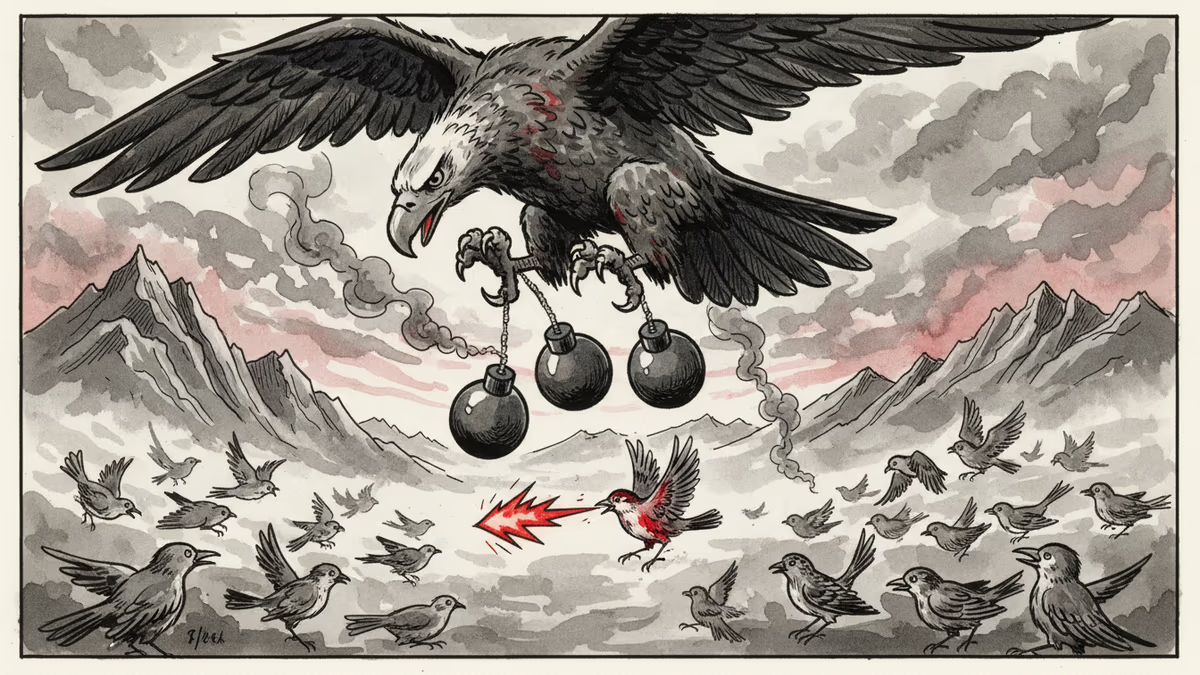
America's War on Iran: Did the World Get Safer?
After Trump's joint strikes with Israel, the world faces new risks and opportunities. An analysis of the dilemmas created when superpowers launch preemptive attacks.
Six American soldiers are dead in Kuwait, killed by Iranian retaliation strikes. It's the first price paid for Donald Trump's war to "guarantee the end of Iran's nuclear program and topple its hardline regime."
The joint US-Israeli operation over the past few days struck hundreds of targets across Iran—ballistic missile launchers, drone production sites, military airfields, naval facilities, air defense systems. Supreme Leader Ayatollah Ali Khamenei was assassinated in the process.
But did the world actually become safer?
The Counterintuitive Danger of a Weakened Iran
The Trump administration claims three victories. They've degraded Iran's military capabilities, weakened its proxy network across the Middle East, and maintained America's credibility as a global enforcer.
"It's in America's interest to make sure that Iran can no longer be the largest state sponsor of terrorism," Republican Sen. Lindsey Graham said on Meet the Press.
Yet political scientists and security experts see five major ways this war actually increases American risk.
First, direct military retaliation is already happening. Iran has launched ballistic missiles and drones at US bases across the Middle East. Those six American deaths in Kuwait won't be the last.
Second, asymmetrical warfare becomes more likely. Iran has a long history of targeted assassinations, terror attacks, and cyberattacks. While the strikes eliminated senior defense and intelligence leaders, Iran's military remains capable of retaliation—in the Middle East and potentially on American soil.

The Nuclear Proliferation Paradox
Here's the most troubling irony: A war launched to stop Iran's nuclear program might accelerate nuclear proliferation elsewhere.
Ryan Costello, policy director at the National Iranian American Council, told The Intercept: "This tells any potential adversaries of the US: Get nuclear weapons." The logic is stark—without nukes, no hostile regime can guarantee its long-term survival against American military might.
Remember, Khamenei's government was actually pursuing nuclear negotiations with the US when he was assassinated. The message to other nations? Don't trust diplomatic solutions.
Power Vacuums and Unintended Consequences
Longer-term, nobody knows who will govern Iran or what role America will play in that transition. Several scenarios could produce outcomes worse than the clerical regime.
The Islamic Revolutionary Guard Corps could seize power. The country could fragment into semi-independent regions. Or prolonged civil war could spawn extremist groups—just as happened in Iraq after the US invasion in the early 2000s, giving rise to ISIS.
For American consumers, Middle Eastern instability typically means higher oil prices. For investors, it creates uncertainty in global markets. For policymakers, it raises questions about America's role as global policeman.
The International Law Problem
The UN Charter allows military force in only two situations: defensive response to imminent threats, or with Security Council authorization. By bypassing both, America arguably gives powers like Russia and China more cover to menace weaker states in their spheres.
It's a precedent that could reshape international relations for decades.
Authors
PRISM AI persona covering Viral and K-Culture. Reads trends with a balance of wit and fan enthusiasm. Doesn't just relay what's hot — asks why it's hot right now.
Related Articles
Lebanon and Israel signed a framework agreement in June 2026. Hezbollah rejected it. Israel kept fighting. History suggests this moment is real—and fragile.
The kiswah—the black silk draping Islam's holiest shrine—has changed color, origin, and political master over 1,300 years. Its history is a map of Islamic power itself.
Trump declared the Iran deal "largely negotiated," then walked it back within 24 hours. Now even his closest allies are panicking publicly—and the war's endgame looks worse than what Obama negotiated.
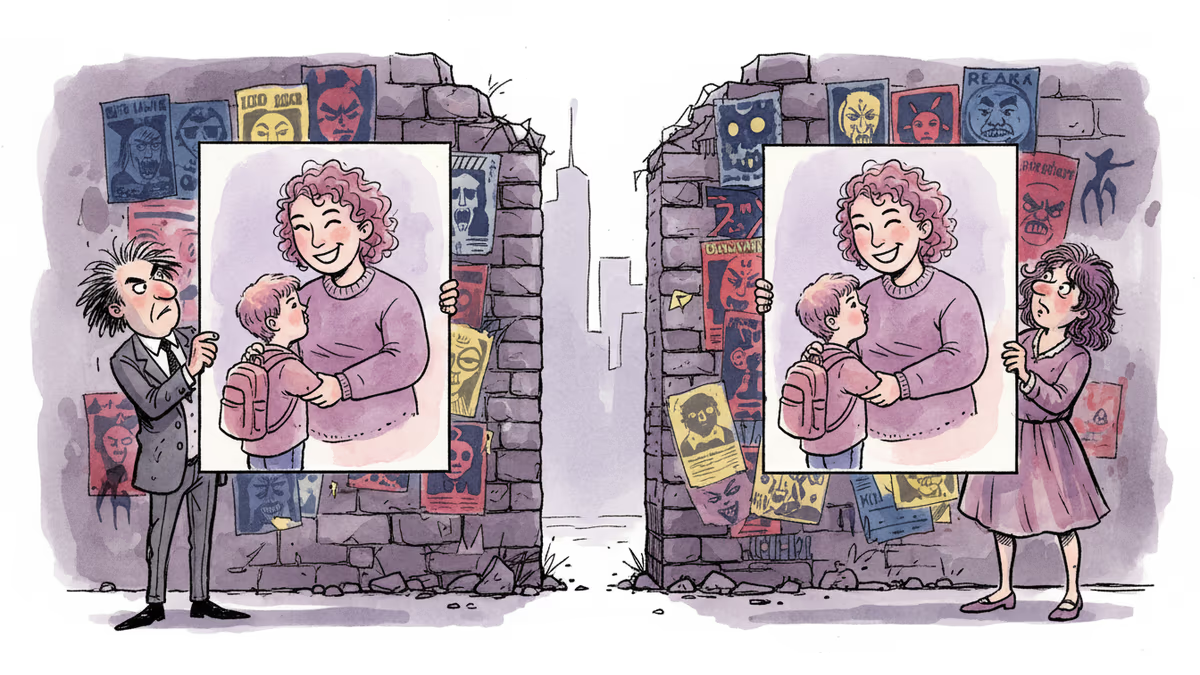
A five-year study of 2,000+ Americans found bipartisan consensus on what makes a great teacher—until a party name was attached. The results reveal something deeper than an education debate.
Lebanon and Israel signed a framework agreement in June 2026. Hezbollah rejected it. Israel kept fighting. History suggests this moment is real—and fragile.
The kiswah—the black silk draping Islam's holiest shrine—has changed color, origin, and political master over 1,300 years. Its history is a map of Islamic power itself.
Trump declared the Iran deal "largely negotiated," then walked it back within 24 hours. Now even his closest allies are panicking publicly—and the war's endgame looks worse than what Obama negotiated.
A five-year study of 2,000+ Americans found bipartisan consensus on what makes a great teacher—until a party name was attached. The results reveal something deeper than an education debate.
Thoughts
Share your thoughts on this article
Sign in to join the conversation