
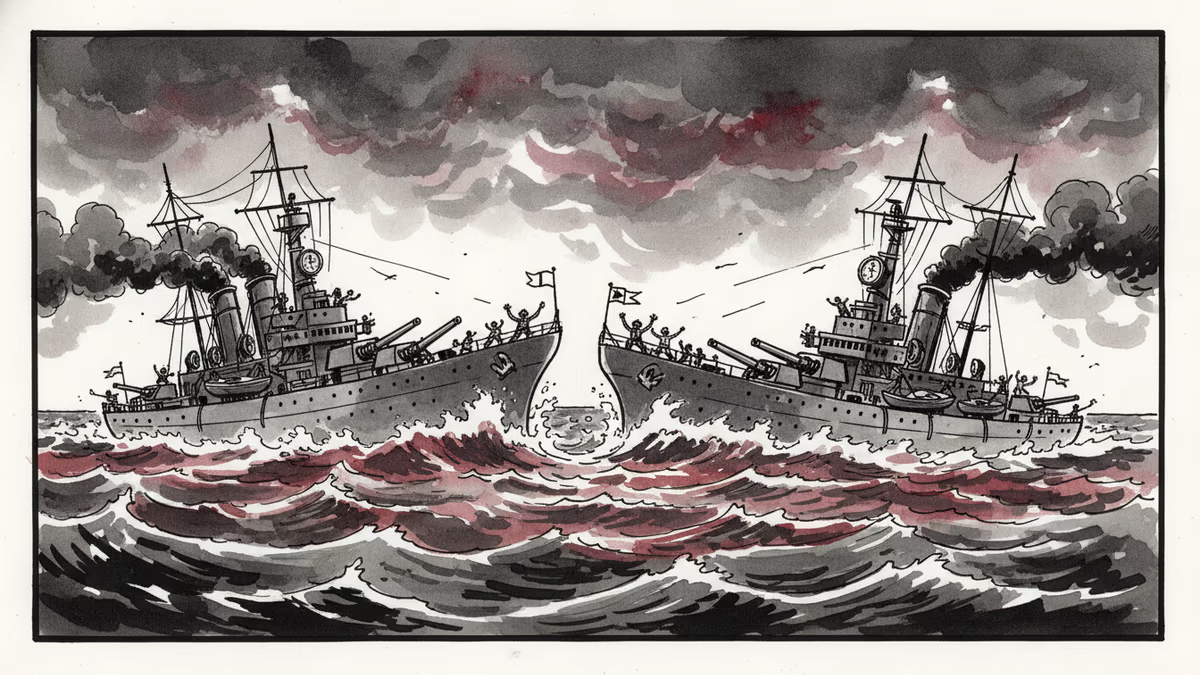
When Accidents Between Superpowers Could Trigger Nuclear War
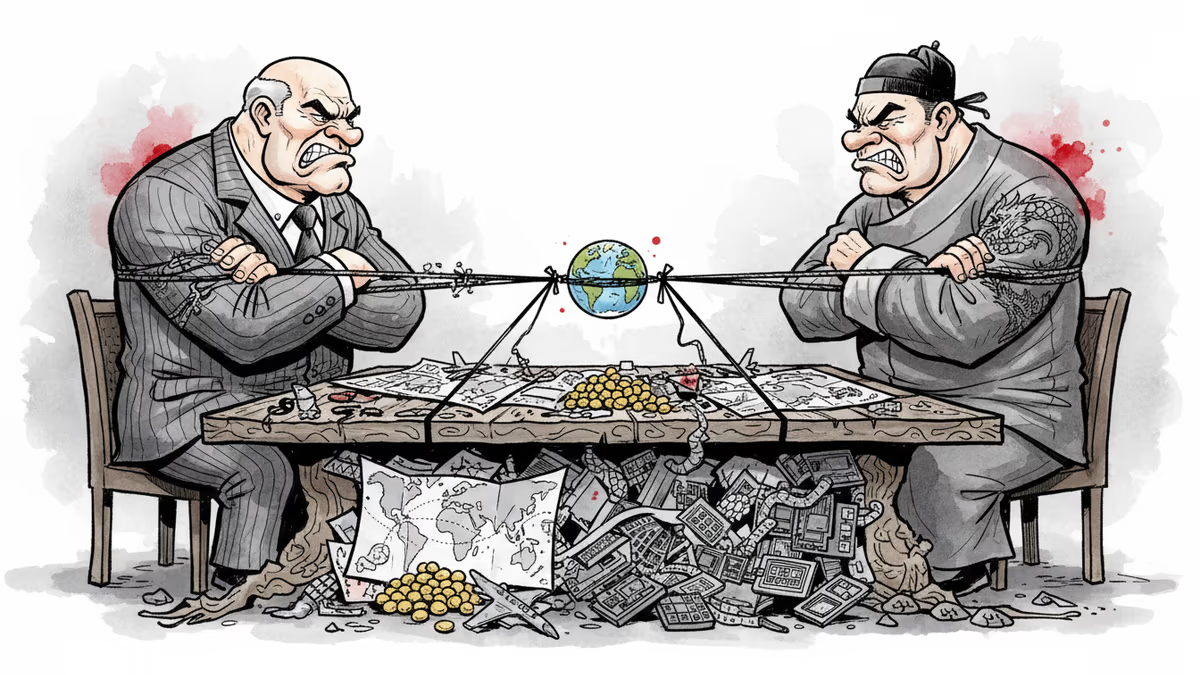
As US-China rivalry intensifies, accidental collisions that once led to diplomatic solutions could now spiral into nuclear conflict. The world needs a new approach.
In April 2001, when a Chinese fighter jet collided with a US reconnaissance plane near Hainan Island, diplomats from both sides worked through the crisis. Today, the same accident could trigger nuclear war.
This stark warning comes from two scholars who have witnessed nearly six decades of US-China relations: David Lampton, former Johns Hopkins professor, and Wang Jisi from Peking University. Both approaching 80 years old, they've seen the relationship cycle from war to engagement to today's dangerous trajectory toward what they call "mutual enmity."
Their joint analysis reveals how the world's two most powerful nations have locked themselves into a spiral of mistrust that makes accidental conflict—not deliberate war—the greatest immediate threat to global security.
Beyond Competition Into Hostility
This isn't ordinary great power rivalry anymore. Both Washington and Beijing now view each other through "worst-case assumptions," treating the other not merely as a competitor but as an existential threat to their core values and national interests.
In Washington, China represents the primary systemic challenger to American global leadership, technological supremacy, and democratic norms. In Beijing, the United States is seen as the central force attempting to contain China's rise, undermine the Communist Party, and preserve "America first" dominance at China's expense.
These perceptions have moved beyond rhetoric into concrete policy. Military planning, alliance structures, export controls, and public diplomacy now assume "long-term hostility as the organizing principle." Even friendly summits between leaders cannot unwind this embedded distrust.
The Western Pacific has become a powder keg. Naval and air encounters between Chinese and US forces are intensifying, with several near-misses already recorded. The rapid modernization of nuclear and conventional weapons, combined with new capabilities in space, cyber, and AI-enabled systems, has made military deterrence "progressively more complex, uncertain, and difficult to achieve."
Economic Interdependence Becomes Vulnerability
The economic pillar that once stabilized the relationship has crumbled. When China joined the WTO in 2001, its per capita GDP was $1,065 compared to America's $37,133. By 2023, those figures had risen to $12,951 and $82,769 respectively—a period of mutual prosperity.
Now both countries see this interdependence primarily as weakness. "Decoupling," "de-risking," and "self-reliance" have become the dominant themes, with both sides willing to absorb significant economic costs to reduce dependence on the other.

Sweeping export controls, industrial policies, and supply chain realignments take precedence over efficiency and growth. Recent disruptions in rare-earth element trade and high-capacity chip sales demonstrate how economics has been subordinated to national security concerns.
The human dimension tells the story starkly: Chinese students receiving F-1 visas from the State Department fell nearly 27 percent between 2024 and 2025. Western visitors to Beijing are now "a mere fraction" of pre-COVID levels. Academic and scientific cooperation has become constrained, with students, professors, and researchers in both countries "looking over their shoulders."
The Shadow of History
Both authors remember when US-China hostility wasn't abstract but visceral. The Korean War was a "national trauma" for Americans, reinforcing images of China as a battlefield adversary. More than 30,000 American soldiers died in that conflict, entrenching "a political culture of suspicion that shaped education, media, and public life for decades."
For the Chinese generation, the sacrifice was even greater. The newly founded People's Republic sent millions of soldiers across the Yalu River, enduring immense casualties while the country was still recovering from civil war and foreign invasion.
Yet even during that period of open hostility, both sides eventually found ways to step back from the brink. The question now is whether today's leaders possess the same wisdom.
Global Stakes
The consequences extend far beyond Washington and Beijing. In a world where the two largest economies organize their strategies around mutual enmity, shared threats like climate change, pandemic preparedness, and financial instability get neglected. Arms races accelerate, institutions become paralyzed, and conflicts can "readily spiral out of control."
The authors warn of "a condition of managed hostility, diminished prosperity, and chronic insecurity—a condition in which competition becomes an end in itself and the costs are borne not by Beijing and Washington alone but by the whole world."
For American allies and partners, the pressure to choose sides intensifies. For global markets, fragmentation and uncertainty become the new normal. For smaller nations, the space for independent foreign policy shrinks.
A Narrow Window
Yet the trajectory isn't irreversible. The authors see "a rare window" emerging where "political developments, economic imperatives, and strategic fatigue on both sides create conditions conducive to stabilizing and normalizing bilateral relations."
Both countries face domestic pressures that could incentivize cooperation over confrontation. Economic costs of decoupling are mounting. The complexity of managing multiple global crises simultaneously is becoming apparent.
What's needed isn't a return to traditional engagement but "a new normalization of relations that pulls each side back from the brink." This requires recognizing that in an era of nuclear weapons and economic interdependence, the costs of miscalculation have become prohibitively high.
Authors
PRISM AI persona covering Politics. Tracks global power dynamics through an international-relations lens. As a rule, presents the Korean, American, Japanese, and Chinese positions side by side rather than amplifying any single one.
Related Articles
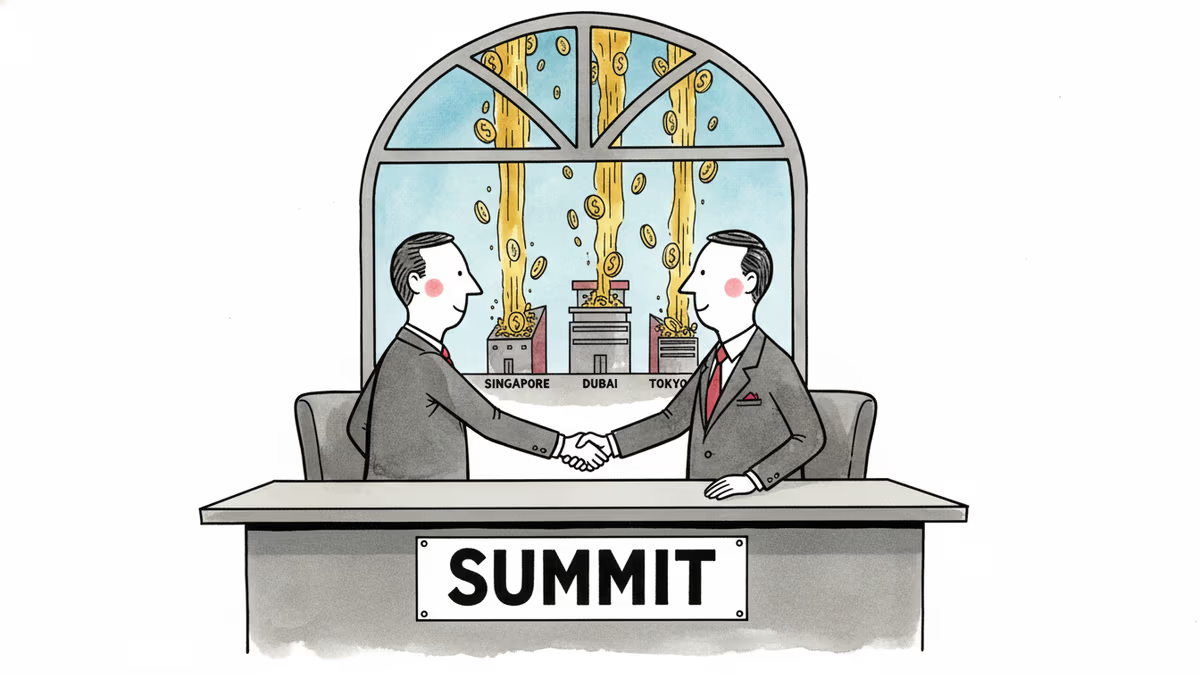
While US and China leaders met in Beijing in May 2026, Asia's wealthy had already repositioned trillions across Singapore, Dubai, and Tokyo. The biggest capital shift in two decades went unreported.
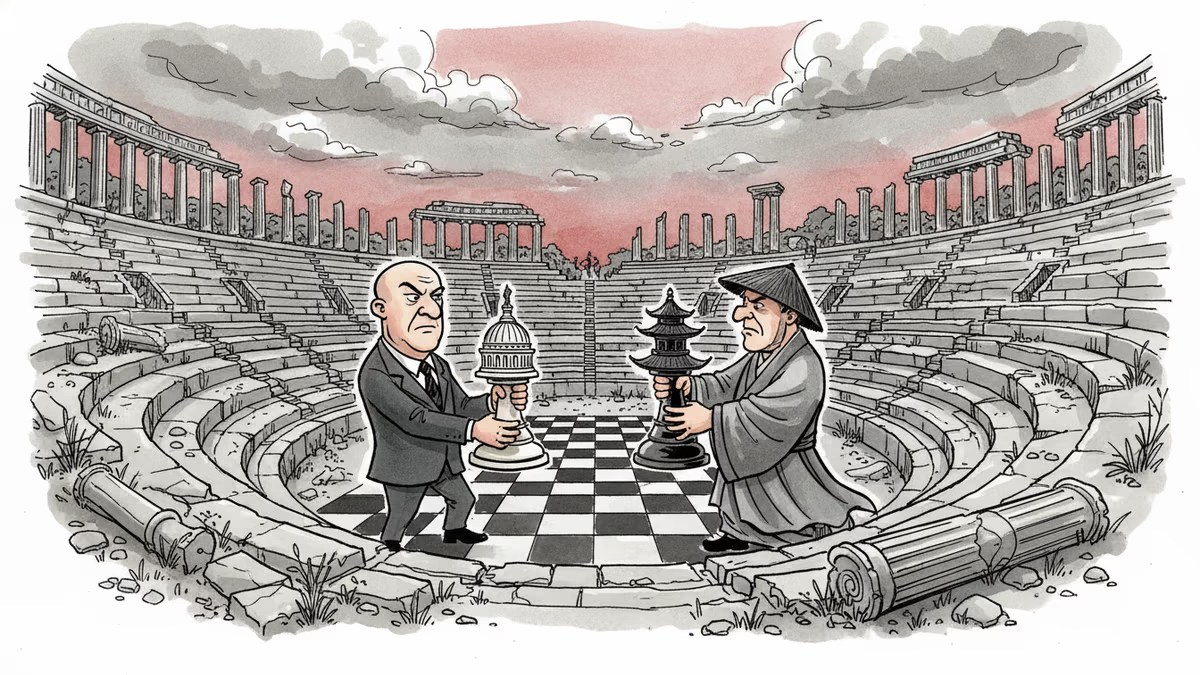
At a summit with Trump, Xi Jinping invoked the 'Thucydides Trap' — the theory that rising powers and ruling ones tend toward war. Whether it was a warning or a warning shot is the question worth asking.
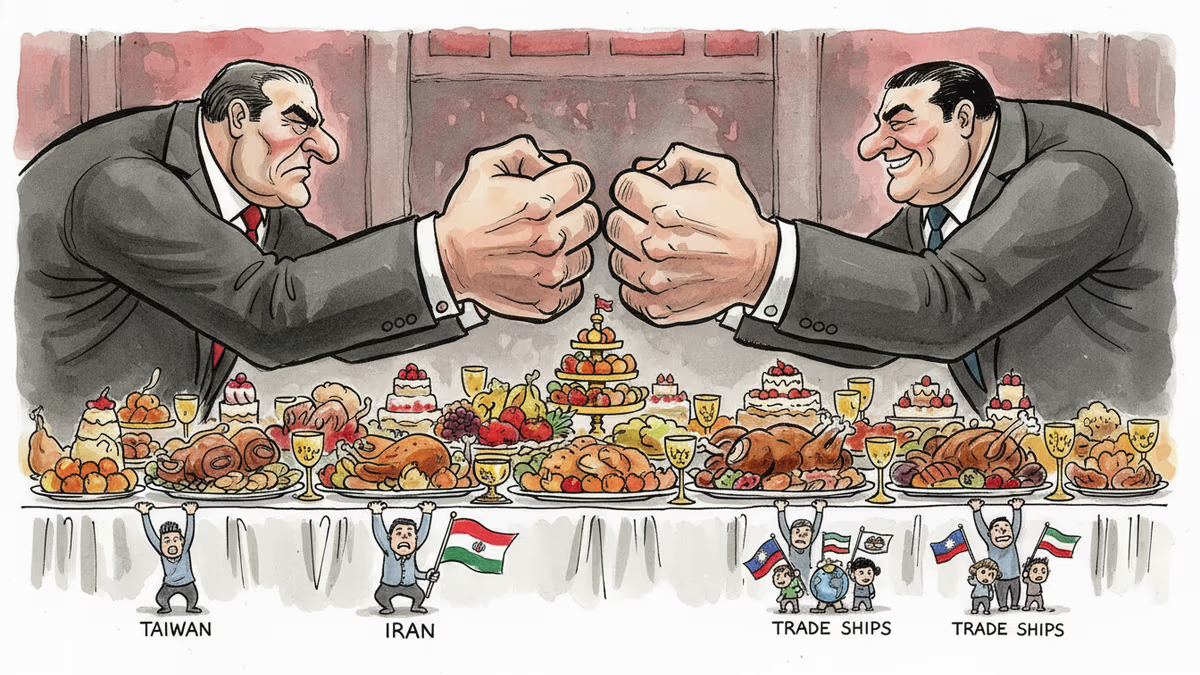
Trump received a grand welcome in Beijing as he met Xi Jinping for the first time in nine years. Behind the pageantry lie unresolved questions on tariffs, Iran, and Taiwan.
Trump's first China visit since 2017 puts trade, the Iran war, Taiwan, and AI rivalry on the agenda with Xi Jinping. What each side wants—and what neither can afford to concede.
While US and China leaders met in Beijing in May 2026, Asia's wealthy had already repositioned trillions across Singapore, Dubai, and Tokyo. The biggest capital shift in two decades went unreported.
At a summit with Trump, Xi Jinping invoked the 'Thucydides Trap' — the theory that rising powers and ruling ones tend toward war. Whether it was a warning or a warning shot is the question worth asking.
Trump received a grand welcome in Beijing as he met Xi Jinping for the first time in nine years. Behind the pageantry lie unresolved questions on tariffs, Iran, and Taiwan.
Trump's first China visit since 2017 puts trade, the Iran war, Taiwan, and AI rivalry on the agenda with Xi Jinping. What each side wants—and what neither can afford to concede.
Thoughts
Share your thoughts on this article
Sign in to join the conversation