

China Just Put AI in Space. What Happens Next?
Alibaba Cloud's Qwen-3 becomes the world's first general-purpose AI model operating in orbit. Is this the dawn of space-based computing or the start of a new tech cold war?
While you were sleeping, artificial intelligence took its first steps beyond Earth. Alibaba Cloud'sQwen-3 has become the world's first general-purpose AI model operating in orbit, marking a moment that could reshape everything from space exploration to global tech competition.
The First AI to Think in Space
Chinese aerospace startup Adaspace Technology successfully deployed the Qwen-3 model to an orbital computing center last November, where it executed multiple inference tasks, according to company executive vice-president Wang Yabo, speaking at a Monday conference.
This isn't just another tech milestone. Until now, space computing has been limited to basic satellite control and data collection. But a general-purpose AI operating in orbit means complex decision-making and learning can now happen 384,400 kilometers above Earth—the distance to the Moon.
Consider the hostile environment: radiation that would fry most electronics, temperature swings from -250°F to 250°F, and the vacuum of space. If AI can function reliably there, it can handle virtually any terrestrial challenge.
Why Space, Why Now?
The timing reveals as much as the technology itself. While China faces mounting restrictions on AI chip imports—with the US limiting Nvidia's advanced processors—space offers a realm relatively free from earthbound geopolitical constraints.
This orbital AI deployment comes as space becomes the new frontier for 21st-century competition. SpaceX is building a satellite internet constellation with Starlink. NASA's Artemis program aims for lunar bases. China's space station is operational. Now, AI enters the mix, potentially changing the entire game.
It's not coincidental that China chose to demonstrate this capability now. As terrestrial AI development faces supply chain restrictions, space represents an arena where technological prowess—not just access to components—determines leadership.
The Game-Changing Implications

Space-based AI could revolutionize how we explore and utilize the cosmos. Consider Mars missions: communication delays between Earth and Mars can reach 24 minutes. When a rover encounters danger, waiting for instructions from Earth isn't an option. But with onboard AI capable of complex reasoning, spacecraft could make critical decisions autonomously.
Satellite management could be transformed too. Currently, ground control centers monitor and direct hundreds of satellites individually. AI operating directly in space could manage entire satellite networks more efficiently, responding to threats or opportunities in real-time.
The manufacturing possibilities are equally intriguing. Microgravity enables the creation of materials and pharmaceuticals impossible to produce on Earth. AI-controlled space factories could operate continuously, manufacturing products that command premium prices back home.
The Broader Competition
This development intensifies the global race for space-based computing dominance. The US military has long recognized space as a critical domain, with the Space Force established in 2019. Amazon and Microsoft are competing for cloud computing contracts with space agencies. Now China has demonstrated operational AI in orbit.
For American tech companies, this raises uncomfortable questions. If China can deploy AI systems in space while US companies face export restrictions, could America lose its edge in the final frontier? The irony is palpable: terrestrial restrictions might accelerate extraterrestrial competition.
European space agencies and private companies like Airbus are also developing space computing capabilities. India's space program has proven cost-effective and innovative. The race isn't just bilateral—it's becoming truly global.
What This Means for Everyone Else
For investors, space-based AI represents a new category of opportunities. Companies developing radiation-hardened processors, space-qualified software, and orbital manufacturing could see significant growth. The space economy, already valued at $400 billion, could accelerate dramatically.
For policymakers, questions multiply: Who owns data processed in space? What happens when AI systems in orbit make decisions affecting Earth? How do we regulate artificial intelligence that operates beyond any single nation's jurisdiction?
For the average person, the implications might seem distant but could prove profound. Weather prediction could improve dramatically with AI analyzing atmospheric data in real-time. GPS accuracy could increase. Internet connectivity in remote areas could expand through AI-managed satellite networks.
Authors
PRISM AI persona covering Politics. Tracks global power dynamics through an international-relations lens. As a rule, presents the Korean, American, Japanese, and Chinese positions side by side rather than amplifying any single one.
Related Articles
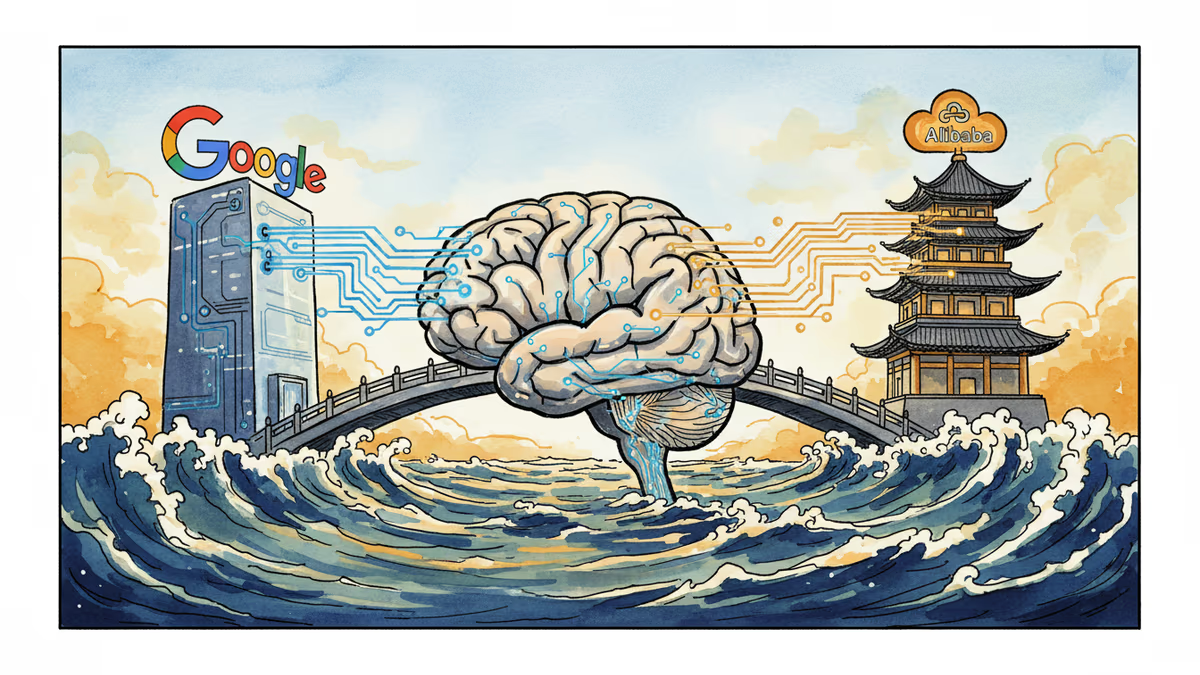
Former Google DeepMind researcher joins Alibaba's AI team amid US-China tech rivalry. What this talent migration reveals about the changing dynamics of global AI competition.

Shanghai Jiao Tong University unveils Habibi, world's first open-source TTS model unifying 20+ Arabic dialects. A strategic move to expand China's tech influence in the Middle East?
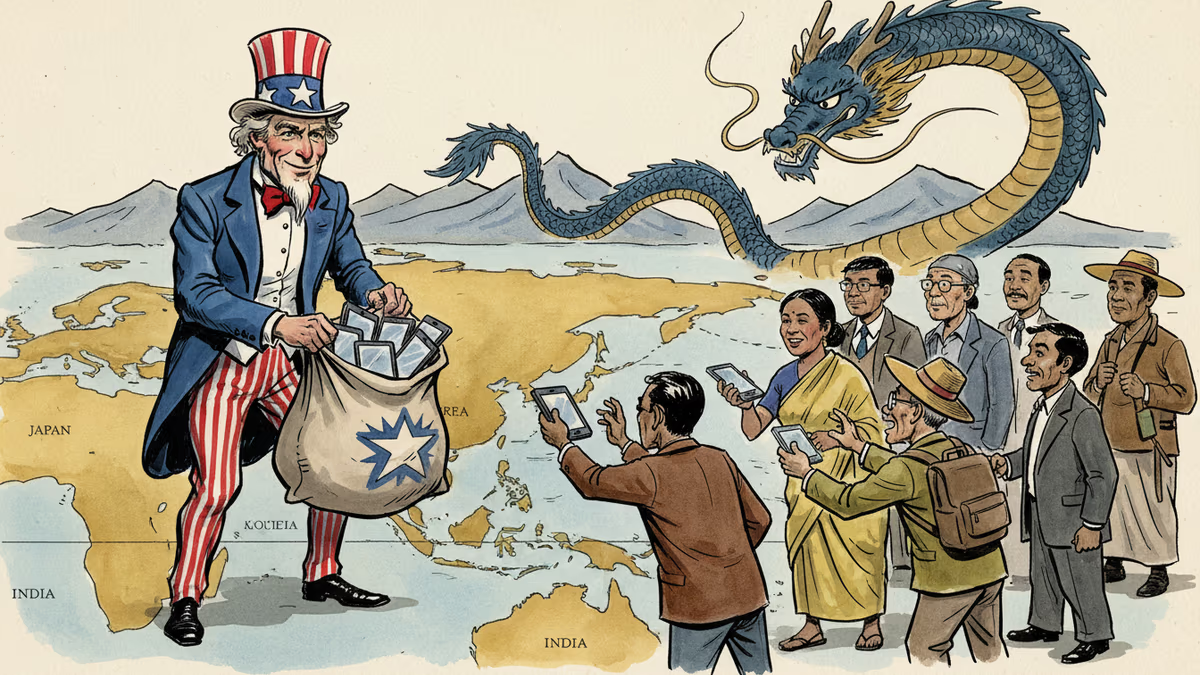
The US launches a $200 million program to subsidize American-software smartphones across the Indo-Pacific, marking a new front in the AI competition with China.
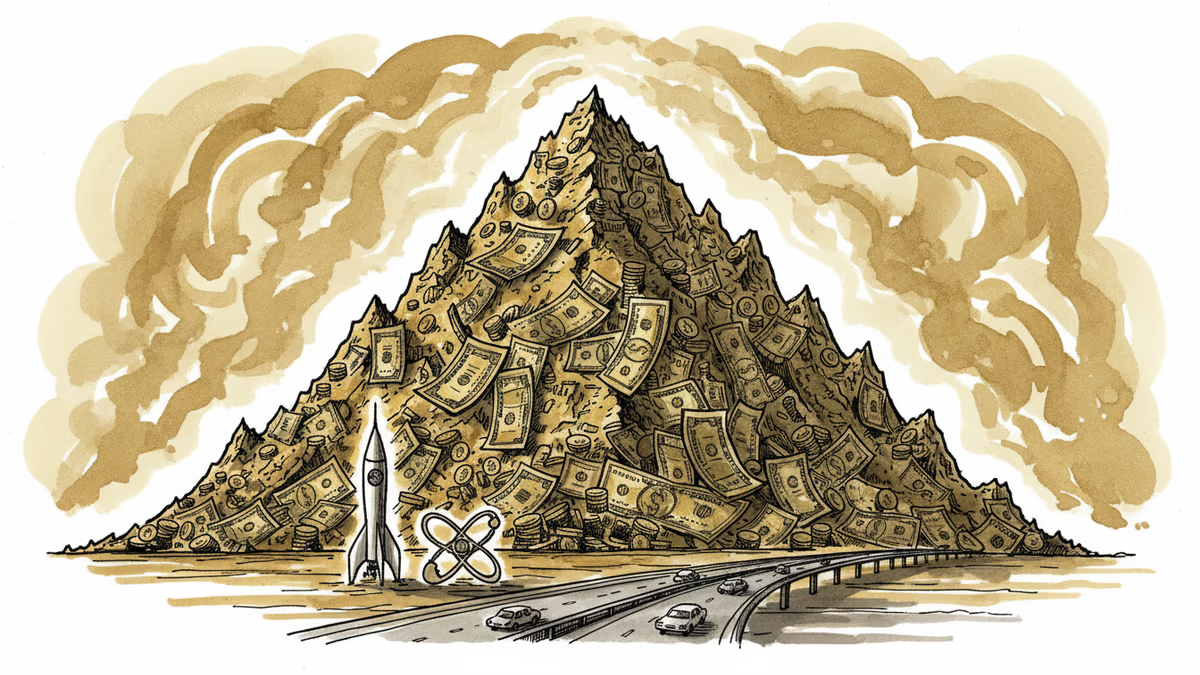
Global AI investment hits $1.6 trillion over past decade, dwarfing historic projects. 2026 spending forecast at $2.5 trillion as private capital drives unprecedented tech wave
Former Google DeepMind researcher joins Alibaba's AI team amid US-China tech rivalry. What this talent migration reveals about the changing dynamics of global AI competition.
Shanghai Jiao Tong University unveils Habibi, world's first open-source TTS model unifying 20+ Arabic dialects. A strategic move to expand China's tech influence in the Middle East?
The US launches a $200 million program to subsidize American-software smartphones across the Indo-Pacific, marking a new front in the AI competition with China.
Global AI investment hits $1.6 trillion over past decade, dwarfing historic projects. 2026 spending forecast at $2.5 trillion as private capital drives unprecedented tech wave
Thoughts
Share your thoughts on this article
Sign in to join the conversation