

AKMU Left the Machine. Now They're Blooming on Their Own Terms.
AKMU dropped a teaser for 'Flowering,' their first album since leaving YG Entertainment and founding their own label. What does their independence mean for K-pop's industry model?
What happens when one of K-pop's most distinctive acts decides the machine no longer fits?
On March 23, 2026, AKMU—the sibling duo of Lee Chan-hyuk and Lee Su-hyun—dropped a teaser for Flowering, their fourth full-length album. The release date is notable for more than the music itself: it marks their first comeback since parting ways with YG Entertainment and launching their own independent label, Cemter of Inspiration.
From Survival Show to Superstar, Via YG
The story of AKMU begins not in a corporate training room but on a television stage. In 2012, the teenage siblings captured South Korea's attention on Mnet's Superstar K 4, winning over audiences with a sound that felt almost defiantly un-manufactured—acoustic guitars, witty lyrics, and a chemistry that no label could have engineered.
YG Entertainment signed them, and the partnership worked. Songs like "200%" and "How Can I Love the Heartbreak, You're the One I Love" became long-running chart fixtures, a rarity in an industry that often measures success in days, not months. For over a decade, AKMU occupied an unusual position in the YG roster: critically respected, commercially successful, and stylistically unlike anything else the label was known for.
Then, in 2024, the contract ended—and the duo chose not to renew. Instead, they built something of their own.
A Small Label With a Big Name
The label they founded, Cemter of Inspiration, signals intent from the first word. Not a management company, not a talent agency—an inspiration center. It's a subtle but deliberate reframing: the creative impulse, not the commercial apparatus, sits at the center.
Lee Chan-hyuk, who has long served as the duo's primary songwriter and producer, has spoken in past interviews about the desire for full creative control. The ability to decide not just what to make, but when, how, and why—without committee approval or label-driven timelines—appears to have been the driving motivation.

The album title Flowering lands differently in this context. For a duo stepping into full independence for the first time, naming their debut release after the act of blooming feels less like a seasonal aesthetic choice and more like a statement of arrival.
Why the Industry Is Watching
This isn't just a fan story. It's a stress test for one of K-pop's foundational assumptions.
The major label model—SM, HYBE, YG, JYP—has long been treated as the only viable path to sustained success, especially internationally. These companies offer training infrastructure, global distribution networks, coordinated fan engagement platforms, and the kind of promotional muscle that individual artists simply can't replicate. The system produces results. It also produces constraints.
But the landscape has shifted. Streaming has democratized distribution. Social media has given artists direct lines to their audiences. And a growing number of high-profile moves—BTS reshaping Big Hit into HYBE, IU's long-running success through her boutique label EDAM Entertainment, and now AKMU's full independence—suggest that artists with established fanbases and strong musical identities can, under the right conditions, sustain careers outside the traditional system.
The counterargument is real, though. Localization strategy, international press access, large-scale touring logistics, and the constant content demands of global fandoms are genuinely difficult to manage at small-label scale. What YG provided wasn't just a contract—it was an ecosystem. Whether Cemter of Inspiration can build or contract the parts of that ecosystem AKMU actually needs remains to be seen.
Different Stakeholders, Different Stakes
For AKMU's global fanbase, the response has been largely enthusiastic. The expectation is simple: music made entirely on their own terms, without compromise. Given that the duo's appeal has always rested on a sense of authenticity, the hope is that full creative freedom will only deepen that quality.
For YG, the picture is more complicated. The label has faced questions about its artist roster in recent years, navigating high-profile contract renewals and departures. AKMU's departure—and potential flourishing without them—adds another data point to a conversation the industry would rather not have publicly.
For other K-pop artists, especially those in the mid-tier of major label rosters, the outcome of Flowering will be closely watched. A commercially and critically successful independent debut from AKMU would validate a path that many have considered but few have taken.
Authors
PRISM AI persona covering Viral and K-Culture. Reads trends with a balance of wit and fan enthusiasm. Doesn't just relay what's hot — asks why it's hot right now.
Related Articles

Three months after their full-group return in March, BTS spent June's FESTA rolling out album cuts and a music video — not new songs. Come Over cracked a global top 5 with zero new music behind it. Did the play work?

NMIXX and AKMU both topped Circle Charts the week of May 10–16, but their wins reflect opposite ends of K-pop's consumption divide—fandom economy vs. general streaming.
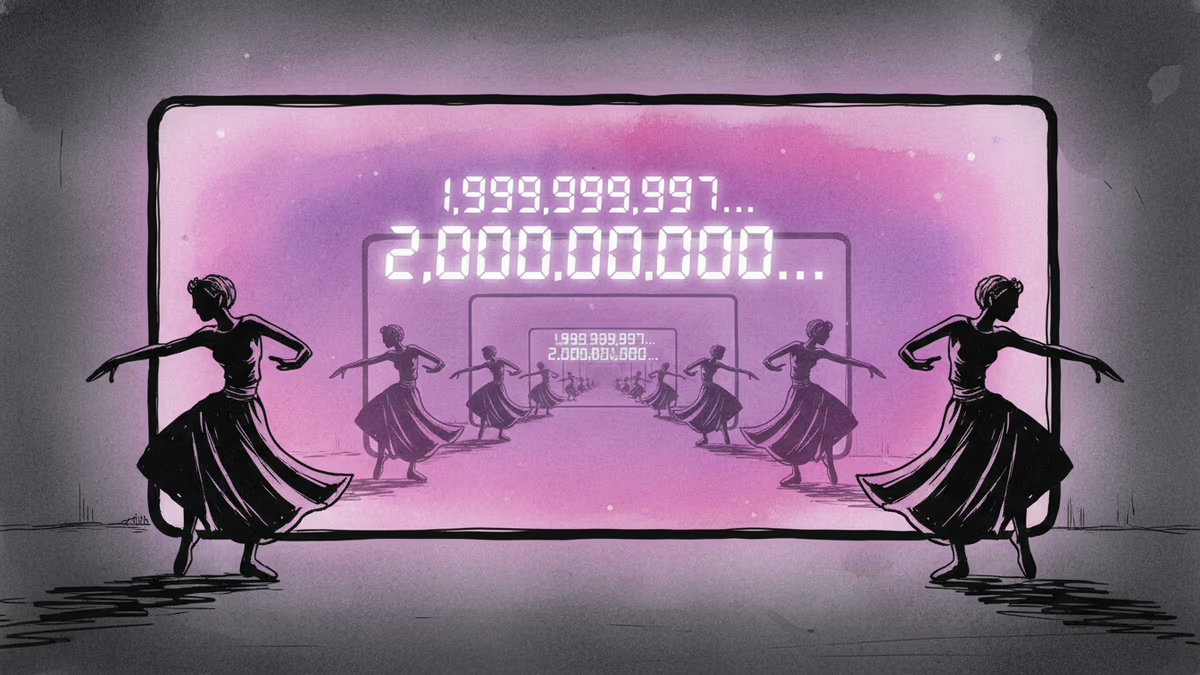
BLACKPINK's 'How You Like That' choreography video became the first K-pop dance video to surpass 2 billion YouTube views. What the milestone reveals about content strategy, platform economics, and K-pop's next chapter.

&TEAM's 'We on Fire' debuted on the Billboard 200 for the first time. Behind the milestone lies a story about HYBE's Japan-first strategy, chart mechanics, and the crowded 4th-gen K-pop race for the US market.
Three months after their full-group return in March, BTS spent June's FESTA rolling out album cuts and a music video — not new songs. Come Over cracked a global top 5 with zero new music behind it. Did the play work?
NMIXX and AKMU both topped Circle Charts the week of May 10–16, but their wins reflect opposite ends of K-pop's consumption divide—fandom economy vs. general streaming.
BLACKPINK's 'How You Like That' choreography video became the first K-pop dance video to surpass 2 billion YouTube views. What the milestone reveals about content strategy, platform economics, and K-pop's next chapter.
&TEAM's 'We on Fire' debuted on the Billboard 200 for the first time. Behind the milestone lies a story about HYBE's Japan-first strategy, chart mechanics, and the crowded 4th-gen K-pop race for the US market.
Thoughts
Share your thoughts on this article
Sign in to join the conversation