
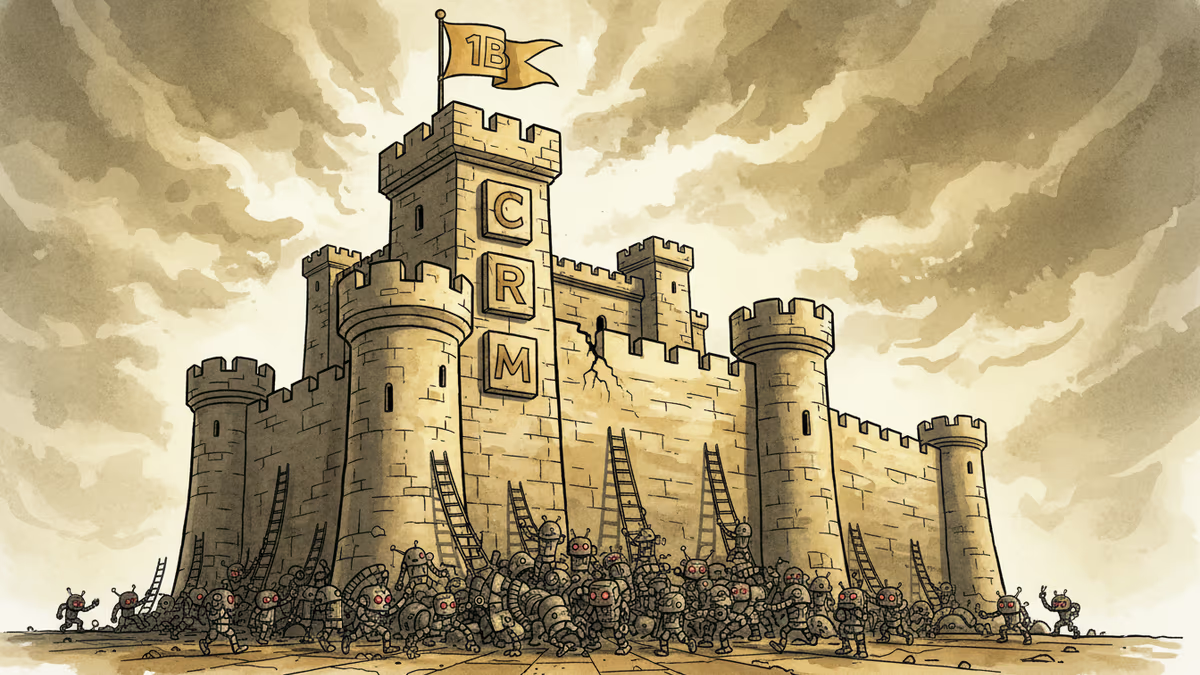
Agentforce Crosses $1B, But Salesforce's Moat Is Still Being Tested
Salesforce beat Q1 estimates and Agentforce hit $1.2B annualized revenue. But a soft RPO and slightly missed guidance tell a more complicated story about AI's threat to enterprise software.
Salesforce stock is down 33% this year. The market has essentially been pricing in a slow death by AI. Then Wednesday's numbers arrived.
The company posted Q1 revenue of $11.13 billion against a consensus of $11.05 billion, and adjusted EPS of $3.88 versus an expected $3.12—a beat of nearly 25% on the bottom line. Net income climbed from $1.54 billion to $2.11 billion year over year. By most measures, a solid quarter.
The stock barely moved after hours.
The Number That Actually Matters
Bury the lede at your peril: Agentforce annualized revenue hit $1.2 billion, up 205% year over year, crossing the $1 billion threshold for the first time. That's the headline Salesforce CEO Marc Benioff has been building toward since the company launched its AI agent platform in late 2024.
Agentforce lets businesses deploy autonomous AI agents across sales, customer service, marketing, and commerce workflows—essentially automating tasks that used to require human labor or clunky rule-based bots. The $1.2 billion figure is still small relative to the company's $111 billion total quarterly revenue run rate, but the trajectory is the argument. Salesforce is betting that its decades of customer data and workflow integration give it an edge no AI startup can replicate overnight.
The quarter also included the acquisition of commerce startup Cimulate and sales startup Momentum (both undisclosed terms), plus a notable win: the U.S. Veterans Health Administration agreed to adopt an AI agent system built in Slack. Public sector reference deals matter for enterprise sales cycles.

Where the Story Gets Complicated
For all the Agentforce momentum, two numbers gave investors pause.
First, guidance. For the current quarter, Salesforce projected revenue of $11.27 billion to $11.35 billion—the midpoint lands just below the $11.36 billion analysts expected. Full-year guidance was raised to $45.9 billion to $46.2 billion, but the midpoint of $46.05 billion again trails the $46.12 billion consensus. These are small misses, but in a stock already under pressure, small misses sting.
Second, and more structurally important: remaining performance obligation (RPO) came in at $67.9 billion, short of the $68.61 billion consensus. RPO is the pipeline—contracted revenue not yet recognized. It's the best forward-looking indicator of whether enterprise customers are actually committing to Salesforce's platform at the rate the company needs. A shortfall here doesn't just disappoint for one quarter; it raises questions about whether the AI narrative is converting into signed contracts at scale.
The Existential Question Hasn't Gone Away
While Salesforce beat on earnings, the broader anxiety driving its 33% decline this year hasn't been resolved. The thesis against the company—and against enterprise SaaS broadly—goes like this: as general-purpose AI models (GPT, Claude, Gemini) become capable enough to handle sales automation, customer service, and data analysis, companies will stop paying premium SaaS license fees and build their own solutions on top of foundation models.
This pressure isn't unique to Salesforce. ServiceNow, Workday, and SAP face the same structural challenge. The incumbents' answer is roughly the same: we have the data, the integrations, and the trust relationships that AI startups don't. Salesforce's specific version of that answer is Agentforce—layer AI agents on top of 20+ years of CRM data and call it a moat.
The 205% growth rate suggests the pitch is landing with some customers. The RPO miss suggests the urgency isn't universal.
This content is AI-generated based on source articles. While we strive for accuracy, errors may occur. We recommend verifying with the original source.
Related Articles
Silicon Valley engineers pulled back the curtain on AI agents this week—revealing hidden costs, operational chaos, and a growing gap between C-suite hype and ground-level reality.

Solana Foundation reports 15 million on-chain payments by AI agents, positioning the network as infrastructure for a machine-driven internet economy. What happens when AI holds the wallet?

OpenClaw, built by an unknown Austrian developer, became the star of Nvidia's GTC. It's now raising uncomfortable questions about whether the world's most valuable AI companies are worth what investors think.
Nvidia CEO Jensen Huang called OpenClaw the 'next ChatGPT,' triggering a 22% surge in MiniMax and 14% in Zhipu. Here's what it means for investors and the US-China AI race.
Silicon Valley engineers pulled back the curtain on AI agents this week—revealing hidden costs, operational chaos, and a growing gap between C-suite hype and ground-level reality.
Solana Foundation reports 15 million on-chain payments by AI agents, positioning the network as infrastructure for a machine-driven internet economy. What happens when AI holds the wallet?
OpenClaw, built by an unknown Austrian developer, became the star of Nvidia's GTC. It's now raising uncomfortable questions about whether the world's most valuable AI companies are worth what investors think.
Nvidia CEO Jensen Huang called OpenClaw the 'next ChatGPT,' triggering a 22% surge in MiniMax and 14% in Zhipu. Here's what it means for investors and the US-China AI race.
Thoughts
Share your thoughts on this article
Sign in to join the conversation