
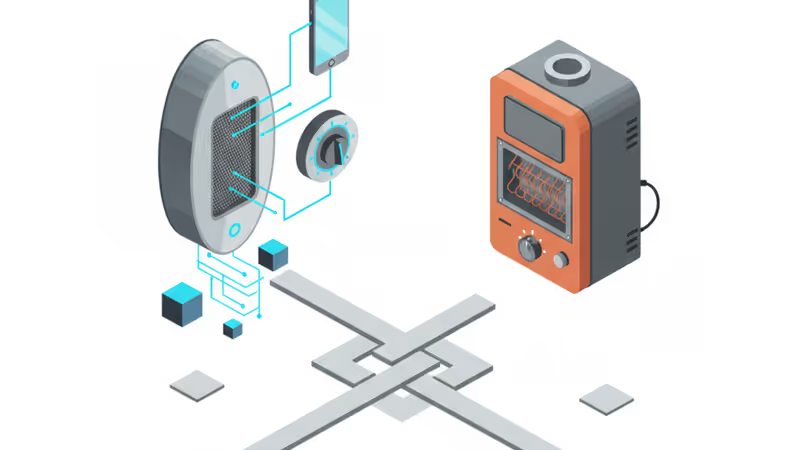
The Smart Heater Revolution: Why This 'Dumb' Appliance is the New Tech Battleground
A simple space heater review reveals a major tech trend: the battle for the intelligent home. Learn why this 'dumb' appliance matters for the future of tech.
The Lede: Beyond a Simple Hot Box
You’re not looking at a simple product roundup for space heaters. You're looking at a signal from a forgotten front in the smart home war. While the industry chases smart speakers and connected doorbells, a quiet revolution is happening in the most mundane of appliances. The evolution of the humble space heater—from a glowing fire hazard to a quiet, thermostatically-precise, and efficient device—is a microcosm of the next great tech platform battle: ambient environmental control. The question is no longer just "which heater is best?" but "who will own the air you breathe and the temperature you feel?"
Why It Matters: The End of 'One-Size-Fits-All' Climate Control
The traditional, centralized HVAC system is a relic of an era of cheap energy and low consumer expectations. It's a blunt instrument in a world that demands precision, efficiency, and personalization. The rise of the sophisticated space heater matters for three key reasons:
- Energy Grid Fragility: As grids strain under demand and energy costs soar, hyper-localized, on-demand heating (or "zone heating") becomes a critical tool for household efficiency. Heating one room with a 1,500-watt smart device is vastly more efficient than firing up a 25,000-watt furnace to heat an entire empty house. This isn't about comfort; it's about economic and infrastructural resilience.
- The Data-Driven Home: A smart heater is a sensor. It knows the room's temperature, occupancy patterns (when you turn it on/off), and its own energy consumption. This data is the currency of the future smart home, enabling predictive, automated climate systems that anticipate needs rather than just reacting to them.
- The Air Quality Imperative: Post-pandemic, consumers have a new awareness of indoor air quality. Companies like Dyson aren't just selling a heater; they're selling a multi-function environmental appliance that heats, cools, and purifies. This bundling strategy redefines the category and raises the price ceiling, turning a commodity into a premium health-tech device.
The Analysis: A Three-Way Race for Your Room
The space heater market, once a sleepy backwater, now showcases a classic technology conflict between three distinct strategic approaches:
The Ecosystem Play: Dyson
Dyson’s strategy is to create a premium, walled garden of home environment tech. Their $500+ Hot + Cool devices aren't just heaters; they are statements. By integrating air purification and advanced filtration, Dyson elevates the device from a utility to a wellness product. The high price pays for R&D, brand prestige, and crucially, the integration into a single Dyson app ecosystem. They are betting that consumers will pay a premium for a single, beautifully designed device that solves multiple problems, locking them into the Dyson platform.
The Disruptive Performer: Dreo
Dreo, and similar agile brands, represent the "Good Enough" revolution on steroids. They leverage mature, commoditized components (efficient ceramic elements, quiet brushless motors, smart thermostats) and combine them with excellent design and aggressive pricing. The $100 Dreo 714 winning "Best Overall" isn't an accident. It's a direct assault on the legacy players, proving that premium features like quiet operation and precise temperature control are no longer the exclusive domain of high-priced brands. They win by delivering 90% of a Dyson's performance for 20% of the price, unbundling the core function from the ecosystem.
The Incumbent Engineer: Vornado
Vornado represents the old guard of engineering-led innovation. Their core competency is air circulation—the physics of moving air efficiently. They build durable, powerful machines focused on a single task. Their challenge is adapting to a world where software, sensors, and user experience are as important as airflow mechanics. They are trusted and reliable, but risk being outmaneuvered by Dyson's ecosystem and Dreo's value proposition.
PRISM Insight: The 'Home Climate OS' is the Real Prize
The endgame isn't about selling more heaters, purifiers, or humidifiers. The ultimate prize is creating the integrated 'Home Climate OS'—a centralized, AI-driven platform that manages a home's entire thermal and atmospheric environment. Imagine a system that uses presence detection to heat only occupied rooms, syncs with the local energy grid to run during off-peak hours, and adjusts humidity and air purity based on real-time sensor data. The hardware—the heaters and coolers—will become commoditized nodes on this network. The company that controls the software and data layer will own the customer and the high-margin recurring revenue stream.
PRISM's Take: Pay Attention to Boring Tech
The space heater market is a powerful lesson for tech executives and investors: the most significant disruptions often emerge from the most overlooked categories. The commoditization of advanced components is creating opportunities to reinvent every 'dumb' appliance in the home. The winners won't be those who make a slightly better hot box, but those who understand they aren't in the hardware business at all. They're in the business of selling personalized, efficient, and healthy environments as a service.
Related Articles

Holiday tech gift guides reveal crucial shifts in consumer preferences, market maturity, and strategic opportunities for tech companies and investors. PRISM analyzes the deeper trends.

Hyper's founder is back with BMX and semi-solid state batteries. Is this the end of lithium-ion fire risk and the start of a new era for portable power?

Flagship phones are losing their edge. Our expert analysis reveals how the mid-range market is becoming the new hub of innovation, delivering premium value for less.
Holiday gift guides reveal Big Tech's true strategy: using simple gadgets as Trojan Horses to win the long-term war for ecosystem dominance and data.