

The Smart Home's Trojan Horse: Why Holiday Gifting is Big Tech's Real Battlefield
Holiday gift guides reveal Big Tech's true strategy: using simple gadgets as Trojan Horses to win the long-term war for ecosystem dominance and data.
The Lede: Beyond the Gift Wrap
While the annual parade of smart home gift guides suggests a market focused on simple convenience, the reality is far more strategic. For the busy executive, the key takeaway is this: the holiday season is not about selling smart plugs, it's the primary infiltration vector for Amazon, Google, and Apple to colonize the home. Each gifted device, no matter how trivial, is a beachhead in the multi-trillion-dollar war for platform dominance and ambient computing's future.
Why It Matters: The Ecosystem Infiltration Strategy
A gift guide entry for a $25 smart switch is not about a $25 sale. It represents a critical, low-friction entry point into a consumer's private life. The strategic implications are profound:
- Data as the Real Product: A smart thermostat isn't just controlling temperature; it's learning household routines, occupancy patterns, and energy consumption. This data is invaluable for shaping future products, services, and targeted advertising.
- Voice Assistant Primacy: Most entry-level gadgets require a voice assistant (Alexa, Google Assistant, Siri) for full functionality. A gifted smart speaker or display normalizes interaction with a specific AI, making it the default for future commands, from media consumption to e-commerce.
- Platform Lock-In: The first device is the anchor. A consumer with a few Alexa-compatible Wyze cams is significantly more likely to purchase an Echo Show or Ring doorbell than to start over with a competing Google Nest or Apple HomeKit setup. The gift establishes a subtle but powerful technological moat.
The Analysis: From Hobbyist Dream to Mass-Market Land Grab
The smart home's journey from the complex, wire-it-yourself days of X10 to the current plug-and-play reality is a story of strategic simplification. The initial vision of a single, unified 'smart home system' failed to gain mass adoption due to high costs, complexity, and consumer paralysis. Big Tech learned a valuable lesson: don't sell the system, sell the components. And the easiest way to sell a component is to position it as a gift.
This has reshaped the competitive landscape:
- Amazon (The Volume Play): Leveraging its e-commerce dominance, Amazon has flooded the market with a vast army of low-cost, Alexa-enabled devices from its own brands (Ring, Blink, Eero) and third-party partners. Its strategy is ubiquity, making Alexa the de facto standard through sheer market penetration.
- Google (The Intelligence Play): Google leverages its superiority in AI and data integration. The Nest Hub isn't just a speaker; it's a visual interface for Google's core strengths—Search, Photos, and Maps. Each device is a sensor feeding the larger Google intelligence graph.
- Apple (The Privacy & Premium Play): Apple's HomeKit is a slower, more deliberate push, using privacy and seamless integration within its high-margin hardware ecosystem as the key differentiators. Gifting a HomePod or Apple TV is an invitation into a secure, albeit walled, garden.
PRISM Insight: The Ambient Computing Endgame
The proliferation of these gifted 'Trojan Horse' devices is the critical first phase of the shift to ambient computing. The ultimate goal is for technology to recede into the background, becoming an invisible, predictive, and automated layer of our environment. The 'smart home' as a category will cease to exist; it will simply be 'the home'.
For investors and strategists, the focus should not be on the low-margin hardware itself, but on the platforms that aggregate the most nodes (devices) and control the flow of data. The rise of interoperability standards like Matter is the next key battleground. While it promises to break down walled gardens, in reality, it may simply shift the point of competition from hardware compatibility to the superiority of the AI and services that interpret the data flowing through the new standard.
PRISM's Take:
The next time you see a list of 'Top 10 Smart Home Gifts,' do not see a collection of convenient gadgets. See it for what it is: a strategic menu of infiltration options offered by the world's most powerful technology companies. They are betting that a thoughtful gift today will secure a loyal platform user—and a continuous stream of personal data—for the next decade. The consumer believes they are unwrapping a product; they are, in fact, onboarding to an ecosystem. The quietest battle of the tech wars is being fought, and won, one gift-wrapped smart plug at a time.
Related Articles

A US Senate probe into AI data centers and soaring electricity bills marks a new regulatory battle. Discover the hidden infrastructure costs threatening the AI boom.
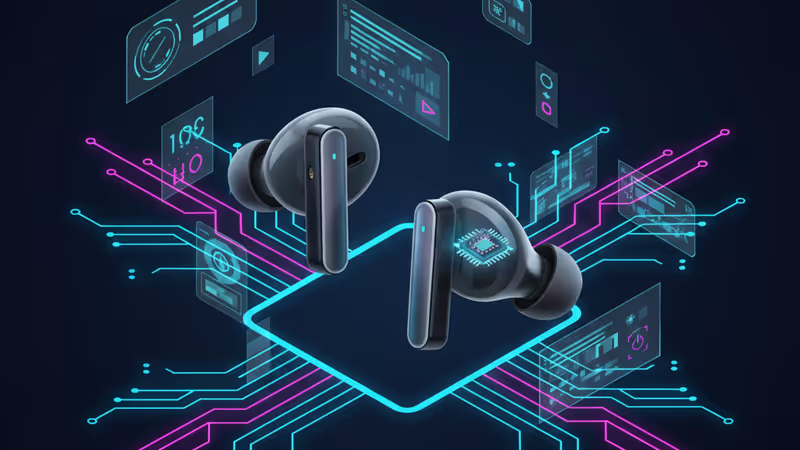
Apple's new AirPods are more than just earbuds. Discover our expert analysis on how they're becoming a platform for health, AI, and ambient computing.
Apple's new AirPods are more than just earbuds. Discover our expert analysis on how they're becoming a platform for health, AI, and ambient computing.
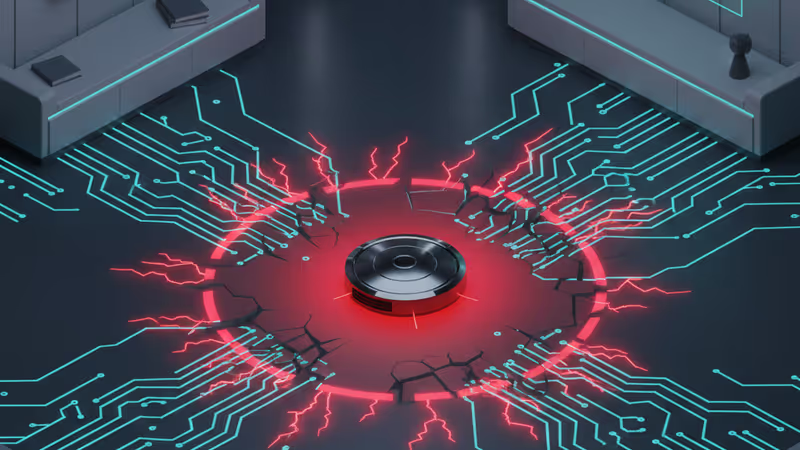
Roomba pioneered home robotics but now faces an existential crisis. Our analysis breaks down the strategic failures that led to its decline and the hard lessons for the tech industry.