

China's 2025 Talent Coup: Why 7 Top Western Scientists Moved East
In 2025, at least seven top scientists and mathematicians left Western institutions for China. We analyze this new front in the talent wars amid the US-China tech rivalry.
The global map of scientific talent is being redrawn. In 2025 alone, at least seven world-class scientists and mathematicians left Western institutions for China. According to reports from the South China Morning Post (SCMP), this trend highlights China's strategic success in securing top minds amid its escalating tech rivalry with the United States.
An Exodus from North America
One of the most notable moves involves star mathematician Chen Min, who returned home after decades in the US. He has left Purdue University's maths department to join the Eastern Institute of Technology in Ningbo as a full-time faculty member, marking the latest in a series of high-profile academic returns to China.
From Canada, China secured another major academic coup with the recruitment of mathematics luminary Joshua Zahl. Zahl's move came shortly after he gained international acclaim for solving the more than 100-year-old three-dimensional Kakeya conjecture, a puzzle that had stumped mathematicians for a century.
A Magnet for AI and Foundational Science
The trend isn't limited to North America. Award-winning mathematician Professor Zhong Xiao departed Finland after nearly three decades, bringing his foundational research, which is critical to artificial intelligence (AI), back to China. Meanwhile, the move of top Harvard mathematician Liu Jun to China is seen as part of the same strategic current, underscoring Beijing's focus on building prowess in fundamental science.
This content is AI-generated based on source articles. While we strive for accuracy, errors may occur. We recommend verifying with the original source.
Related Articles
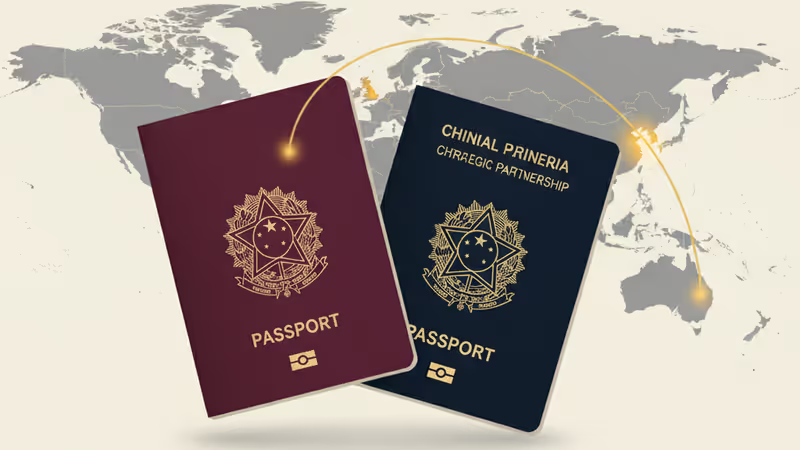
Brazil is preparing to waive visa requirements for Chinese tourists and business travelers, with an announcement expected in early 2026. The move aims to deepen ties with its largest trading partner, China.

As 2025 draws to a close, a stark analysis suggests the Russia-Ukraine war could continue for another 12 to 18 months. PRISM examines the current stalemate and the global implications of a long-term conflict.
From Israeli raids in the West Bank to post-colonial legislation in Algeria, local conflicts and political tensions are escalating globally. An analysis of the underlying trend and its impact on global security.

A rare report on Chinese state TV shows the PLA conducting wargame simulations of battles in the Gulf of Mexico, near Cuba and Mexico, signaling a potential expansion of its global military ambitions.
Brazil is preparing to waive visa requirements for Chinese tourists and business travelers, with an announcement expected in early 2026. The move aims to deepen ties with its largest trading partner, China.
As 2025 draws to a close, a stark analysis suggests the Russia-Ukraine war could continue for another 12 to 18 months. PRISM examines the current stalemate and the global implications of a long-term conflict.
From Israeli raids in the West Bank to post-colonial legislation in Algeria, local conflicts and political tensions are escalating globally. An analysis of the underlying trend and its impact on global security.
A rare report on Chinese state TV shows the PLA conducting wargame simulations of battles in the Gulf of Mexico, near Cuba and Mexico, signaling a potential expansion of its global military ambitions.